

Don’t let election predictions or results impact your investment choices.
What does the rematch between Joe Biden and Donald Trump in the 2024 U.S. presidential election mean to financial markets?
Holding a presidential election when emotions are running high, and the political divide seems wider than ever feels momentous. After all, the selection of a particular candidate or political party can result in significant changes to economic, social and environmental policies that affect industries or market sectors.
But election results don’t drive financial market outcomes over time, so trying to time your investments around elections doesn’t pay. Neither does positioning your portfolio based on expected outcomes. You may have heard that one party is good or bad for stocks in general or particular industries. Based on the data, we haven’t seen that the conventional wisdom holds true over time.
We believe your saving and investing behaviour should drive your financial success — developing and sticking to a long-term plan.
The political party controlling 1600 Pennsylvania Ave. isn’t likely to affect your retirement needs or the amount of money you save for a down payment on a home. The levers you can pull to improve your chances of enjoying a fully funded retirement or financing a college education for a loved one exist independently of the party in office.
We understand the anxiety you may be feeling as we approach the election. It’s natural, and it’s real. Figure 1 shows that market volatility increases near the time of the Democratic and Republican party national conventions through Election Day. But this volatility has historically subsided just as quickly after the election.
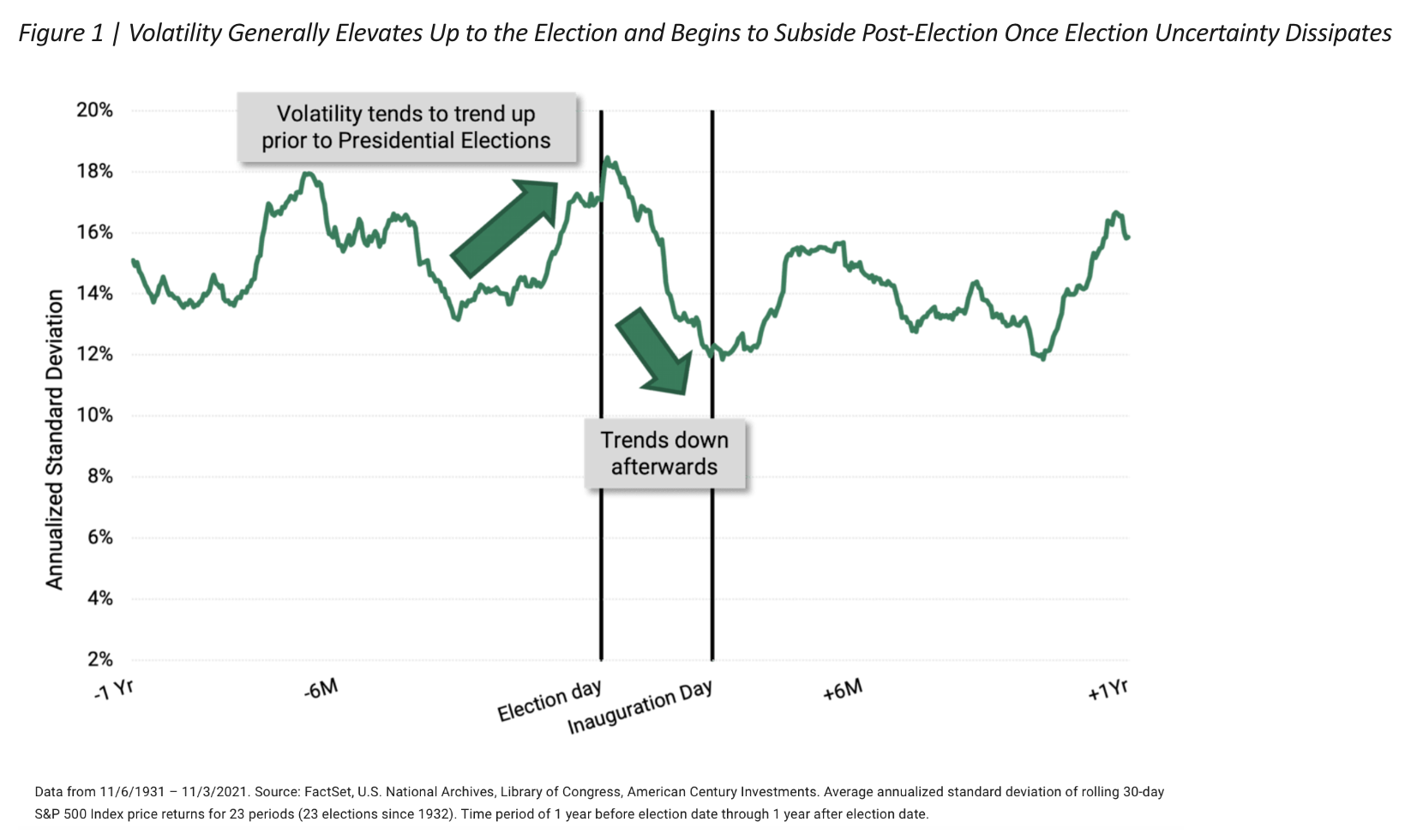
If we widen our lens to look at market volatility in the years before and after presidential elections, we find that volatility stayed in the same general range. If electoral outcomes had huge impacts on markets, we would expect to see some big divergence or changes. We just don’t see evidence that electoral outcomes move markets.
Some investors might look at Figure 1 and conclude they could gain something by trading out of markets around elections and getting back in later. Our analysis shows, however, that it’s best to maintain a consistent approach by staying focused on your investment goals and not jumping in and out of the market. Figure 2 shows returns for different trading strategies around presidential elections.
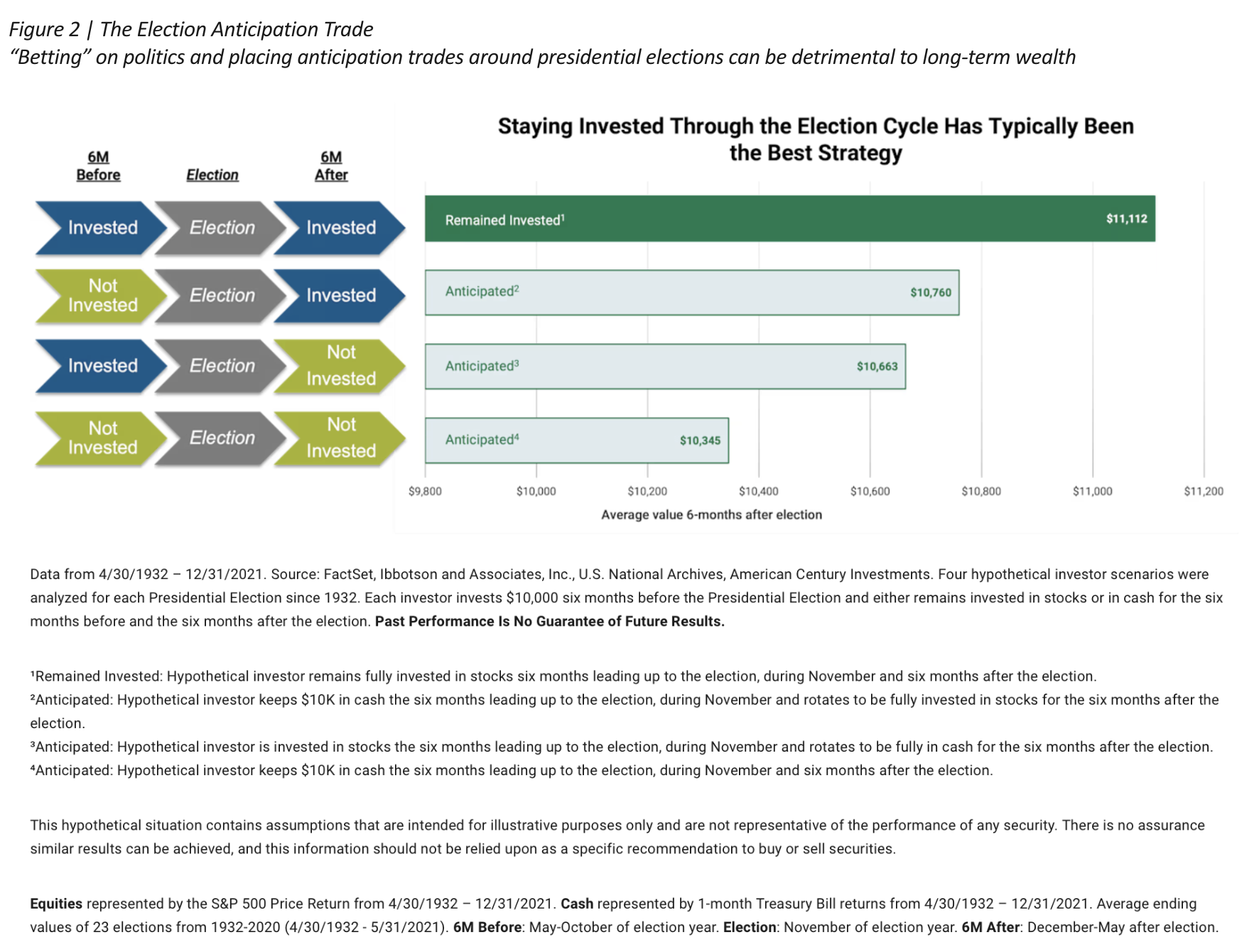
Markets have tended to go up much more often than they have tended to go down over time, so it’s better, on average, to be in the market. And because market gains often come in short, sharp jumps, being out of the market when these jumps occur could seriously affect your long-term returns. That’s why the best result shown in Figure 2 was staying invested, while the worst result was staying out of the market for the longest period. Trading in or out around the election produced outcomes between the two extremes.
What’s likely to drive market returns in the short run?
As we’ve seen since late last year, rising and falling expectations for rate cuts[1] by the Federal Reserve (Fed) are a significant source of volatility in the global markets. We believe this volatility will continue up to and beyond election day. Investors want to see continued economic resilience and clarity around Fed policy before they make corporate profits and other business fundamentals their primary investment considerations.
It’s also important to note that the U.S. isn’t alone in electing new leadership in 2024. Voters in countries accounting for 60% of the world’s gross domestic product (GDP) will go to the polls.1Each of these elections can potentially change the course of policy that affects the regulatory and operating environment for businesses.
Geopolitical tension hangs over the market as well. Beyond their tragic humanitarian impacts, the ongoing wars in Ukraine and Gaza remain threats to turn into broader conflicts that could ripple through the global economy.
So, what should I do about the election?
Our analysis suggests that investors who do best over the long haul stick to their plans and stay diversified, not try to time the market by trading in and out of asset classes.
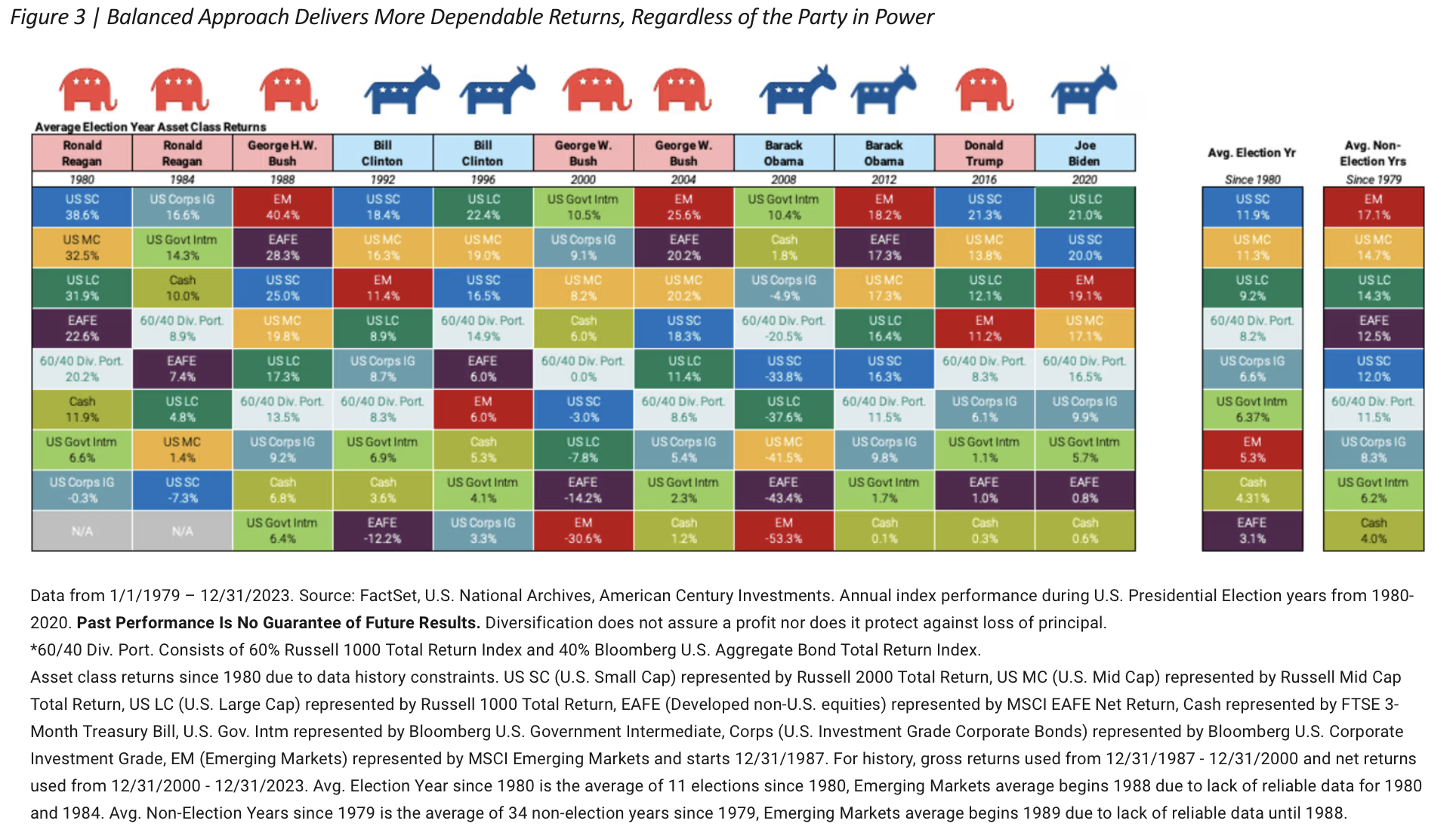
Figure 3 demonstrates how performance and leadership vary across asset classes during election years. The only discernible pattern we see is that a balanced approach has delivered performance consistently in the middle of the pack, avoiding the big swings we see elsewhere.
Stay focused on your financial goals
We think this data helps clarify the difficulty of positioning your portfolio in anticipation of electoral outcomes. Betting on politics is hard and potentially costly, even if you pick the right candidate or political party. You must be correct in predicting the winning candidate and time trades perfectly and correctly foresee the winning candidate’s effect on the markets.
Don’t let election predictions or results impact your investment choices. We believe successful long-term investing relies on developing and sticking to your financial plan.
By Richard Weiss, CIO of multi asset strategies
———-


