

What are the the thematics impacting AI and their potential impacts for investors?
Commentary about artificial intelligence (AI) has been overtaken by headlines dominated by Trump, tariffs and trade. However, this does not reflect a slowing in the pace of AI; to the contrary, progress is accelerating as discussed in this article from GSFM’s investment partner TD Epoch.
Artificial intelligence is evolving at an unprecedented pace, reshaping industries, workplaces, and everyday life in just a few short years. Advances in machine learning, natural language processing and generative models have rapidly moved AI from experimental research into mainstream use. It is powering tools that can analyse vast datasets, create human-like content and automate complex tasks once believed to require uniquely human intelligence.
To demonstrate the ongoing evolution of AI, this article focuses on five of the most important AI themes in play today: physical AI, China’s ascending capabilities, Trump’s tech agenda, agentic AI and open-source AI models. The sector is evolving from perception AI (image and speech recognition) to generative AI (creating content) to agentic AI (coding, customer service, research) to physical AI (self-driving cars, general robotics, drones)[1].
The future of AI is physical AI
With respect to physical AI, there is substantial overlap in the underlying technology for autonomous vehicles (AVs), robots and drones, which explains why all three are concurrently experiencing rapid advances.
AVs have been front-page news for over a decade but have finally reached take-off (Figure 1). One driverless taxi company in the US just cracked ten million rides, elevating it from a research project to a $45 billion company. The company is operating in San Francisco, Los Angeles, Phoenix and Austin, with Atlanta and Miami coming soon[2].
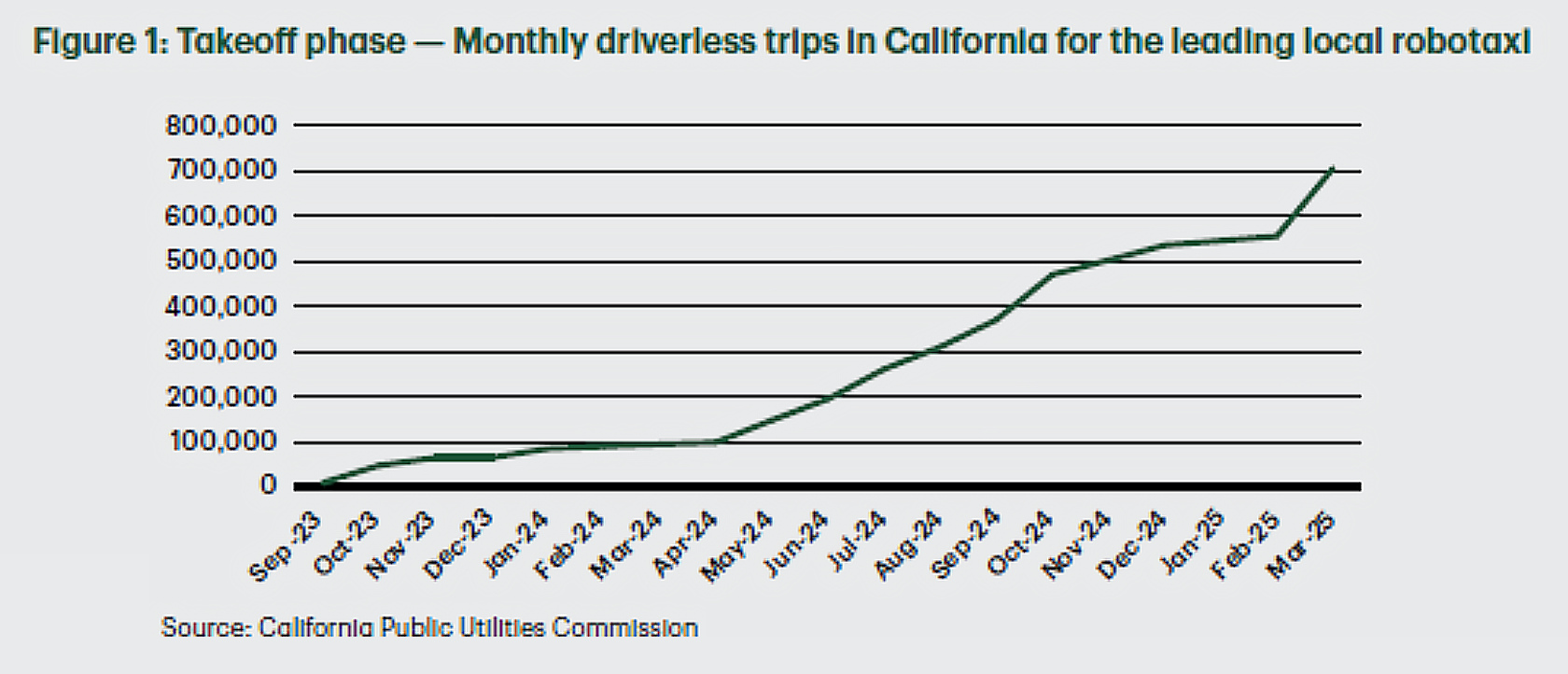
More recently, an EV company launched a limited robotaxi service in Austin, Texas, with much hyped plans for a massive expansion by end-2025; the robotaxi platform could account for 90 percent of the company’s enterprise value by 2029, according to Ark Invest. The firm estimates its cost per vehicle at $50,000, and better safety data has driven its insurance costs down by 50 percent. Finally, the rollout in China, which is already ahead on most metrics, is accelerating.
Beyond cars, an AV company based in Pittsburgh, Pennsylvania launched commercial self-driving trucks last month, with regular service between Dallas and Houston, Texas and plans to expand to El Paso, Texas and Phoenix, Arizona by end-2025[3]. Rollouts are accelerating in dozens of countries across the globe as AV capabilities improve and safety concerns wane[4].
Drones are another example of physical AI; the war in Ukraine has seen a ‘Cambrian Explosion’ in shapes, sizes, objectives and capabilities. Global shipments have increased ten-fold since 2015 and Grand View Research expects a 14 percent compound annual growth rate (CAGR) for worldwide revenues from 2025 to 2030, with a rapid shift towards fully autonomous drones. They have already changed the future of the defense industry, and not just in Ukraine[5]. The Defense Innovation Unit (DIU) within the US Department of Defense is focused on seven critical technology sectors, including AI and autonomy, and is working closely with Silicon Valley. Delivery drones are also flying high in both the US, and Meituan in China[6].
In terms of production China is leagues ahead, making more drones in a day than the US does in a year, according to Morgan Stanley. The Trump administration is determined to narrow this gap. An executive order promises far-reaching deregulation to strengthen the American drone industrial base and promote their export[7]. Further, the Federal Aviation Administration (FAA) will soon publish a draft rule on drones, with a final rule by early 2026. Will this work? Early signs are encouraging, with startups determined to shape the future of drones through their emphasis on AI and autonomous systems. One defense technology company with an estimated value of $30 billion is currently building a drone factory in Ohio the size of 87 football fields.
Physical AI is an exciting development, but the future won’t arrive overnight. There remain many hurdles, including data, vexing edge cases (the last 10 percent is always fiendishly difficult) and legitimate safety concerns. It also seems likely that large language models won’t get us there. Next-gen model architecture will require a better understanding of the physical three dimensional and sensory world, as well as persistent memory, and improved capabilities for planning and reasoning.
The most sophisticated robots today find it exceedingly difficult to fold laundry, load a dishwasher, or make a sandwich[8]. Everything about bringing AI into the world of atoms is hard and there is only a handful of firms globally that excel at both software and hardware. Expect progress to be measured in years and decades rather than months and quarters.
AI superpower: China is home to 50 percent of the world’s AI researchers
China has made enormous advances in all domains, including physical AI, infrastructure, applications and foundational models[9]. A few months ago, China’s leading AI company released its R1 model, sending shockwaves through global markets. R1’s reasoning and problem-solving capabilities demonstrated that America’s lead over China has narrowed significantly (Figure 2).
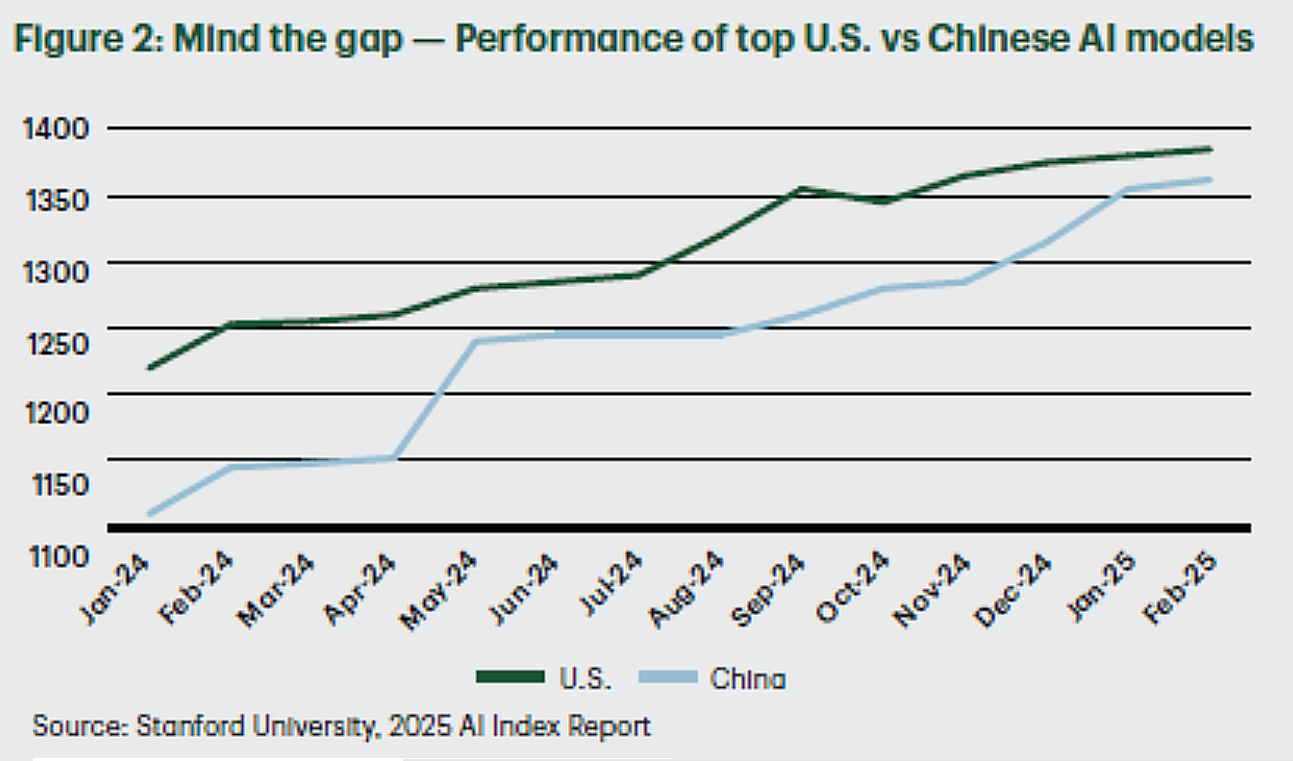
This is probably the least surprising thing that’s happened in 2025. Afterall, China has 25 percent more software engineers than the US, leads in AI research publications, and was granted 50 percent more AI patents in 2024 (although US patents are cited seven times as often). What will be the best AI model at end-2025? According to the betting site Polymarket, only two of the top seven companies are Chinese. It is likely the top company will be American. However, Epoch expects this ranking to change dramatically by end-2026.
An annual list of the top universities in the world is provided by Nature, one of the most cited scientific journals. Its most recent ranking shows Chinese universities holding eight of the top ten slots (the other two are Harvard and MIT)[10].
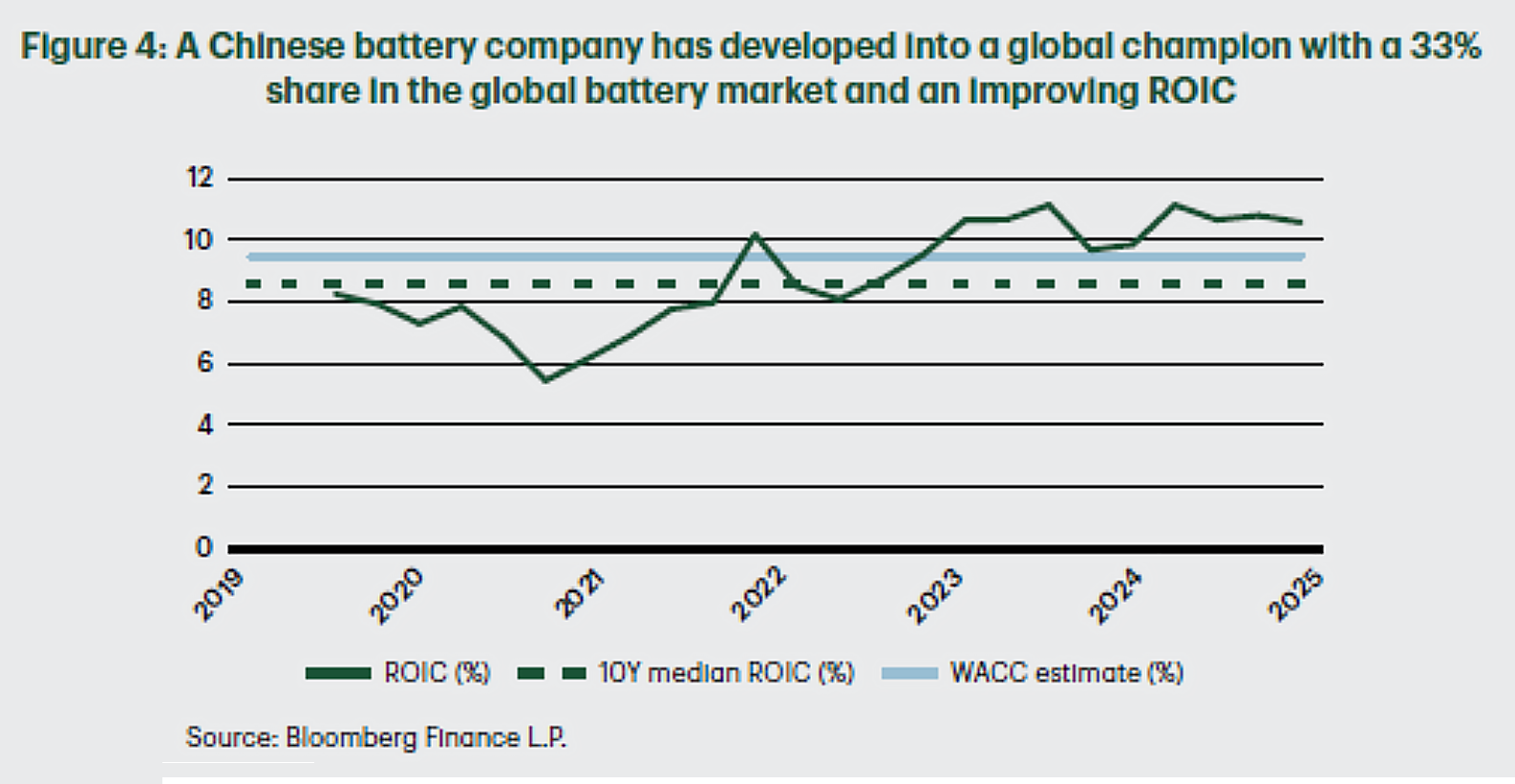
China is also leading the US in most aspects of physical AI, largely because of its “Made in China 2025” plan to dominate industries of the future. To illustrate, China accounts for 51 percent of all global robot installations (versus 9 percent for the US) and has a 70 percent share in drones. Additionally, China has a 70 percent global share in batteries, which is a critical component of physical AI systems.
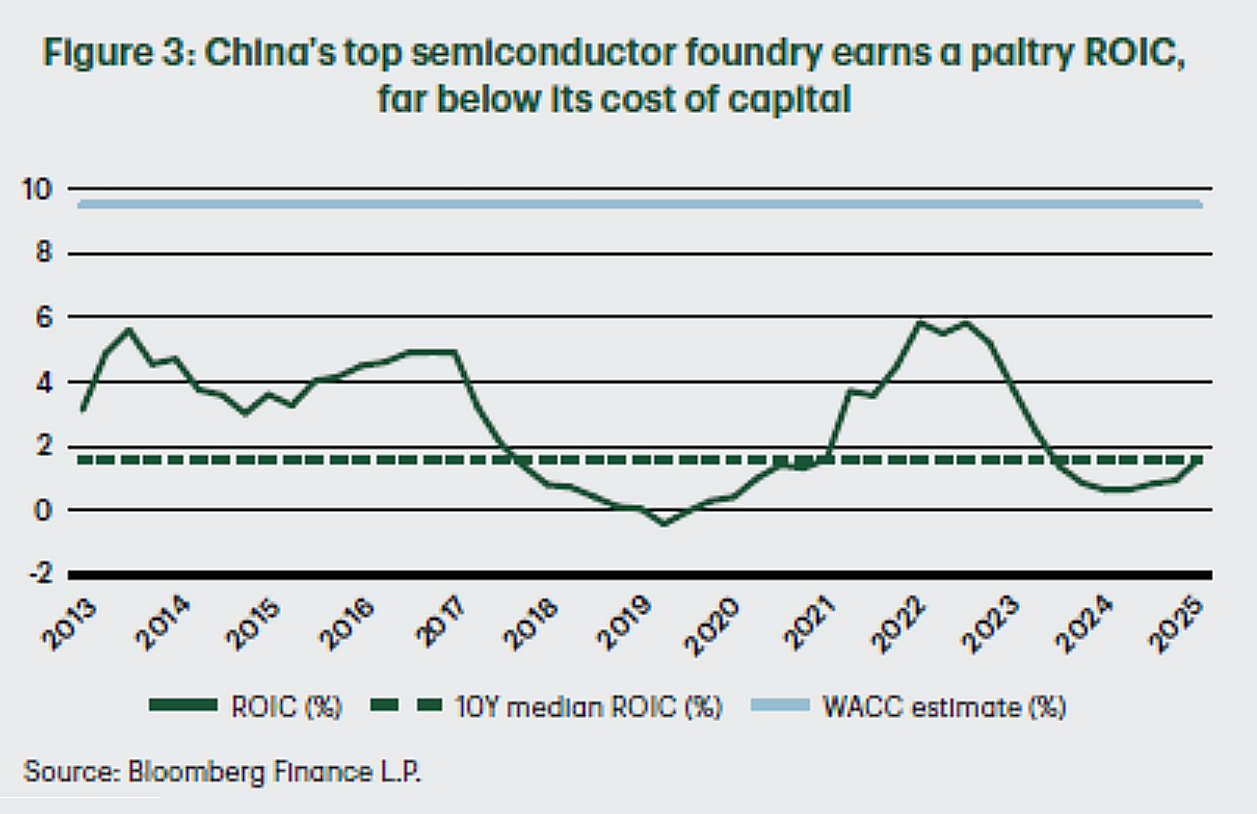
However, most Chinese companies are terrible capital allocators. For example, China’s top chipmaker has an important public mission (ensuring self-reliance and countering US export controls) and is partially state-owned, with the government’s effective stake in the range of 40 to 50 percent. Reflecting this, the company has produced a dismal return on invested capital (ROIC), averaging two percent over the last decade (Figure 3). However, several AI-adjacent companies have become global champions and feature impressive returns (Figure 4).
China also possesses numerous private companies that are global leaders, including the world’s dominant telecoms equipment manufacturer. It also manufactures smart phones, semiconductors and AV systems, and in terms of breadth, is considered by some expert commentators to be the world’s #1 tech company. Other examples include dominance in drones, a leading video-sharing social network, smart security and automatic vehicles.
Pro-tech Trump: “It’s time to build”
Beijing’s “Made in China 2025” industrial policy, aimed at dominating the industries of the future, has been enormously successful. It has also created gaping vulnerabilities and critical risks for America which, for the first time in decades, now views industrial policy as a national security imperative.
Recall that Tech CEOs enjoyed front row seats during Trump’s inauguration, signalling their importance to the administration. Three days later and to much fanfare, Trump released the “Removing Barriers to American Leadership in AI,” Presidential action. Further, his administration will soon submit an action plan to “sustain and enhance America’s global AI dominance in order to promote human flourishing, economic competitiveness, and national security.”
This is all part of Trump’s “America First” strategy on AI, recognising it is critical for all three domains of power (economic strength, tech leadership, defence capabilities). So far, the strategy has resulted in executive orders (EOs) on critical minerals, the electric grid, nuclear power and natural gas permitting, as well as revoking Biden’s EO on AI safety.
Trump has also introduced tariffs to encourage the homeshoring of semiconductors and other sectors critical to AI development. Further, a major objective of the One Big Beautiful Bill is to encourage domestic investment. And the evidence over the last few years suggests such incentives can be extremely effective (Figure 5). Beyond semiconductors, the administration wants to encourage the construction of data centres, as well as factories for batteries, drones, and all elements of defence tech.

Agentic AI: From a glitchy gimmick to diffuse deployment
The fourth theme concerns a type of model that has made great strides this year. Agentic models break complex objectives into small, simple tasks, with the number of tasks the leading AI models are capable of handling doubling every seven months[12].
While generative AI models respond directly and immediately to prompts, agentic AI reasons through multi-step tasks, usually with minimal human intervention. Examples of applications include writing code (debugging, building APIs and websites) and customer service reps (pulling data from customer profiles, learning from previous conversations).
Agentic AI is also improving at tasks such as organising a birthday party or booking a trip. The process by which a model gathers data from various sources (airlines, hotels, restaurants for example), analyses it, and then iteratively creates and improves the agenda is termed “Iterative Reasoning and Learning” This is especially useful when the feedback loop allows the model to adjust plans and respond to unforeseen challenges.
Reflecting these improvements, roughly 40 percent of startups are now focused on agentic AI. By 2030 we expect its capabilities will include:
- Generating human-level text (e.g., legal and financial analysis)
- Creating full-length films and games
- Real-time translation into multiple languages
- Advanced personal assistants
- Fully operational customer service reps
- Autonomous drug design.
It will also become an indispensable collaborative partner for projects such as writing books, music production, interior design, marketing strategies, portfolio management and retirement planning. Over the last 25 years, Application Programming Interfaces (APIs) became ubiquitous (allowing different software systems to communicate and exchange data). Similarly, as agentic AI becomes commonplace, Model Context Protocols (MCPs) will become pervasive. They allow AI agents to integrate with external tools, APIs, data sources and websites.
Open source versus the proprietary giants
Two years ago, it appeared that most AI models would be closed and proprietary. However, through 2024 and into 2025 open-source models have been snagging a progressively larger share of the marketplace, representing one of the biggest surprises over the last eighteen months[12].
Open source offers many societal benefits, including greater transparency and accountability. It also produces a more vibrant ecosystem, encouraging collaboration, shared innovation and much faster progress. The main disadvantage is that it is tougher to regulate and enforce guardrails, thereby increasing weaponisation (bioterrorism, cyberattacks) and national security risks (China, Russia, Iran, North Korea).
What is made public? In the narrowest of cases just the parameter values or model weights. Intermediate cases include source code and model architecture, while the most open will also include training data. Given that it costs tens of billions of dollars to develop a leading AI model, why would a company choose to open source? The goal is to attract developers and customers, so that network effects kick in and your model becomes a global standard and a major platform. Such an ecosystem opens up many avenues to monetise the initial heavy investment.
Open source models and platforms include those from a dominant social media company, a French AI startup, the leading Chinese AI company, a widely used machine learning framework, developed by the leading search engine, a machine learning library used by the EV pioneer and a community platform, hosting millions of pre-trained AI models and tools, which has become the first stop for developers building models or apps. Reflecting the market’s evolution, the leading US AI company has announced that its next model, due in a couple of months, will be open source. It is already #1 in terms of popularity, and this move will help it stay there, at least for a few more quarters. However, from an investment perspective, will it ever generate free cash?
AI progress continues to accelerate: Three implications for investors
First, Epoch believes that investors should overweight quality tech. This is where the bulk of innovation is occurring, as reflected in the sector’s high margins and return on capital. Further, rather than concentrated bets on hype or hope stocks, Epoch recommends a diversified portfolio of companies that have demonstrated skill in capital allocation and possess a track record of free cash flow generation.
The key risks to this view? That it will take considerably longer for killer apps to arrive, similar to the experience of the tech boom in the late-1990s. Additionally, it is a highly disruptive technology. In Silicon Valley, titans rise, and titans fall, sometimes shockingly swiftly. Many of today’s incumbents will be displaced by hungry startups and become case studies for the innovator’s dilemma. Recall that only one of the top fifteen global tech companies in 2000 remains in that elite tier today.
The second implication for investors is that, outside of tech, American exceptionalism is waning. This suggests investors should increase their exposure to global champions outside the US (including in China), many of which trade at significantly discounted multiples. Epoch also believes the USD is overvalued and could decline dramatically over the next three years.
Third, infrastructure as an asset class is extremely compelling. The AI boom requires enormous spending on data centres, electrical grids, and so on. Further, the “reinventing globalisation” theme means huge outlays for factories, ports, pipelines and such. Together, this creates an excellent environment for investing in infrastructure.
Take the FAAA accredited quiz to earn 0.5 CPD hour:
CPD Quiz
The following CPD quiz is accredited by the FAAA at 0.5 hour.
Legislated CPD Area: General (0.5 hrs)
ASIC Knowledge Requirements: Economic Environment (0.5 hrs)
please log in to start this quiz
———
Notes:
[1] https://www.nvidia.com/gtc/
[2] https://waymo.com/waymo-one/
[3] https://aurora.tech/
[4] https://arstechnica.com/cars/2023/09/are-self-driving-cars-already-safer-than-human-drivers/
[5] https://www.diu.mil/blue-uas
[6] https://www.economist.com/briefing/2025/06/12/chinas-low-altitude-economy-is-taking-of
[7] https://www.whitehouse.gov/presidential-actions/2025/06/unleashing-american-drone-dominance/
[8] “The humanoid workforce is running late,” MIT Tech Review, May 2025 and “Robot dexterity still seems hard,” Construction Physics, April 2025.
[9] “The superpower technology race: Xi Jinping’s plan to overtake America in AI,” May 2025, The Economist.
[10] https://www.nature.com/nature-index/research-leaders/2024/institution/academic/all/global
[11] “Where is my ten-minute AGI?” Epoch AI, May 2025
[12] Why China is giving away its tech for free: Its newfound fondness for open source is awkward for an authoritarian state.” The Economist, June 2025.
The information included in this article is provided for informational purposes only and is general advice only. It does not take into account an investor’s own objectives. The information contained in this article reflects, as of the date of publication, the current opinion of TD Epoch and is subject to change without notice. Sources for the material contained in this article are deemed reliable but cannot be guaranteed. We do not represent that this information is accurate and complete, and it should not be relied upon as such. Any opinions expressed in this material reflect our judgment at this date, are subject to change and should not be relied upon as the basis of your investment decisions. All reasonable care has been taken in producing the information set out in this article however subsequent changes in circumstances may occur at any time and may impact on the accuracy of the information. Neither TD Epoch, GSFM Pty Ltd, their related bodies nor associates gives any warranty nor makes any representation nor accepts responsibility for the accuracy or completeness of the information contained in this article.
CPD Quiz
The following CPD quiz is accredited by the FAAA at 0.5 hour.
Legislated CPD Area: General (0.5 hrs)
ASIC Knowledge Requirements: Economic Environment (0.5 hrs)
please log in to start this quiz
———
Notes:
[1] https://www.nvidia.com/gtc/
[2] https://waymo.com/waymo-one/
[3] https://aurora.tech/
[4] https://arstechnica.com/cars/2023/09/are-self-driving-cars-already-safer-than-human-drivers/
[5] https://www.diu.mil/blue-uas
[6] https://www.economist.com/briefing/2025/06/12/chinas-low-altitude-economy-is-taking-of
[7] https://www.whitehouse.gov/presidential-actions/2025/06/unleashing-american-drone-dominance/
[8] “The humanoid workforce is running late,” MIT Tech Review, May 2025 and “Robot dexterity still seems hard,” Construction Physics, April 2025.
[9] “The superpower technology race: Xi Jinping’s plan to overtake America in AI,” May 2025, The Economist.
[10] https://www.nature.com/nature-index/research-leaders/2024/institution/academic/all/global
[11] “Where is my ten-minute AGI?” Epoch AI, May 2025
[12] Why China is giving away its tech for free: Its newfound fondness for open source is awkward for an authoritarian state.” The Economist, June 2025.
The information included in this article is provided for informational purposes only and is general advice only. It does not take into account an investor’s own objectives. The information contained in this article reflects, as of the date of publication, the current opinion of TD Epoch and is subject to change without notice. Sources for the material contained in this article are deemed reliable but cannot be guaranteed. We do not represent that this information is accurate and complete, and it should not be relied upon as such. Any opinions expressed in this material reflect our judgment at this date, are subject to change and should not be relied upon as the basis of your investment decisions. All reasonable care has been taken in producing the information set out in this article however subsequent changes in circumstances may occur at any time and may impact on the accuracy of the information. Neither TD Epoch, GSFM Pty Ltd, their related bodies nor associates gives any warranty nor makes any representation nor accepts responsibility for the accuracy or completeness of the information contained in this article.


Have feedback on this article? Contact Us
Earn CPD Points
 CPD: US middle market private credit – the investment case
In today’s rapidly shifting investment landscape, traditional sources of fixed income are struggling to meet the yield and diversification needs of investors. They are also becoming more closely correlated with [...]
 CPD: A new global order and implications for investors
The new global order differs from its predecessor in four ways, as outlined in the following article from GSFM’s investment partner TD Epoch. For decades, the US has been unrivalled [...]
 CPD: Is your approach to client risk profiling putting you at risk?
Introduction The shockwaves that followed the announcement of ‘Liberation Day’ tariffs by Donald Trump brought an abrupt and unsettling end to a three-year bull market. Major global indices plummeted by [...]
 CPD: Ethics and the advice practice
When last published, the FAAA’s Value of Advice Index[1] saw trust in financial advice at an all-time high, which reinforces the importance of ethical practice. This article, proudly sponsored by [...]
 CPD: Retirement income strategy choices
There’s a wide variety of income strategies used across the market, with an equally wide variety of labels attached to these strategies. Each varies in complexity, its ability to mitigate [...]