
Fund managers must evolve product and engagement strategy to stay adviser-aligned

Cameron Spittle
Investment Trends has released its 2025 Adviser Product and Marketing Needs Report, providing an in-depth analysis of how Australian financial advisers select investment products, construct portfolios, and engage with fund managers. The report examines evolving preferences, decision drivers and communication needs across advice practices.
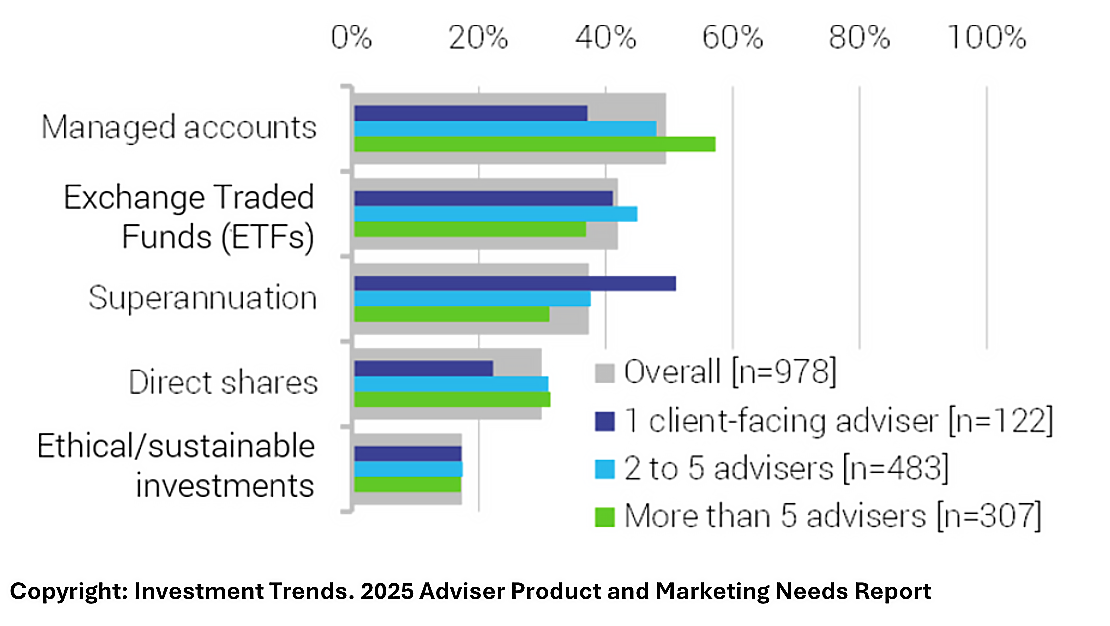
The report shows that research and asset consultants continue to play a pivotal role in adviser product selection, especially in managed accounts and super. Overall, 77% of advisers rely on a third party, with usage rising to 90% in larger practices. Their recommendations influence decisions around managed accounts (49%), ETFs (42%) and super (37%), with research, reputation and expertise among the most valued attributes.
For which of the following products do you typically rely on (your asset consultant’s) recommendation? By practice size. Among advisers who rely on consultants to help select investments for their client. 5 shown
“Adviser practices are leveraging a combination of research (licensee and external), asset consultants and in some cases platforms to support their decision making.” said Cameron Spittle, Director at Investment Trends. “For asset managers, the findings highlight the importance of building strong relationships with a broader range of consultants and influencers, whose recommendations can significantly shape product uptake.”
The report also shows that ETF usage continues to climb across both index and active categories, largely at the expense of unlisted managed funds. Among new non-super inflows not placed in managed accounts, 24% (up from 21%) go to ETFs compared to 31% (down from 43%) to unlisted managed funds. Advisers favour ETFs for international equities and are expanding their use of active ETFs across all asset classes, especially where structure, access and cost-efficiency are key.
“The structural appeal of ETFs is accelerating adviser adoption, not just for index exposure but increasingly for active strategies,” said Spittle. “Fund managers who adapt strong-performing strategies into ETF vehicles will be well placed to attract new client flows as advisers continue to shift toward more accessible product structures.”
The report also highlights that rising market volatility is prompting advisers to step up client engagement. Nearly half report increased client contact over the past six months. While advisers generally prefer fewer touchpoints, those anticipating further turbulence are calling for deeper engagement, particularly via in-person events, videos or informed BDMs.
“Volatility isn’t just reshaping portfolios, it’s reshaping relationships,” said Spittle. “Advisers want fewer but more meaningful interactions, led by BDMs who bring real insight. Responsiveness and product knowledge matter most, cited by 66% and 60% of advisers respectively.”


