SQM Research has released its latest data on residential property vacancy rates.
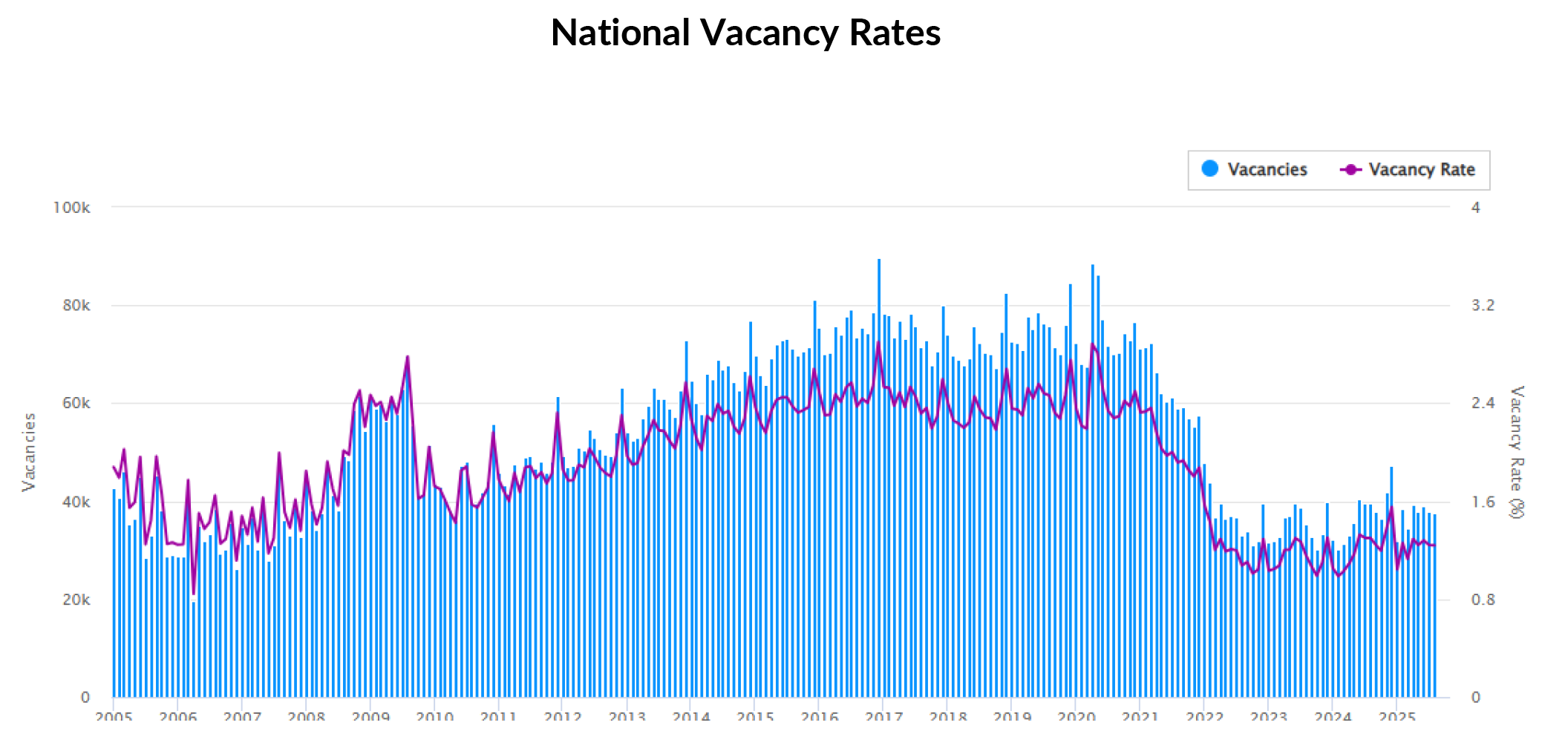
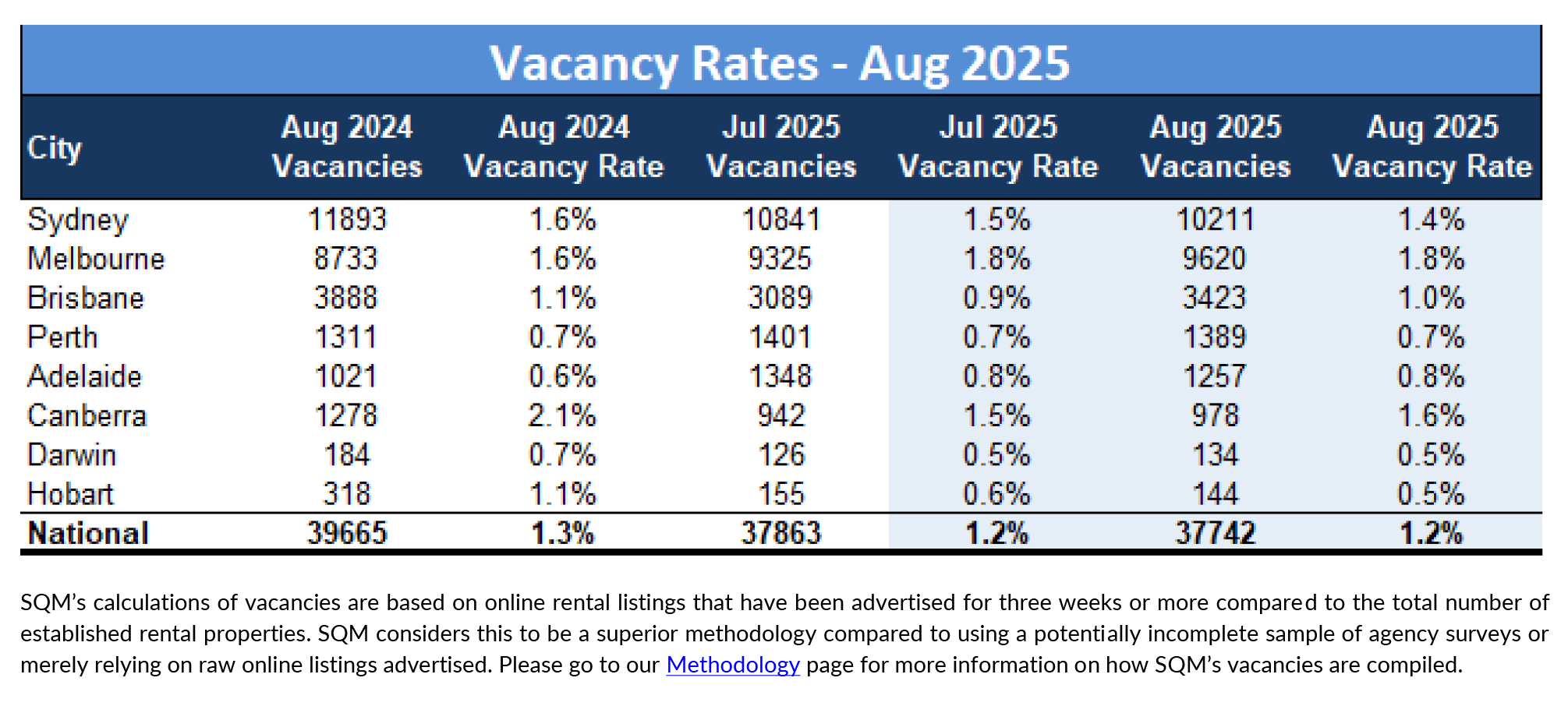
Australia’s national residential vacancy rate remained unchanged at 1.2% in August 2025, with 37,742 vacancies recorded—just 121 fewer than July. The market continues to show signs of stabilisation, with modest shifts across capital cities.
Capital city highlights
Sydney: Tenant demand continues to tighten the market, pushing the vacancy rate down to 1.4% (from 1.5%), with vacancies falling to 10,211—the lowest in over a year.
Melbourne: Tight to stable vacancy levels persist as leasing activity slows, with the rate holding at 1.8% and vacancies rising to 9,620.
Brisbane: A modest rise in vacancies to 3,423 nudged the rate up to 1.0%, though the city remains one of the tighter rental markets nationally.
Perth: Tightness continues, with the vacancy rate unchanged at 0.7% and vacancies dipping slightly to 1,389.
Adelaide: Very low vacancy conditions prevail, with the vacancy rate steady at 0.8% and vacancies easing to 1,257. Canberra: A slight seasonal lift saw the vacancy rate rise to 1.6% (from 1.5%), with vacancies increasing to 978.
Darwin: The market remains super tight, with the vacancy rate holding at 0.5% and vacancies rising marginally to 134.
Hobart: Strong rental demand pushed the vacancy rate down to 0.5% (from 0.6%), with vacancies declining to 144.
Advertised rents analysis
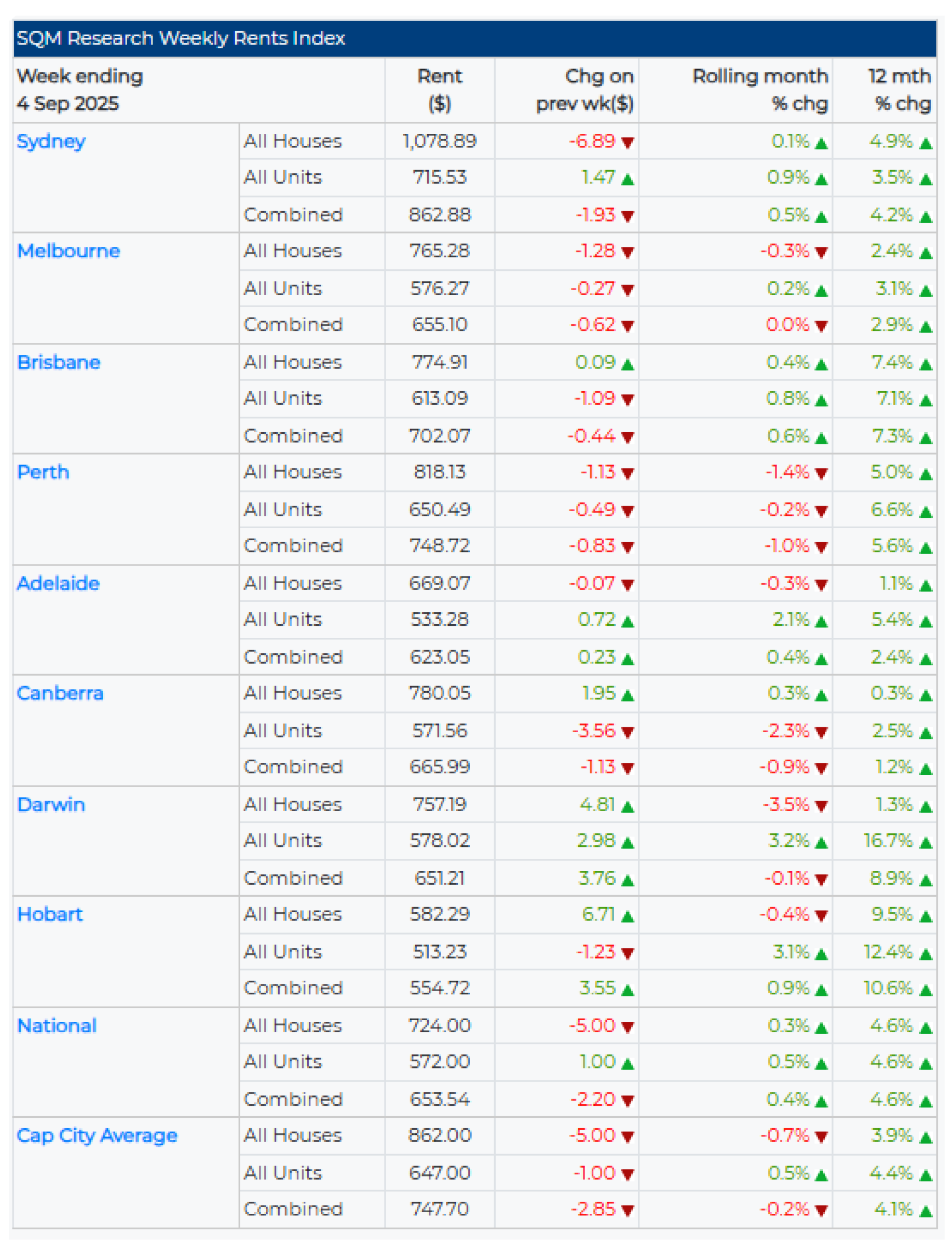
Rental trends across the capitals were mixed in August, with units generally outperforming houses in monthly growth. Nationally, combined rents rose 0.4% monthon-month and 4.6% year-on-year, reflecting ongoing affordability pressures and shifting tenant preferences.
For the week ending 4 September 2025, the national combined rent average reached $653.54 —up 0.4% over the rolling month and down 2.2% year-on-year. The capital city average sits at $747.70, reflecting a 2.85% annual decrease.
Sydney: Unit demand continues to drive growth, with combined rents rising 0.5% for the month and 4.2% year-on-year.
Melbourne: Rent levels remained flat (0.0% monthly change), with annual growth at a modest 2.9%, mirroring the city’s elevated vacancy rate.
Brisbane: Strong rental momentum persists, with combined rents up 0.6% for the month and 7.3% year-on-year.
Perth: A notable monthly decline of 1.0% in combined rents contrasts with solid annual growth of 5.6%, suggesting short-term easing.
Adelaide: Steady conditions saw combined rents rise 0.4% for the month and 2.4% year-on-year.
Canberra: Rents softened, with a 0.9% monthly decline and 1.2% annual growth, reflecting seasonal turnover and affordability constraints.
Darwin: Despite a slight monthly dip (-0.1%), annual growth remains strong at 8.9%, led by unit rents surging 16.7%.
Hobart: The standout performer, Hobart recorded a 0.9% monthly rise and a robust 10.6% annual increase in combined rents.
Commentary
Louis Christopher, Managing Director of SQM Research, commented: “The national vacancy rate has held firm at 1.2% for August, suggesting ongoing shortages in rental supply across most capital cities. Sydney continues to tighten, now at 1.4%, which is indicative of ongoing tenant demand and limited new stock.
“Hobart and Darwin stand out with double-digit annual rent growth, driven largely by unit demand. Nationally, rents continue to edge higher, particularly for units, which are now outperforming houses in most capitals.
“Overall, the data points to a market that remains tight, albeit the days of 20%+ rental growth are well and truly behind us. Investors should note the resilience in Brisbane and Hobart, while policymakers may need to monitor affordability pressures in Sydney and Darwin.”