Super funds back on track for a credible return for FY26 despite March falls

Mano Mohankumar
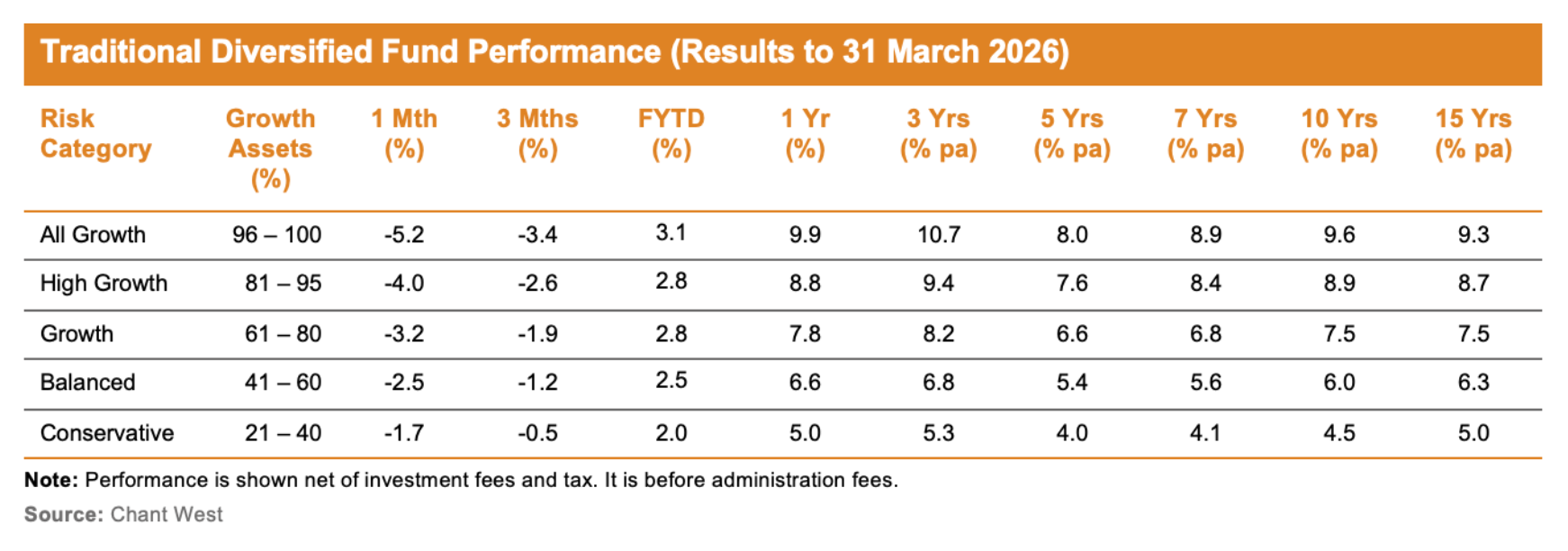
Sparked by the US-Iran conflict and renewed concerns around interest rates amid rising inflation, super funds experienced a significant pullback in March, with the median growth fund (61–80% growth assets) down 3.2% for the month. However, share markets have since rallied strongly and Chant West estimates that the median growth fund is up 3.1% so far in April. That almost entirely offsets the March decline and brings the estimated median return over FY26 up to 6%, with about 10 weeks of the financial year remaining.
Chant West Head of Superannuation Investment Research, Mano Mohankumar, says that the April rally has been on the back of optimism around a potential de-escalation in Middle East tensions, easing oil prices and solid corporate earnings.
“The experience since the start of March is another clear reminder of why it’s important for super fund members to stay patient and maintain a long‑term perspective. Members who panicked after seeing their balances fall in March and switched to lower‑risk options or cash not only crystallised paper losses, but also missed out on the subsequent V‑shaped rebound. Over time, missing out on returns like these can make a significant difference to a member’s balance at retirement due to the power of compounding.
“That’s why we remind members that super is a long-term investment and encourage them to see a financial adviser if they’re thinking of switching options. An adviser can help assess their broader financial position, including assets held outside of super, and ensure their investment strategy remains appropriate.”
The table below compares the median performance to the end of March 2026 for each of the traditional diversified risk categories in Chant West’s Super Fund Performance Survey, ranging from All Growth to Conservative. It doesn’t include any estimated performance for March to date. All risk categories have generally met their typical long-term return objectives, which generally range from CPI + 1.5% for Conservative funds to CPI + 4.25% for All Growth.
Long-term performance remains above target
MySuper products have been operating for over 12 years, so when considering performance, Mohankumar says it’s important to remember that super is a much longer-term proposition.
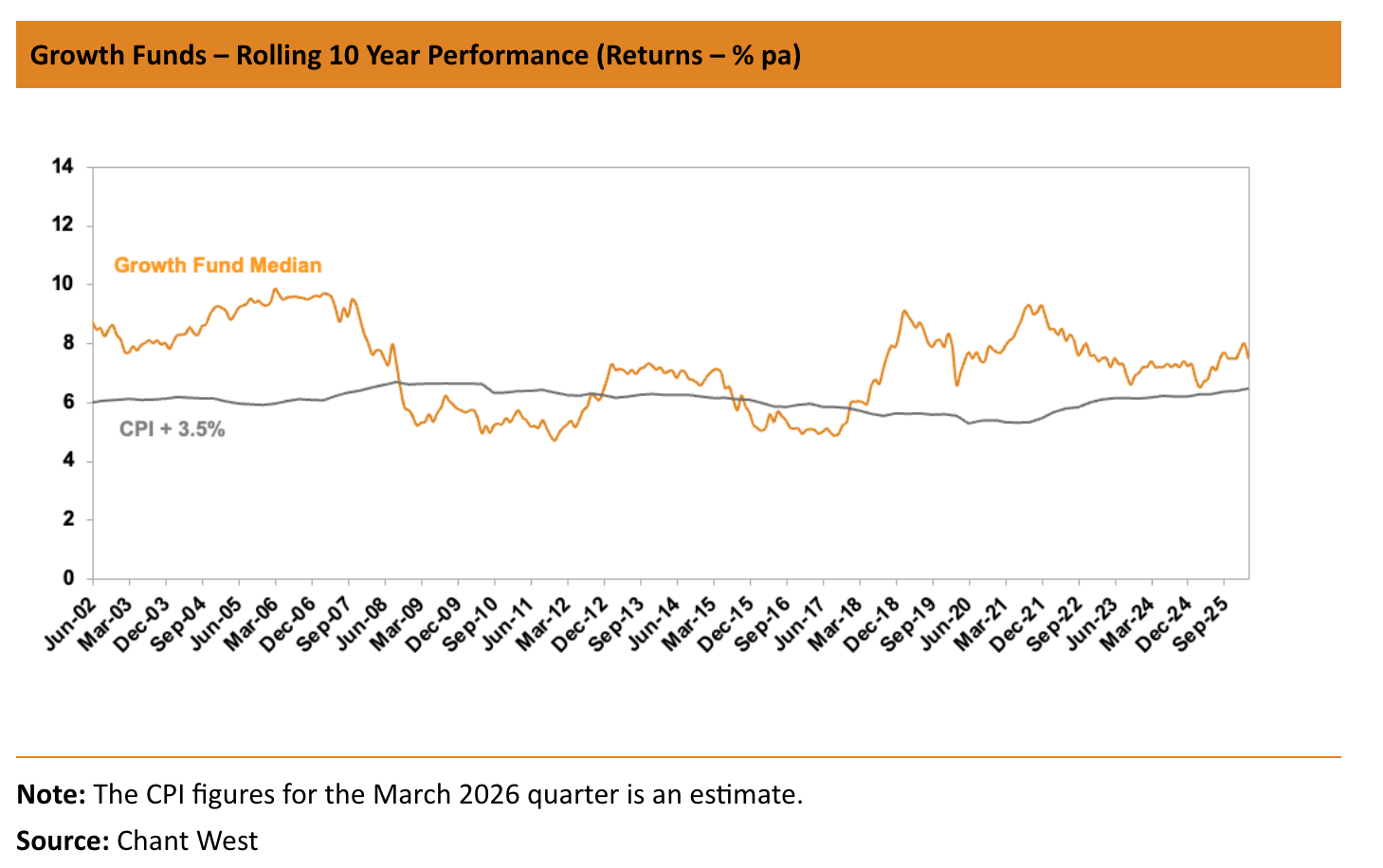
“Since the introduction of compulsory super in July 1992, the median growth fund has returned 7.9% p.a. The annual CPI increase over the same period is 2.7%, giving a real return of 5.2% p.a. – well above the typical 3.5% target. Even looking at the past 20 years, which includes three major share market downturns – the GFC in 2007-2009, COVID-19 in 2020, and the high inflation and rising interest rates in 2022 – super funds have returned 6.5% p.a., which is still ahead of the typical objective.”
The chart below shows that for most of the time, the median growth fund has exceeded its return objective over rolling 10-year periods, which is a commonly used timeframe consistent with the long-term focus of super. The exceptions are two periods between mid-2008 and late-2017, when it fell behind. This is because of the devastating impact of the 16-month GFC period (end-October 2007 to end-February 2009) during which growth funds lost about 26% on average.