

Jason Todd
We have been cautious on Australian equities and we maintain that stance. While there are pockets of support beneath the surface, the domestic backdrop presents a number of meaningful headwinds that we think will keep the ASX200 bouncing within its twelve month trading range of 8,400 to 9,100 for some time yet. We are conscious that being cautious has now become a consensus call and that does make us a little nervous, because the consensus has had a poor track record in recent years. But there is a time to be anti-consensus, and while we are happy to back ourselves against the crowd, we don’t think the current risk-reward balance argues for that now.
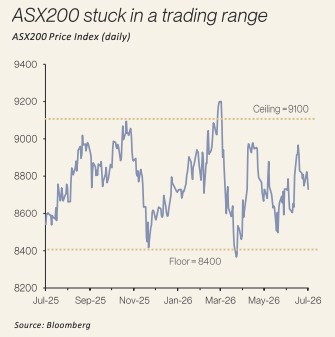
It might seem dreary to remain cautious, but there is a lot of action going on below the headline index level. In a rising market, what you don’t own is not particularly important because the sheer weight of stocks moving higher lifts all boats. In a rangebound market, the opposite is true. There are fewer stocks moving higher, so avoiding the underperformers becomes just as important as identifying the winners. We think this dynamic will persist until the conditions are in place to position for the next upswing.
We see five key headwinds that will keep the Australian market rangebound as we move into the August reporting season and beyond:
First, tight monetary policy remains in place. The Reserve Bank of Australia (RBA_ has hiked 75 basis points so far this year, across February, March and May, taking the cash rate to 4.35 percent and making this one of the more aggressive tightening cycles in the G10. Most economists now expect the Bank to stay on hold through the rest of 2026 before easing twice in 2027. But the RBA’s own June minutes retained a hawkish bias, noting the Board will do what it considers necessary, “including increasing the cash rate further if required.” Whichever way that goes, cost-of-living pressure on households is not going to abate quickly from here.
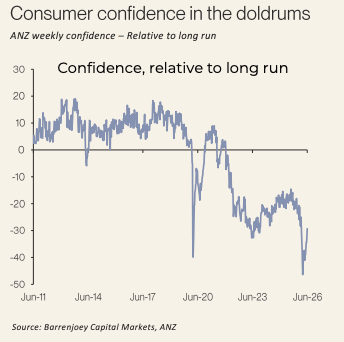
Second, consumer confidence is weak, and the sudden stop in the housing market will further undermine the spending backdrop through the second half of the year. Real household disposable income growth is forecast to slow from 6.9 percent to 4.2 percent this year, sequential house price growth in Sydney and Melbourne has turned negative, and auction clearance rates are sitting at levels that have historically preceded national price declines. Unemployment is forecast to drift up from 4.0 percent to around 4.7-4.9 percent by 2027. Housing has historically been an important transmission channel for consumer wealth and sentiment, and a stalling market removes a tailwind that households had been leaning on.
Third, key parts of the equity market are facing both cyclical and structural earnings downside risk. This includes the banks, selected consumer discretionary names and healthcare. Bank earnings growth is expected to decelerate from around 8 percent this year to roughly 3 percent by 2028, and healthcare earnings growth is forecast at just over 2 percent this year, the weakest of any sector, with earnings revisions running at minus 8 percent and the pharma and biotech sub-sector down close to 40 percent on a relative basis year to date. These are not small corners of the index, and downgrades here carry weight at the aggregate level even while other parts of the market hold up reasonably well.
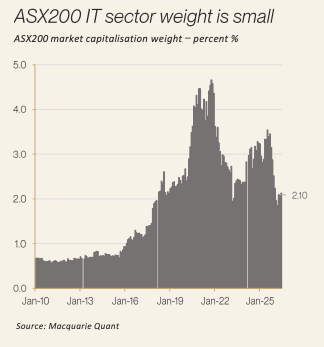
Fourth, Australia simply doesn’t have enough technology exposure to support the overall index, and the exposure it does have remains under pressure from the disruptive effects of AI rather than benefiting from the theme the way the largest offshore markets have. Information technology is only around 2 percent of the index by weight and roughly half a percent of earnings, software and services are down close to 24 percent on a relative basis year to date, and sector earnings growth is forecast at less than 1 percent this year. Consensus earnings growth for Australia over the next two years also sits well below the broader Asia -Pacific region, where AI-exposed markets such as Korea are seeing earnings growth measured in the hundreds of percent rather than single digits.
Fifth, there is a real risk of a policy misstep, whether from the RBA or from government. Markets are reasonably good at pricing known risks, but a policy error – tightening too far, too fast, or fiscal decisions that further squeeze households – is harder to price in advance and has the potential to do more damage to sentiment and earnings than any of the other four headwinds on their own.
But this is only half the story
We know this is only half the story. There are positives for the equity market, but in our view, they are not broad enough or strong enough to carry the entire index higher, even if they will continue to provide support at the individual stock level.
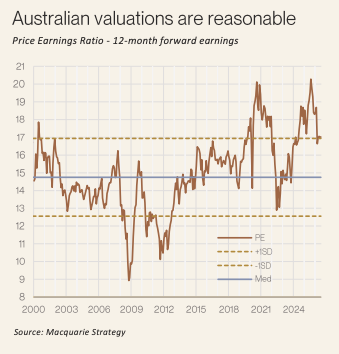
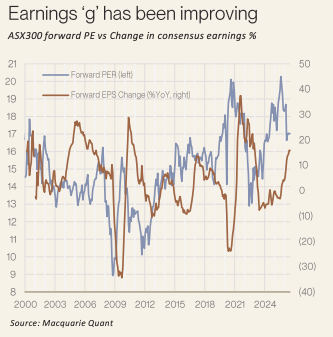
To recap the positives: Australia doesn’t have a valuation problem, and frankly we never thought it did, even when the market was trading on a peak multiple of 23 times earnings. The index has since de-rated to around 17 times forward earnings, only modestly above its ten year average of 16.4 times and not far off the 1992-2016 long-run average of 14.9 times. That means there is no aggregate de-rating pressure sitting over the entire market the way there might be if valuations were genuinely stretched.
In addition, falling energy prices should alleviate some of the inflationary and cost pressures households and businesses are facing as we move deeper into the year. Following the de-escalation around the Strait of Hormuz, oil price forecasts have been cut to around 80 dollars a barrel by year end, down from 90 previously, which should provide a meaningful boost to household purchasing power through the second half of the year.
But perhaps the most important tailwind is a resilient global economy, one that has sustained itself through recent Mid-East geopolitical turmoil. Twelve month US recession probability estimates have been pared back to around 15 percent, in line with the long-run average and down from 25 percent before the US-Iran agreement, while June flash PMIs across developed markets point to growth running close to trend as the drag from the conflict unwinds.
The AI capex cycle continues at pace globally and is increasingly dragging in stocks and sectors that sit both upstream and downstream of the theme, including power infrastructure and electrical equipment, servers and racks, networking and interconnectivity, and picks and shovels exposures such as the miners that supply critical minerals into the build-out. The top five hyperscalers are now expected to spend in the order of 750 billion US dollars on capex this year, up roughly 80 percent on last year, rising towards 920 billion in 2027, and that investment momentum is increasingly broadening out beyond data centres into energy, industrials and infrastructure.
Heading into the August reporting season, we think this backdrop argues for staying selective rather than stepping back from the market altogether. Consensus full year earnings growth for the ASX200 sits at around 13 percent, but that headline number disguises enormous dispersion: Materials earnings are tracking towards growth of close to 46 percent, while technology is barely growing at under 1 percent, energy earnings are down around 15 percent and utilities are down around 9 percent.
Materials alone have driven the bulk of the index’s earnings momentum this year. In our view, peak earnings growth expectations have now likely been reached, and breadth is narrowing rather than broadening. We continue to favour quality balance sheets, pricing power and resilient earnings streams over leverage, discretionary exposure and rate sensitivity.
Within banks, where price targets across the sector sit meaningfully below current trading levels, we are watching margin trends and bad debt provisioning closely given where we sit in the cycle, and we remain wary of consumer discretionary names with limited ability to pass through cost pressure. We also think it pays to look through to the businesses benefiting from the global AI capex cycle, even where the exposure is indirect, such as picks and shovels (miners) as well as those which support the infrastructure needs of data centres.
While this is a reasonable list of positives, we see these global tailwinds as supports against downside risk rather than drivers of upside potential for the Australian market, particularly while domestic concerns remain front and centre. It is also worth flagging that the part of the global market most levered to the AI and capex theme is itself looking crowded: price momentum as a factor looks more overbought now than at any point in the past 26 years, positioning looks stretched on most crowding measures, and momentum has effectively become synonymous with the AI trade.
That is not a reason to chase the global theme any harder than it is a reason to chase domestic cyclicals – in both cases, the risk reward looks better served by patience. No one likes a rangebound market, and no one likes it when large parts of the index are facing earnings downside risk at the same time, because it creates the sense that the market is working hard just to stand still.
But before we get to the next genuine economic upswing – which we think is more likely to be measured in years rather than something to be traded tactically – and before we can begin to properly factor in rate cuts from the RBA, we think the market has to swallow some medicine first. If a rangebound market trading between 8,400 and 9,100 is the worst outcome from here, that is not too bad in the scheme of things. The lucky country will once again have been lucky to navigate another tightening cycle, alongside a fair degree of policy upheaval at a federal level, with only a few scratches to show for it.
By Jason Todd


