
As Australia’s baby boomers move inexorably towards their retirement, many will turn to their financial adviser for help and guidance. How much will they need to fund their retirement? What about all those complex taxation rules? How can I begin to help my children out? And so the questions continue.
This will undoubtedly place the adviser in a most challenging position – on the one hand, yes, their services are desperately needed. On the other hand, the adviser has been under seemingly continual scrutiny, change and indeed challenge for the last few years. While the pace and magnitude of change in the advisory profession shows no real signs of abating, the anecdotal feedback we are receiving continues to confirm that market sentiment is slowly improving and confidence is on the rise.
Given all of this, it appears to us that Australian principals are now faced with an interesting dilemma. How do they react to such a market? However, perhaps an even more fundamental question should be – how well placed are they to do what they have to do, to look after their clients as well as their own practice?
Of course, there won’t be a ‘one size fits all’ answer to these questions. And while it is always wise to have one eye on the forces shaping the environment of tomorrow, it also prudent to understand where the marketplace is today and how it is changing over the short term. It is here that the key findings from the recently released Business Health Future Ready IV* research paper provides real insight.
- Since 2002, Business Health has released a series of white papers providing a comprehensive insight into the health of the Australian advisory industry and its preparedness for the future. These papers have become known as the Future Ready analysis. The fourth in this series, Future Ready IV, was released earlier this year and is based on the consolidated analysis from Business Health’s HealthCheck data warehouse which now contains information on over 2,000 Australian practices.
As can be seen from the following graph, when comparing the ‘health’ of practices today to the position in 2007, we have seen incremental improvements in some areas, but at a high level, there seems to have been little progress.
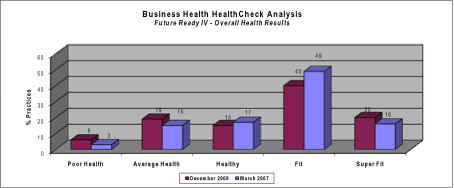
While the stronger practices seem to have gotten stronger (the number of firms adjudged in the elite Super Fit category was up from 16% of the marketplace to 20%), the number of firms rated Healthy or better dropped from 82% to 75%. On the other hand, the number of Poor and Average Health practices has actually increased over the past two years – they now stand at 25% of our data set, up from 18% in 2007.
Although in many regards this still represents a strong result (the Business Health best practice benchmarks are unapologetically set quite high), and Australian firms remain at the forefront of global practice management, the fact remains that one in four of the better firms in this country are still in need of a stronger “health” plan.
While each practice is unique and the challenges (and hence solutions) vary from firm to firm, without doubt, the tumultuous market conditions of late, have had an enormous impact. Many principals have (in most cases quite rightly) had to divert much of their management focus and attention into addressing other more immediate concerns, causing a lot of the practice management initiatives to stall.
In future issues we will take a look at various aspects of running a practice – the key profit drivers; what’s working, what isn’t. And to help AdviserVoice readers monitor the changes occurring within the advisory profession, we are delighted to announce that Business Health has compiled the first ever Australian Practice Health Index. We will be releasing the Index in the next issue of AdviserVoice and will thereafter look to explore any changes occurring to it in future issues.


