
Building Approvals; PSI
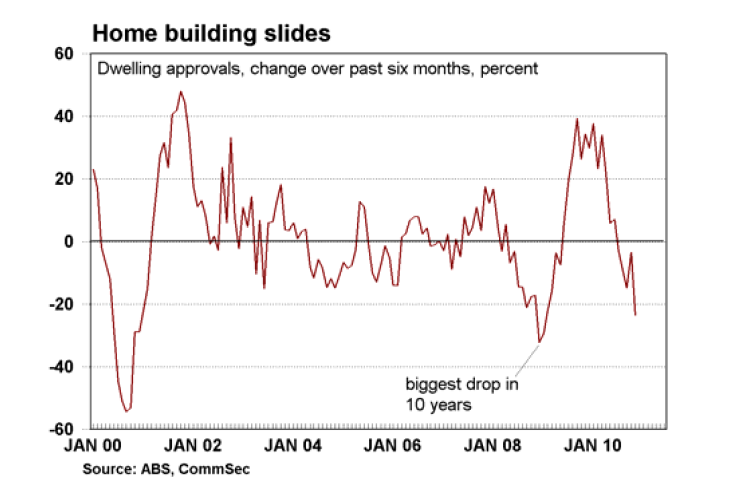
- The outlook for home builders is gloomy. Approvals to build news homes slumped by 4.2 per cent in November. The slide in approvals marked the seventh decline in eight months. Over the past eight months approvals have fallen by 23 per cent
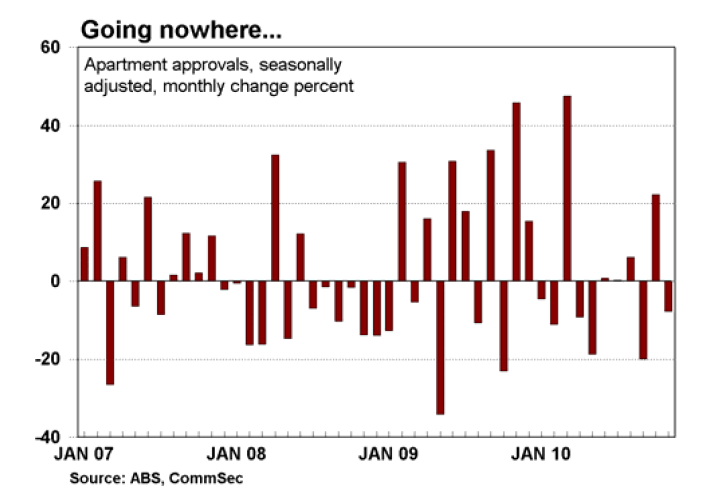
- The all-important new house segement was down by 2.0 per cent and apartment approvals fell by 2.0 per cent.
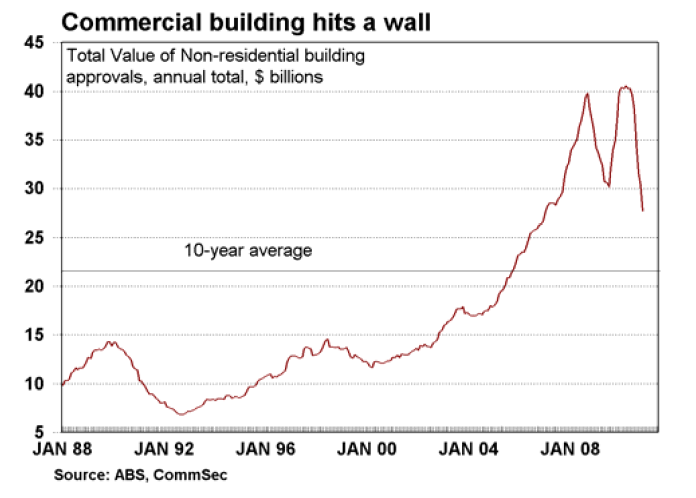
- The value of building approvals fell by 3.5 per cent in November to be down 32.5 per cent in annual terms, largely driven by a weakness in commercial building.
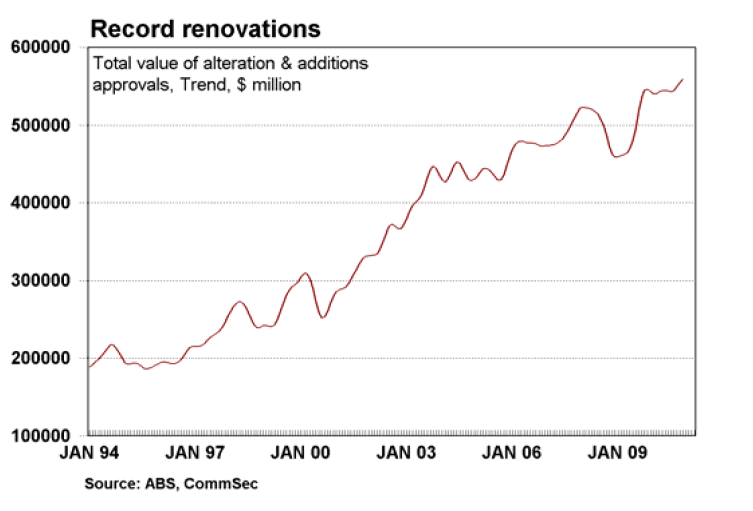
- The value of alterations and additions rose to record highs in trend terms as a growing number of people elect to renovate rather than move.
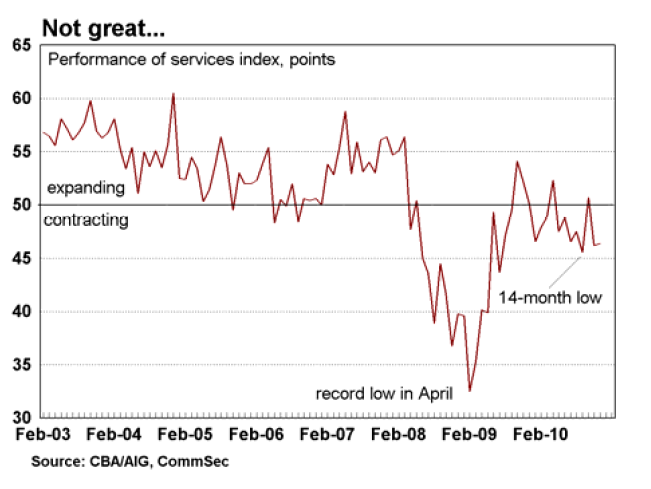
- The services sector is still going backwards. The Performance of Services index rose modestly from 46.2 to 46.4 in December. Any reading below 50 suggests that the services sector is contracting. The services sector contacted for ten months in 2010.
What does it all mean?
- The latest slide in building approvals rings true with the anecdotal evidence that we have been hearing for some time. Not only are approvals below longer-term averages but they have fallen for seven out of the past eight months. And the downturn is not just limited to home building with the value of commercial construction loans sliding by just shy of 60 per cent on a year ago. All areas of the construction sector would be rightly worried about the outlook.
- The rate hikes have certainly taken their toll on the housing sector over the past year and unfortunately for the sector it is unlikely that a turnaround is going to take place anytime soon – especially given the double whammy rate hike in November is yet to make its mark on the data.
- While approvals to build new homes may be sliding one area that has picked up pace is the renovation market. In smoothed terms the value of alterations and additions rose to a record high of almost $560 million in November. Whether it is higher home prices or the cost of building or development that is driving the increase, people seem to be electing to renovate rather than move.
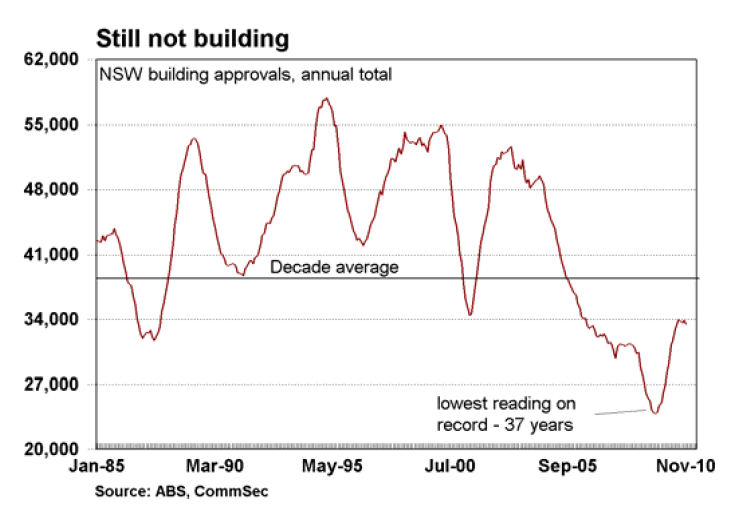
- Interestingly when you look across the states Victoria continues to outshine the rest. In annual terms approvals in Victoria are still up 4 per cent on a year ago, compared with the likes of NSW, Queensland, South Australia and Tasmania which have recorded double digit losses. The strength in construction activity in Victoria has provided a healthy degree of support for the state economy over the past year.
- While interest rate rises have been the driver for the weaker activity levels, state, federal and local governments need to share part of the blame. In states like NSW, costs for developers need to be reassessed,
as a degree of under building continues to take place. The sustained slide in rental vacancy rates is a clear indicator of the level of under building. - The data yesterday highlighted the contraction in the manufacturing sector and the story is no different for the service sector. There are a couple of factors driving the weakness in the services sector including higher interest rates, a stronger currency and the conservative buying behaviour of consumers and businesses.
- Businesses are under substantial pressure at present with costs edging higher and consumers driving hard bargains. Input costs and wages remain elevated but selling prices are flat. Business margins are constrained, thus depressing profitability.
- A period of interest rate stability would clearly help the situation. If the Reserve Bank stayed on the interest rate sidelines over the next couple of months, activity levels should improve.
What do the figures show?
Building Approvals:
- New dwelling approvals slumped by 4.2 per cent in November, after rising by 8.3 per cent in October. Dwelling approvals have fallen for seven out of the last eight months and are down 9.9 per cent on levels of a year ago.
- House approvals fell by 2.0 per cent in November (private sector down 1.7 per cent), after rising by 1.2 per cent in October. Apartment approvals fell by 7.7 per cent in November (private sector was down 5.5 per cent) after rising by 22.3 per cent in October. In annual terms apartment approvals are up 3.8 per cent on a year ago.
- Dwelling approvals fell most in Tasmania (down 15.4 per cent) and NSW (down 13.4 per cent) in November. Approvals improved the most in Western Australia (up 7.1 per cent).
- In annual terms approvals across the state: NSW (down 19.4 per cent), Victoria (up 4.9 per cent), Queensland (down 24.6 per cent), South Australia (down 11.6 per cent), Western Australia (down 4.9 per cent),
- The value of building approvals fell by 3.5 per cent in November and was lower by 32.5 per cent on a year ago.
Performance of Services index
- The Performance of Services index rose modestly from 46.2 to 46.4 in December. It was the tenth time in the past 12 months that the PSI has been below 50. Any reading below 50 indicates a contraction of activity.
- The poor performance in services sector activity was largely concentrated in the professional services subsectors. In particular, the activity indices of the property & business services, finance & insurance, and communication services sub-sectors all fell sharply in December.
- On the other hand, the activity indices of the services sub-sectors exposed to household spending generally picked up in the month, after falling back in November. The strongest growth was recorded in the wholesale trade, hospitality and personal & recreational services.
- Sales, orders and employment all recorded modest improvement but still remained below 50, suggesting weak activity levels in coming months. In fact only input prices and wages have index readings above 50
- Profitability is clearly under pressure with the index of selling prices largely unchanged while input prices and wages continue to trend higher.
What is the importance of the economic data?
- The Bureau of Statistics’ monthly Building Approvals release contains figures on local council approvals to build residential structures such as homes and units as well as commercial premises such as offices and shops. Approval is one of the first stages of the construction ‘pipeline’ and is thus a key leading indicator of future activity. An increase in approvals would point to stronger future activity for construction-related companies.
- The Australian Industry Group and Commonwealth Bank release the Performance of Services index each month. The PSI is a key indicator of conditions in the services sector – includes retailing, finance, hotels and cafes.
What are the implications for interest rates and investors?
- It is important to highlight that while the housing sector is cooling it is not about to collapse in a heap. The fundamental for property remain attractive. Population growth remains healthy, vacancy rates continue to slide and the employment growth will support activity in the mid to longer term.
- Overall CommSec expects house prices to consolidate over the next few months, but for the year as a whole we would expect prices to lift by 5-8 per cent.
Produced by Commonwealth Research based on information available at the time of publishing. We believe that the information in this report is correct and any opinions, conclusions or recommendations are reasonably held or made as at the time of its compilation, but no warranty is made as to accuracy, reliability or completeness. To the extent permitted by law, neither Commonwealth Bank of Australia ABN 48 123 123 124 nor any of its subsidiaries accept liability to any person for loss or damage arising from the use of this report.
The report has been prepared without taking account of the objectives, financial situation or needs of any particular individual. For this reason, any individual should, before acting on the information in this report, consider the appropriateness of the information, having regard to the individual’s objectives, financial situation and needs and, if necessary, seek appropriate professional advice. In the case of certain securities Commonwealth Bank of Australia is or may be the only market maker.
This report is approved and distributed in Australia by Commonwealth Securities Limited ABN 60 067 254 399 a wholly owned but not guaranteed subsidiary of Commonwealth Bank of Australia. This report is approved and distributed in the UK by Commonwealth Bank of Australia incorporated in Australia with limited liability. Registered in England No. BR250 and regulated in the UK by the Financial Services Authority (FSA). This report does not purport to be a complete statement or summary. For the purpose of the FSA rules, this report and related services are not intended for private customers and are not available to them.
Commonwealth Bank of Australia and its subsidiaries have effected or may effect transactions for their own account in any investments or related investments referred to in this report.


