
Weekly Petrol Price, Inflation gauge; Lending finance; New car sales
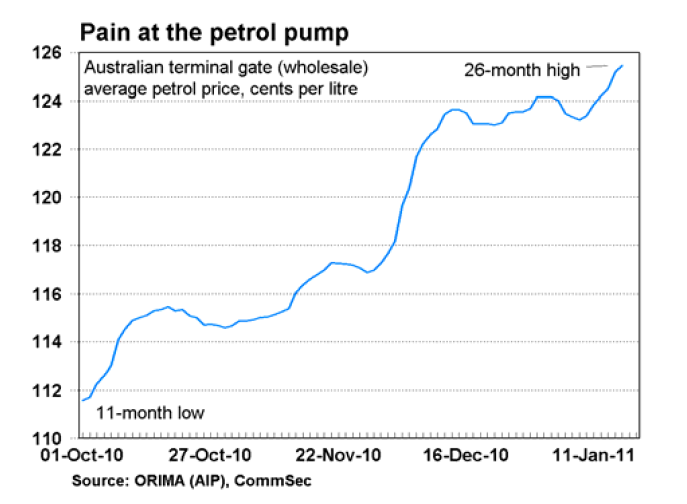
- Motorists need to prepare for higher petrol prices. The terminal gate or wholesale price of petrol leapt by over 2 cents a litre last week to 26-month highs. CommSec expects petrol prices to rise 3 cents a litre over the coming fortnight.
- Inflation is under control. The TD Securities-Melbourne Institute monthly inflation gauge rose by just 0.2 per cent in December. Excluding volatile items, prices were flat – the fifth straight month of negligible growth.
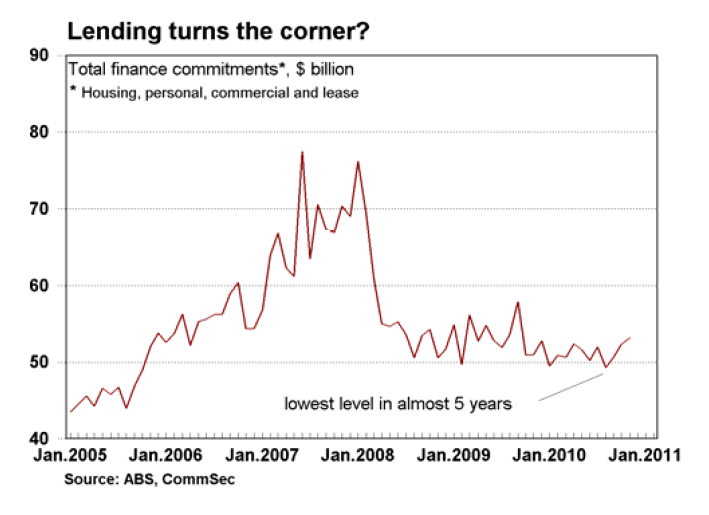
- Lending rose in November. Total lending finance rose for the third consecutive month up by 1.7 per cent in November. Lending totalled $53.2 billion in November, up 4.4 per cent over the year but up a much healthier 7.7 per cent in the past three months.
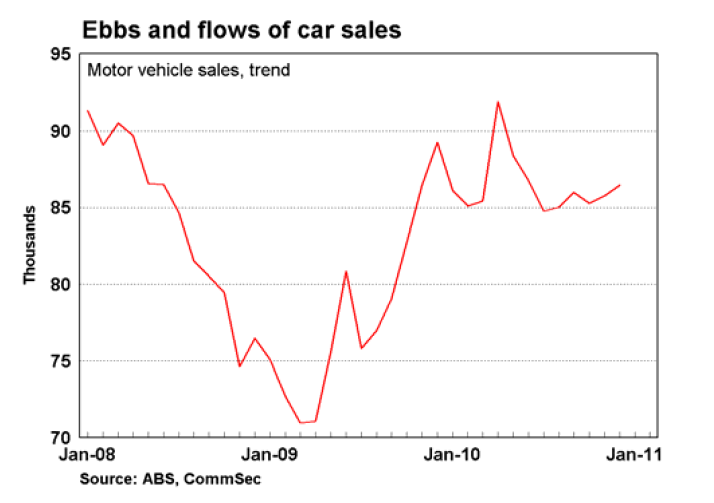
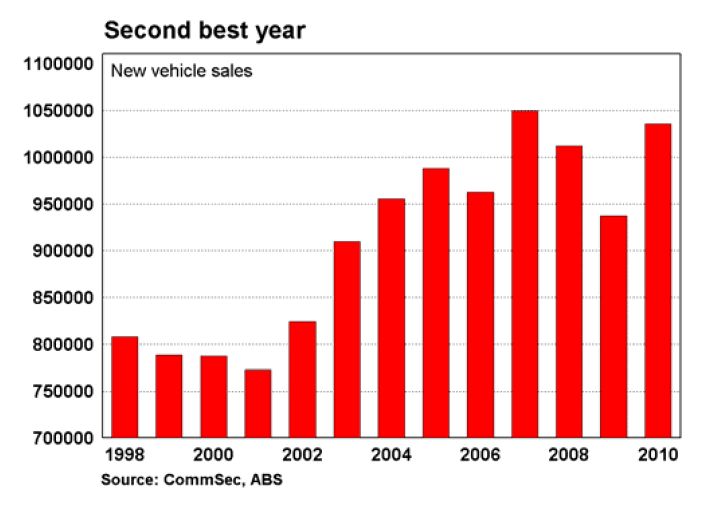
- Australian new car sales recorded a healthy rise in December. Car sales rose by 0.8 per cent in December after a 0.5 per cent rise in November. Passenger car sales rose by 4.8 per cent in the month.
What does it all mean?
- Motorists need to prepare for higher petrol prices over the next fortnight. The wholesale price of petrol leapt by almost two cents a litre last week and more than likely the higher cost will be passed through to motorists over the next 7-10 days.
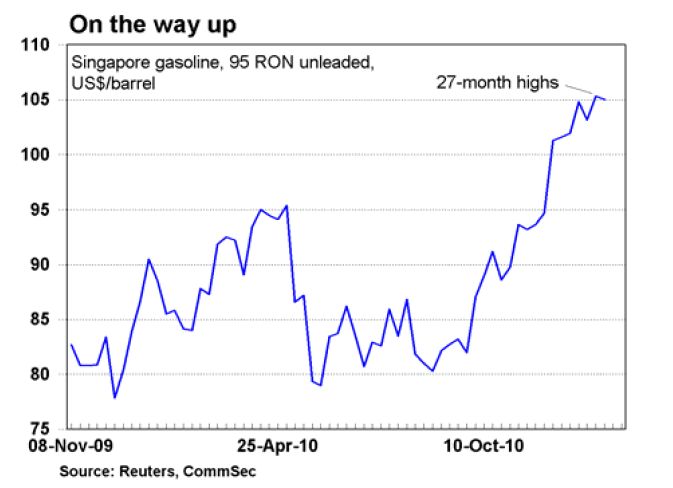
- Not only has the wholesale price continued to rise but increased competition has resulted in petrol retailers selling fuel in some states at or near cost – which is clearly a unsustainable scenario in the longer term. Even on the world stage the Singapore unleaded price is holding just shy of the 27-month highs reached last week. And looking forward the fortunes of the Australian dollar will determine by just what magnitude petrol prices will rise.
- The latest TD inflation gauge suggests that inflation remains well and truly under control at present. In December price rose by just a 0.2 per cent rise. And while the annualised rate of inflation is holding at a seemingly unhealthy 3.8 per cent it is largely a reflection of higher readings in the latter part of 2009 and early 2010 than what is taking place now. In fact over the past six months inflation has been negligible and the annualised result is holding at a more sedate level of 2.6 per cent.
- Strip out volatile elements like fruit and vegetable prices, and petrol and inflation is largely non-existent in Australia. But that is no surprise – retailers of all descriptions have been telling us that is the case for some time. In the current environment businesses are trimming prices to get people to part with their cash, while the strength of the Australian dollar is working at keeping imported inflation low. Once volatile items are excluded, inflation has hardly budged over the past five months, and even the three month annualised rate of inflation is amazingly just 0.1 per cent.
- Looking forward the increase in global oil prices is likely to have a feed through effect on the inflation front. However there is not a lot that the Reserve Bank can do about changes at the petrol bowser or the floods in Queensland – a key driver of changes in fruit and vegetable prices. If underlying inflationary pressures remain contained, then the Reserve Bank can stay on the sidelines until well into 2011.
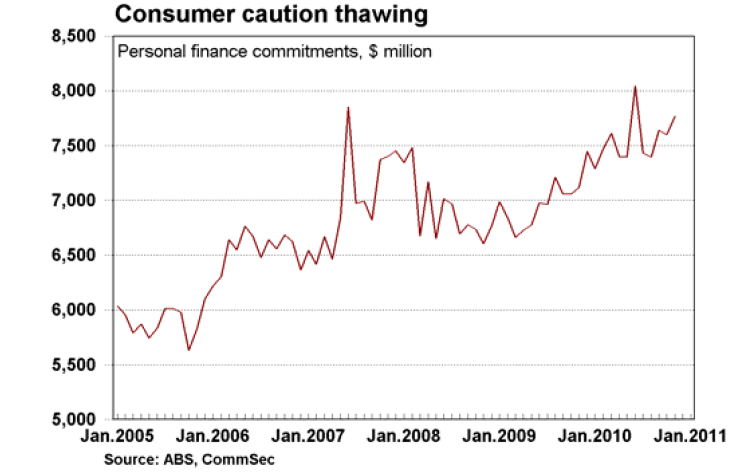
- Lending finance is effectively a forward looking indicator of economic activity – given that any rise in borrowings will eventually translate to a pickup in spending and activity. And while the conservative attitudes of consumers and businesses have kept borrowings weak, there are signs that things are thawing. Lending finance has risen for the third straight month and in annual terms the growth rate is a much healthier 4.4 per cent – marking the best result in 14-months.
- The overall improvement in lending is only in its infancy, and given the November rate hike is yet to have a full impact on the economy, the argument for a period of interest rate stability remains the best outcome. The Reserve Bank would be best served by staying on the interest sidelines – especially given that inflation looks to be well contained at present.
- The latest result on car sales is certainly encouraging, even more so given the surge in sales of passenger cars over the month of December. In seasonally adjusted terms passenger car sales recorded the best monthly increase in eight months. No doubt the strength in the labour market is the clear underlying driver in the pickup in activity. With a sustained increase in employment and resulting improvement in job security, households are once again tentatively spending on big ticket items.
What do the figures show?
Inflation gauge:
- The monthly inflation gauge rose by 0.2 per cent in December after lifting by 0.4 per cent in November. The annual rate of inflation eased from 3.9 per cent to 3.8 per cent.
- Excluding volatile items like petrol and fruit & vegetables, the inflation gauge remained unchanged after rising by 0.1 per cent in November. The annual rate of core inflation fell from 3.2 per cent to 3.0 per cent. The three-month annualised rate of inflation eased from 0.7 per cent to just 0.1 per cent.
- The trimmed mean inflation measure rose by 0.3 per cent in December. The trimmed mean measure is up 3.2 per cent on a year ago while the three-month annualised rate rose from 1.9 per cent to 2.8 per cent.
- TD Securities noted that “Contributing most to the overall change in December were price rises for automotive fuel, fruit and vegetables, and holiday travel and accommodation. These were offset by falls in prices for audio, visual and computing, sport and other recreation, and books, newspapers and magazines. The automotive fuel price increased by 4.7 per cent in December, and while the price of rent was unchanged in the month, annual rent inflation rose to 2.3 per cent, the highest reading since May 2009.”
Petrol prices:
- The national average wholesale (terminal gate) price hit a near 26-month low high of 125.5 cents a litre today. Over the past week the terminal gate price has risen by 2 cents a litre. Just over two months ago (October 1) the terminal gate price stood at an 11-month low of 111.6c/l.
- Last week, the key Singapore unleaded petrol price fell by US33 cents (0.3 per cent) to US$105.02 a barrel. And in Australian dollar terms the Singapore gasoline price fell by 66 cents (0.6 per cent) over the week to $105.40 a barrel.
Lending Finance:
- Total new lending commitments (housing, personal, commercial and lease finance) rose by 1.7 per cent in November after rising 3.3 per cent in October. Lending totalled $53.2 billion in November, up 4.4 per cent over the year but up a much healthier 7.7 per cent in the past three months.
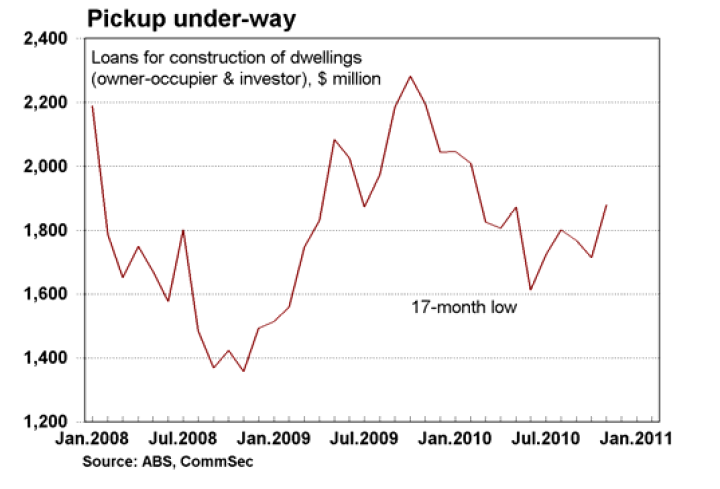
- All housing finance (owner occupier & commercial) rose by 1.1 per cent in November, the third straight monthly gain.
- Commercial finance rose by 1.0 per cent in November. Within commercial commitments, fixed lending rose by just 3.8 per cent but revolving credit slumped by 4.9 per cent. Commercial loans are up 11.1 per cent on a year ago.
- Personal finance rose by 2.2 per cent in November, only the second rise in five months. Within personal commitments, fixed lending rose by 2.0 per cent while revolving credit rose by 2.5 per cent. Personal loans are up 9.2 per cent on a year ago.
- Within fixed lending, all categories are higher than a year ago except residential blocks of land (down 19.5 per cent).
- Lease finance rose by 0.5 per cent in November and loans are up 13.7 per cent over the year.
New car sales
- New car sales rose by 0.8 per cent in December after rising by 0.5 per cent in November.
- Passenger car sales rose by 4.8 per cent in the month, sports utility vehicles fell by 10.7 per cent while “other” vehicles (trucks, utes etc) were up 3.1 per cent. In annual terms “other” vehicle sales were down 24.8 per cent on a year ago.
- In rolling annual terms, 235,285 SUV’s have been sold in the 12 months to December. However SUV sales are down 7.6 per cent on a year ago.
What is the importance of the economic data?
- The TD Securities/Melbourne Institute Monthly Inflation Gauge is designed to “provide a timely and accurate monthly measure of inflation in Australia”. The Bureau of Statistics only releases the Consumer Price Index on a quarterly basis.
- Lending Finance is released monthly by the Bureau of Statistics and contains figures on new housing, personal, commercial and lease finance commitments. The importance of the data lies in what it reveals about the appropriateness of interest rate settings, confidence and spending levels in the economy.
- Weekly figures on petrol prices are compiled by ORIMA Research on behalf of the Australian Institute of Petroleum. National average retail prices are calculated as the weighted average of each State/Territory’s metropolitan and non-metropolitan retail petrol prices, with the weights based on the number of registered petrol vehicles in each of these regions.
- The Australian Bureau of Statistics (ABS) provides monthly estimates of car sales in seasonally adjusted and trend terms after receiving the actual sales data from the car industry. The figures highlight the strength of consumer spending as well as conditions facing auto & components companies.
What are the implications for interest rates and investors?
- Inflation is under control at present but some of the volatile elements like petrol and fruit and vegetable prices are starting to move higher. This complicates the situation for the Reserve Bank. While the Reserve Bank can’t lift rates to respond to factors outside its control, the risk is that higher inflation may become entrenched, with businesses using the higher inflation base to justify price increases.
- The lift in the price of petrol is further bad news for motorists, taking precious spending dollars out of consumer pockets. Retailers already have to contend with the effects of La Nina on seasonal spending, consumer conservatism and higher utility prices.
Produced by Commonwealth Research based on information available at the time of publishing. We believe that the information in this report is correct and any opinions, conclusions or recommendations are reasonably held or made as at the time of its compilation, but no warranty is made as to accuracy, reliability or completeness. To the extent permitted by law, neither Commonwealth Bank of Australia ABN 48 123 123 124 nor any of its subsidiaries accept liability to any person for loss or damage arising from the use of this report.
The report has been prepared without taking account of the objectives, financial situation or needs of any particular individual. For this reason, any individual should, before acting on the information in this report, consider the appropriateness of the information, having regard to the individual’s objectives, financial situation and needs and, if necessary, seek appropriate professional advice. In the case of certain securities Commonwealth Bank of Australia is or may be the only market maker.
This report is approved and distributed in Australia by Commonwealth Securities Limited ABN 60 067 254 399 a wholly owned but not guaranteed subsidiary of Commonwealth Bank of Australia. This report is approved and distributed in the UK by Commonwealth Bank of Australia incorporated in Australia with limited liability. Registered in England No. BR250 and regulated in the UK by the Financial Services Authority (FSA). This report does not purport to be a complete statement or summary. For the purpose of the FSA rules, this report and related services are not intended for private customers and are not available to them.
Commonwealth Bank of Australia and its subsidiaries have effected or may effect transactions for their own account in any investments or related investments referred to in this report.


