
International trade
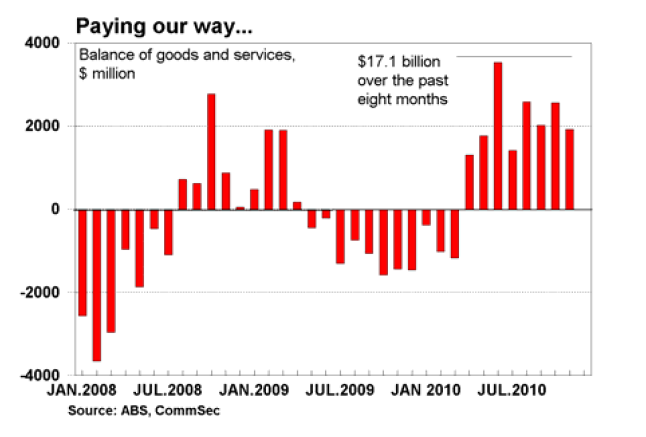
- Australia’s trade surplus narrowed by $636 million to $1,925 million in November. Economists had tipped a surplus near $2 billion. Exports were flat over the month while imports rose by 2.9 per cent. Australia has chalked up trade surpluses of $17.1 billion over just the past eight months.
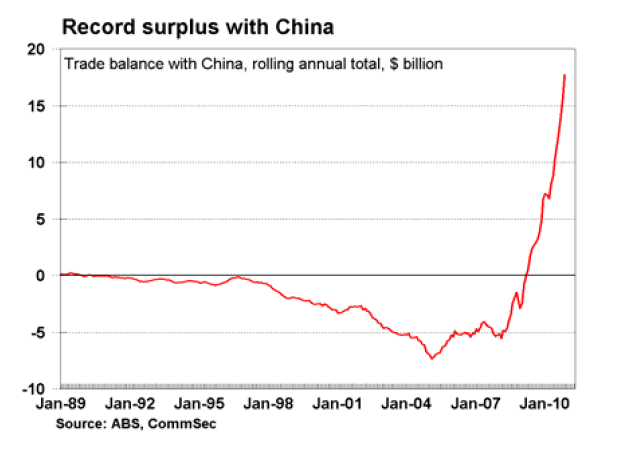
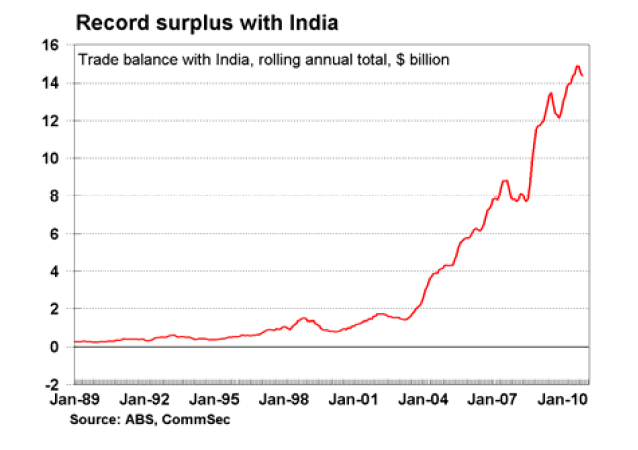
- Australia’s trade surpluses with both China and India soared to record highs over the past year. In the year to November, Australia sent $17.7 billion more in exports to China than it received in imports. Just under two years ago the trade surplus was close to zero.
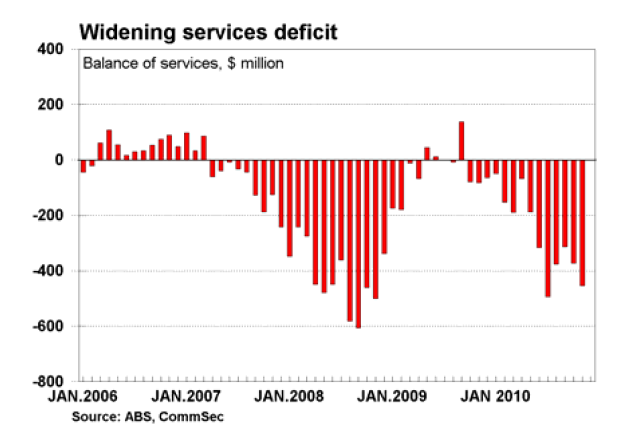
- While the physical trade of goods is in surplus, the services account remains mired in deficit – the deficit widening from $372 million to $454 million in November. The high Australian dollar is a key culprit, depressing tourism receipts.
- Total exports from Queensland were $4,199 million in November – 21 per cent of total Australian exports. The floods in Queensland is likely to see more sedate trade surpluses take place in coming months.
What does it all mean?
- The economy may be going through a soft patch but the dollars keep rolling in. Australia has now notched up its eighth consecutive trade surplus, totalling in excess of $17 billion. Despite the boost to Australian coffers the impact has yet to have a resounding effect on the economy. The weakness in business and consumer spending suggests the additional income is being saved rather than spent.
- However as the Reserve Bank has highlighted increased savings will eventually mean a pickup in spending down the track. It is the multiplier effect that essentially the Reserve Bank is banking on to spur domestic growth over the coming year. At present the additional income is not being spent, but as the recovery gains traction it is likely that Australian businesses and consumers will follow through on spending and investment plans.
- Interestingly Australia is making strong inroads amongst its Asian counterparts. The trade surplus with China has now risen to a record high of just over $17 billion on a yearly basis. Clearly this is a phenomenal result given that just under two years ago that trade surplus was close to zero.
- Similarly the trade balance with India has also expanded. In the year to November the trade surplus with India ballooned to $14.4 billion. Australia’s trade surplus with India has been gradually building over time but it has doubled since the start of 2008.
- Higher commodity prices and increased demand for coal and iron ore has helped insulate the Australian economy. However given the floods in Queensland it is likely that trade surpluses are likely to be more moderate in coming months.
- Not surprisingly the strength of the Australian dollar continues to have a detrimental impact on the services sector. Australia’s services deficit has widened by over $450 million in just the past month. No doubt the strength of the Australian dollar is making Australia a less attractive destination for overseas tourists and potential international students. Interestingly when the Aussie fell below US70c in 2009 the services sector notched up a series of surpluses.
What do the figures show?
International trade
- Australia’s trade surplus narrowed by $636 million in November to $1,925 million. Economists had tipped a $2 billion trade surplus. Exports were flat in the month while imports rose by 2.9 per cent. It was the eighth consecutive trade surplus.
- Rural exports rose by 1 per cent in November while non-rural exports rose by 2.2 per cent and non-monetary gold fell by $325million or 21 per cent.
- Within non-rural exports, coal, coke and briquettes fell by 5 per cent. “On a recorded trade basis, between October and November 2010 exports of bituminous (thermal) coal fell $240m (19 per cent), driven by volumes. Exports of semi-soft coal fell $78m (10 per cent), with decreases in both volumes and prices. These falls were partly offset by hard coking coal which rose $16m (1 per cent), with an increase in volumes and a decrease in prices”.
- Within rural exports meat and meat preparations rose by $35 million or 6 per cent.
- Within imports, consumer imports rose 1.0 per cent in November, capital goods imports rose by 8.3 per cent while intermediate goods imports rose 3.5 per cent.
- While the physical trade of goods is in surplus, the services account remains mired in deficit – the deficit widening from $372 million to $454 million in November. The high Australian dollar is a key culprit, depressing tourism receipts.
- Australia’s trade surplus with China hit a record high of $17.1 billion in the year to November.
What is the importance of the economic data?
- The monthly International Trade in Goods and Services release from the Bureau of Statistics provides estimates on exports and imports of physical goods (such as coal, beef and computers) and services (such as travel receipts). The balance of goods and services (BOGS) is a narrower description of Australia’s external position than the current account estimates. The import data is a useful gauge of consumer and business spending while exports reflect global demand as well as domestic influences such as drought.
What are the implications for interest rates and investors?
- The Reserve Bank will point to our trade surpluses as evidence of the mining boom’s impact on the economy. As more dollars flow into the country, policy has to tighten to soak up the extra money and thus prevent inflationary pressures from building. However the sluggish level of activity at present suggests that the Reserve Bank can hold off on any near term rate hikes.
Produced by Commonwealth Research based on information available at the time of publishing. We believe that the information in this report is correct and any opinions, conclusions or recommendations are reasonably held or made as at the time of its compilation, but no warranty is made as to accuracy, reliability or completeness. To the extent permitted by law, neither Commonwealth Bank of Australia ABN 48 123 123 124 nor any of its subsidiaries accept liability to any person for loss or damage arising from the use of this report.
The report has been prepared without taking account of the objectives, financial situation or needs of any particular individual. For this reason, any individual should, before acting on the information in this report, consider the appropriateness of the information, having regard to the individual’s objectives, financial situation and needs and, if necessary, seek appropriate professional advice. In the case of certain securities Commonwealth Bank of Australia is or may be the only market maker.
This report is approved and distributed in Australia by Commonwealth Securities Limited ABN 60 067 254 399 a wholly owned but not guaranteed subsidiary of Commonwealth Bank of Australia. This report is approved and distributed in the UK by Commonwealth Bank of Australia incorporated in Australia with limited liability. Registered in England No. BR250 and regulated in the UK by the Financial Services Authority (FSA). This report does not purport to be a complete statement or summary. For the purpose of the FSA rules, this report and related services are not intended for private customers and are not available to them.
Commonwealth Bank of Australia and its subsidiaries have effected or may effect transactions for their own account in any investments or related investments referred to in this report.


