
Construction work done
- Construction work done rose by 0.8 per cent in the December quarter, due solely to higher engineering activity.
- Residential building fell by 1.1 per cent in the quarter. CommSec estimates the drop in residential building will detract 0.1 percentage points from December quarter GDP growth. There is still the risk that the economy contracted slightly in the quarter.
- Commercial building slumped by 9.9 per cent in the December quarter while engineering work done lifted by 7.3 per cent.
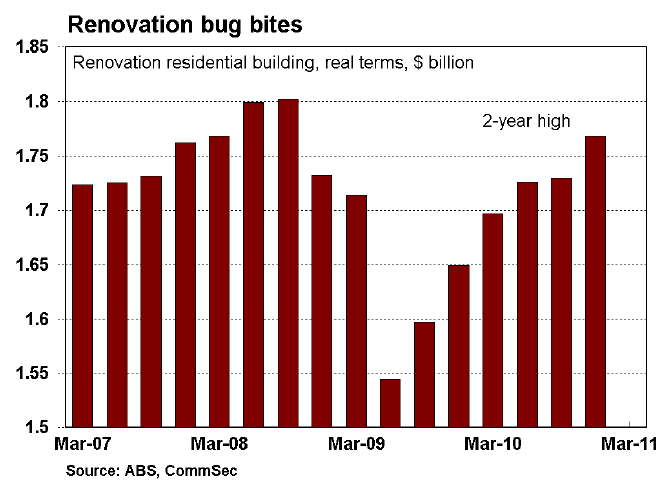
- People are opting to stay and renovate rather than shift properties. Renovation work hit two-year highs in the December quarter.
What does it all mean?
- There is plenty of debate about a two-speed economy. Well, there is evidence that there is also a two-speed construction sector. Engineering activity – roads, bridges railways etc – continues to grow solidly. But commercial and residential building is going backwards.
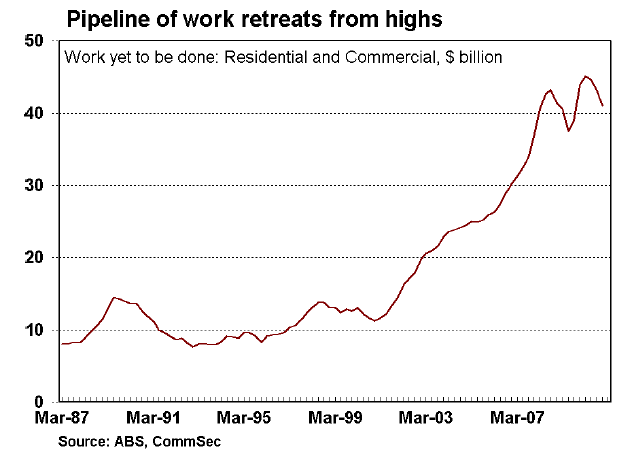
- The other sobering news is that the hefty amount of outstanding projects is continuing to dry up, down for the third straight month. To be certain there is still a lot of work to be done. But the pipeline is now getting smaller, not bigger, easing some of the Reserve Bank concerns.
- If engineering is the star of the construction sector, it is renovations that are starring in residential building. The construction work figures back up other evidence showing that people are opting to stay and renovate, rather than move. While good news for builders and tradespeople, it is less positive for real estate agents.
- Commercial building is a key source of concern. Education projects are drying up, but new offices or shopping centres aren’t replacing them.
- Overall the Reserve Bank would be happy about the balance of forces in construction. The fact that engineering is pushing forward but commercial and residential building are retreating will reduce pressure on labour and materials, and reduce pressure on inflation.
What do the figures show?
- Construction work done rose by 0.8 per cent in real (inflation-adjusted) terms in the December quarter. Public sector construction work fell by 2.8 per cent while private sector activity rose by 2.4 per cent.
- Engineering work rose by 7.6 per cent in the December quarter with private sector activity up 10.2 per cent and public sector work up 2.3 per cent.
- Commercial (non-residential) building fell by 9.9 per cent with private sector work down 9.2 per cent. Residential building fell by 1.1 per cent in the quarter with private sector work down 1.0 per cent. Alterations & additions rose 2.5 per cent but new work fell by 1.7 per cent.
- Construction work rose most in NSW (up 9.4 per cent), followed by Western Australia (up 4.1 per cent). Construction fell in the Northern Territory (down 10.0 per cent), Tasmania (down 3.7 per cent), Queensland (down 2.5 per cent), South Australia (down 2.2 per cent), Victoria (down 0.5 per cent), ACT (down 0.4 per cent).
- The value of work yet to be done fell further from record highs, down by 5.1 per cent to $41.05 billion in the December quarter.
What is the importance of the economic data?
- The Bureau of Statistics releases quarterly estimates of Construction work done. The estimates are based on a survey and cover around 80 per cent of the construction work done in the period. Revised estimates will be released in coming months. The data is useful largely for historical purposes but the work yet to be done estimates provide an early warning signal of future activity. The residential work figures give a good early guide to the strength of residential investment in the national accounts.
What are the implications for interest rates and investors?
- Conditions in the construction sector are very mixed. Had it not been for an uplift of work in NSW, construction would have fallen in the December quarter. And engineering really is the standout, whereas commercial building is weak and residential activity is patchy.
- Construction-dependent companies really need to do their homework in the current environment.
- Today’s data on both wages and construction add weight to the view that the Reserve Bank will stay on the interest rate sidelines for the next couple of months. Certainly flood-rebuilding work will be adding to the pipeline of work later in the year, but falling work levels in other sectors mean that it can be accommodated.
Produced by Commonwealth Research based on information available at the time of publishing. We believe that the information in this report is correct and any opinions, conclusions or recommendations are reasonably held or made as at the time of its compilation, but no warranty is made as to accuracy, reliability or completeness. To the extent permitted by law, neither Commonwealth Bank of Australia ABN 48 123 123 124 nor any of its subsidiaries accept liability to any person for loss or damage arising from the use of this report.
The report has been prepared without taking account of the objectives, financial situation or needs of any particular individual. For this reason, any individual should, before acting on the information in this report, consider the appropriateness of the information, having regard to the individual’s objectives, financial situation and needs and, if necessary, seek appropriate professional advice. In the case of certain securities Commonwealth Bank of Australia is or may be the only market maker.
This report is approved and distributed in Australia by Commonwealth Securities Limited ABN 60 067 254 399 a wholly owned but not guaranteed subsidiary of Commonwealth Bank of Australia. This report is approved and distributed in the UK by Commonwealth Bank of Australia incorporated in Australia with limited liability. Registered in England No. BR250 and regulated in the UK by the Financial Services Authority (FSA). This report does not purport to be a complete statement or summary. For the purpose of the FSA rules, this report and related services are not intended for private customers and are not available to them.
Commonwealth Bank of Australia and its subsidiaries have effected or may effect transactions for their own account in any investments or related investments referred to in this report.


