
Private New Capital Expenditure; Average weekly earnings
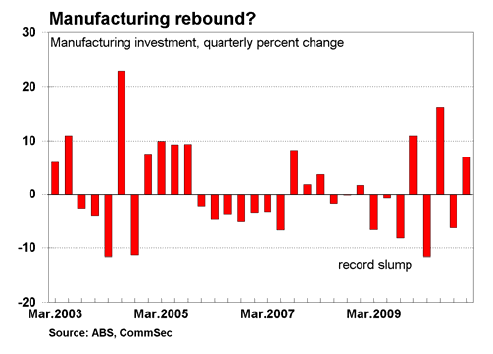
- New business investment rose by a less than expected 1.3 per cent in the December quarter. Manufacturing dominated investment plans with investment in the sector up by 7.0 per cent as opposed to mining investment which fell by 4.8 per cent in the December quarter.
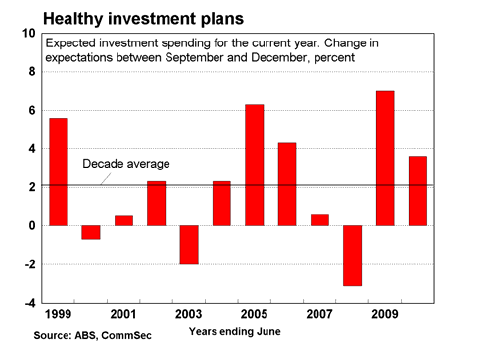
- Businesses expect to invest $128.9 billion in the 2010/11 year up 3.6 per cent on the fourth estimate from the September quarter and slightly above the usual (decade average) upgrade of 2.2 per cent made by firms at this time of the year. Investment plans are up 16.2 per cent on the equivalent estimate made a year ago.
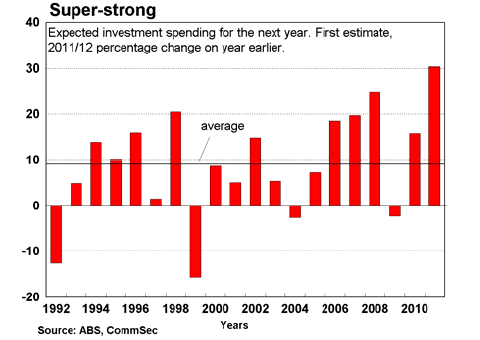
- The first estimate for business investment in 2011/12 is $132.7 billion, up 30.3 per cent on a year ago – marking the biggest percentage lift in first estimate investment plans on record.
- Average weekly earnings rose by 1.1 per cent in the three months to November after a small 0.6 per cent lift in the previous three months. Wages rose by 3.9 per cent over the year – in line with yesterday’s wage cost index, however the result marked the slowest annual growth in four years.
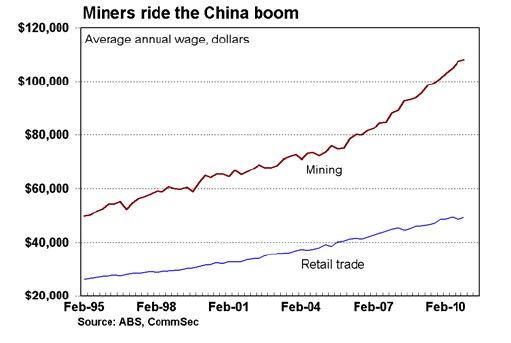
- Over the year male wages rose by 3.8 per cent while female wages rose by 4.5 per cent. The average wage stands at $66,264. The highest average wage can still be found in the mining sector, at $108,009 per year.
What does it all mean?
- The latest capital investment plans certainly paints a mixed picture of the domestic economic landscape. The sluggish 1.3 per cent lift in December quarter investment suggests that businesses remain cautious, investment plans are still not being committed to, and as such activity is likely to be subdued in the near term. However the longer term outlook is much more buoyant. In fact businesses expect to invest around $132 billion over 2011/12 – a record 30 per cent upgrade on the first estimate for 2010/11.
- Overall the results confirm the CommSec view that interest rates will lift in the second half of 2011 with the cash rate ending the year near 5.50 per cent. However it is likely that in the near term interest rates will remain on hold until there is confirmation that Corporate Australia will commit to the ramp up in future spending.
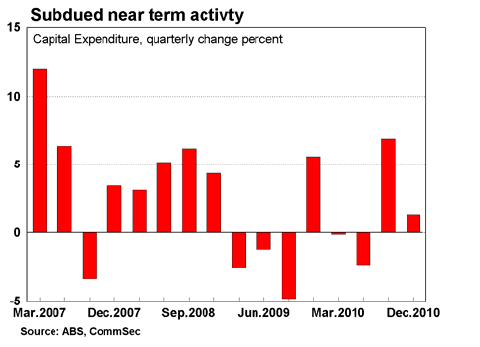
- The result is consistent with the Reserve Bank’s view that growth in the near term is likely to be subdued. No doubt the impact of the natural disasters will have a further detrimental impact on March quarter economic growth. Clearly the focus is the second half of the year and beyond. If the ramp up in investment plans does come to fruition, and given the rebuilding that will take place in flood damaged areas, further rate hikes will indeed be on the cards.
- There is a nice balance in the economy at present. Consumer spending is restrained while business spending is rising modestly. Inflation is under control, wage growth is benign. And according to the Reserve Bank, the job market is not overly tight at present. The Reserve Bank can stay on the interest rate sidelines for a few more months. It’s not nirvana but it is a Goldilocks scenario.
- Investment has been far from uniform, and in past quarters it has been the mining sector that has driven investment. However in the latest quarter investment spending has been largely dominated by the manufacturing sector – providing a degree of comfort given the sustained weakness in the sector.
- Over the coming year it is clear that Australia will be riding on the back of the mining sector. But the non-mining states are unlikely to feel the effects of the rise in incomes until the recovery is well and truly in full swing. No doubt as the recovery gains traction the mining states will be in the driver’s seat and continue to enjoy strong investment flows.
- It is important to highlight that while economic growth is expected to rebound in the second half of the year it is unlikely to be firing on all cylinders. Even the Reserve Bank believes that at present the labour market remains well supplied and that employment growth is likely to moderate to some degree. In fact the latest forecasts only have the unemployment rate dropping just half a per cent over the next two years. More importantly the lift in planned investment is encouraging for the economy as a whole, serving to boost productive capacity and therefore keep any potential inflationary pressures in check.
- According to the latest data average weekly earnings rose by almost 3.9 per cent over the year. Unfortunately this measure tends to be quite volatile and changes in the composition of the labour force – which was especially evident during the global financial crisis – can tend to skew the result. As such the best guide to wage pressures in the economy is the wage price index with the latest figures showing that wage growth is under control.
- The AWOTE data are also affected by compositional changes, such as the shift from full-time to part-time and movements across sectors. But the average weekly earnings data provides useful dollar estimates for wages.
- The latest data on wages highlights what the Reserve Bank has been stating for sometime – that the industrialisation of China and India will lead to major shifts in our economy. Wages in the mining sector are now more than double the earnings in food sectors like cafes and restaurants as well as across the retail sector. And the resources states of Western Australia, Northern Territory and Queensland are dominating in the pay stakes.
- The mining states have been major winners in the pay stakes over the past year, with Western Australia the undisputed leader. However coming up quickly is the Northern Territory. Wages in the ‘top end’ have been stunning, up 7.3 per cent over the past year – well ahead of its counterparts. The industrialisation of China, and in turn, India are paying dividends, and domestically the reallocation of resources in terms of labour to the mining states will only gain in traction over oming year.
What do the figures show?
- Business investment rose by 1.3 per cent after rising by 6.9 per cent in the December quarter. The September quarter result was revised up from the earlier-reported rise of 6.2 per cent. In annual terms investment was up 5.6 per cent on a year ago.
- Spending on buildings fell by 2.8 per cent in the quarter. Spending on equipment rose by 6.1 per cent after easing.
- Spending in the mining sector fell by 4.8 per cent in the December quarter, however investment rose by 7.0 per cent in the manufacturing sector and by 4.6 per cent in “other selected industries”.
- Investment fell in just one of the eight states and territories in the December quarter. The biggest increase was in ACT (up 56.7 per cent), Northern Territory (up 31.8 per cent), South Australia (up 26.6 per cent), Tasmania (up 24.8 per cent), NSW (up 3.0 per cent), Queensland (up 2.7 per cent), and Victoria (up 2.0 per cent). Spending fell only in Western Australia (down 4.9 per cent).
- The overall deflator for investment goods fell by 0.5 per cent in the December quarter after rising by 0.7 per cent in the September quarter. The price of buildings and structures rose by 0.6 per cent in the quarter while the cost of equipment fell by 1.5 per cent.
- Over the year, the cost of investment goods fell by 1.0 per cent. The cost of buildings rose by 2.5 per cent over the year, while the cost of investment equipment fell by 4.8 per cent over the year.
- The fifth estimate of investment for 2010/11 was $128.9 billion, up 3.6 per cent on the fourth estimate and slightly above the usual (average) upgrade in the quarter of 2.2 per cent. Compared with a year earlier, the fifth estimate of investment was up 16.2 per cent on a year ago.
- The first estimate of investment for 2011/12 was $132.7 billion, up 30.3 per cent on a year ago.
Average weekly earnings
- Average weekly earnings rose by 1.1 per cent in the three months to November after a small 0.6 per cent lift in the previous three months. Wages rose by 3.9 per cent over the year – in line with yesterday’s wage cost index.
- Private sector wages rose 1.3 per cent in the quarter and by just 3.5 per cent over the year. Public sector wages rose by 0.8 per cent in the quarter and by 5.1 per cent over the year. Male wages rose 1.3 per cent in the quarter and by 3.8 per cent over the year. Female wages rose by 1.1 per cent in the quarter and by 4.5 per cent over the year.
- Wages rose most over the year in Transport postal and warehousing (up 10.3 per cent), Electricity, gas, water & waste services (up 9.1 per cent), Financial & insurance services (up 8.8 per cent). Wages were weakest over the past year in Rental Hiring and Real Estate Services (down 2.6 per cent), followed by Administrative and support services (up 1.3 per cent), and Retail trade (up 1.4 per cent).
- Across states & territories, we have calculated average annual wages as follows: NSW $66,565 (up 2.7 per cent over the year), Victoria $64,620 (up 4.5 per cent), Queensland $65,619 (up 4.1 per cent), South Australia $60,414 (up 4.0 per cent), Western Australia $73,148 (up 5.4 per cent), Tasmania $57,808 (up 5.5 per cent), Northern Territory $65,900 (up 7.3 per cent) and ACT $76,367 (up 4.3 per cent).
- The highest average wage can still be found in the mining sector, at $107,510 per year. Next highest is scientific & technical services ($79,612), finance & insurance services ($78,933), and information media & telecommunications ($77,110). The lowest average wage is obtained by workers in the accommodation and food services sector ($47,518), followed by retail trade ($48,422) and “other services” ($53,352).
What is the importance of the economic data?
Private New Capital Expenditure and Expected Expenditure is released quarterly by the Bureau of Statistics. The figures show actual and expected spending by businesses on tangible assets such as new buildings, machinery and office equipment. The figures are obtained after sampling 8,000 private business units.
The data on actual spending is broken-down at a state and industry level and estimates are represented in nominal and price-adjusted (volume) terms. The data on expected spending contains a mix of short and longerterm estimates. The short-term estimates may focus on periods just three months ahead while the longer-term estimates may look as far as 18 months into the future.
What are the implications for interest rates and investors?
- Interest rates will continue to rise as the recovery gains traction. However business and consumers will need a few months to adjust to the current economic conditions. Spending and activity needs to be firmly entrenched before interest rates are raised once again.
Produced by Commonwealth Research based on information available at the time of publishing. We believe that the information in this report is correct and any opinions, conclusions or recommendations are reasonably held or made as at the time of its compilation, but no warranty is made as to accuracy, reliability or completeness. To the extent permitted by law, neither Commonwealth Bank of Australia ABN 48 123 123 124 nor any of its subsidiaries accept liability to any person for loss or damage arising from the use of this report.
The report has been prepared without taking account of the objectives, financial situation or needs of any particular individual. For this reason, any individual should, before acting on the information in this report, consider the appropriateness of the information, having regard to the individual’s objectives, financial situation and needs and, if necessary, seek appropriate professional advice. In the case of certain securities Commonwealth Bank of Australia is or may be the only market maker.
This report is approved and distributed in Australia by Commonwealth Securities Limited ABN 60 067 254 399 a wholly owned but not guaranteed subsidiary of Commonwealth Bank of Australia. This report is approved and distributed in the UK by Commonwealth Bank of Australia incorporated in Australia with limited liability. Registered in England No. BR250 and regulated in the UK by the Financial Services Authority (FSA). This report does not purport to be a complete statement or summary. For the purpose of the FSA rules, this report and related services are not intended for private customers and are not available to them.
Commonwealth Bank of Australia and its subsidiaries have effected or may effect transactions for their own account in any investments or related investments referred to in this report.
– Show quoted text –


