
Chinese inflation data
- Inflation prints below forecast. China’s annual inflation rate lifted modestly in January, from 4.6 per cent to 4.9 per cent, but was still below expectations centred on a result near 5.3 per cent.
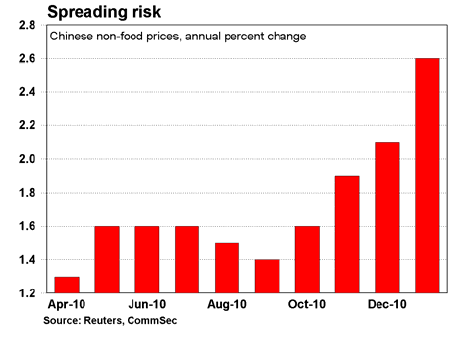
- Most prices higher. Most categories recorded higher inflation in January with food prices up 10.3 per cent on a year ago and non-food prices up 2.6 per cent.
- Business inflation (producer prices) remained high at 6.6 per cent in January.
What does it all mean?
- China’s inflation rate remained uncomfortably high in January, but at least it didn’t lift to the highs that economists were tipping. The other solace for investors is that a change in the weighting system for the consumer price index actually boosted inflation in the month, providing some added comfort about the result.
- But while the annual inflation rate printed below forecasts in January, it was still up a solid 1.0 per cent on the month. In addition producer prices also rose over the month and the year, keeping inflation prominently in the centre of the radar screen. Food, non-food and services inflation all rose at a faster rate in January.
- Last week, China’s central bank lifted interest rates for the second time in six weeks and it is clear from today’s data that further policy tightening can be expected.
- While higher food prices have been the major driver behind the lift in inflation, the central bank will need to lean against other price pressures to ensure that they don’t become locked in.
- China is Australia’s major trading partner and it is now very apparent that when China sneezes, Australia is at risk of catching pneumonia. Provided the Chinese authorities continue to pre-emptively tighten policy to keep inflation at bay, the risk of a boom-bust scenario will similarly recede. But China’s high inflation rate is a clear and present danger.


What do the figures show?
- The annual rate of consumer price inflation rose from 4.6 per cent to 4.9 per cent in January. But the January result was below the 28-month high of 5.1 per cent in November and below forecasts centered on a result near 5.3 per cent. During January consumer prices rose by 1.0 per cent.
- Food prices rose by 10.3 per cent over the year (9.6 per cent in December) while non-food prices rose by just 2.6 per cent (2.1 per cent in December). Services inflation jumped from 2.8 per cent to 4.6 per cent.
- Producer Prices (business inflation) rose by 0.9 per cent in January to stand 6.6 per cent higher than a year ago. The annual rate of producer price inflation was an eight-month high, up from 5.9 per cent in December and higher than economist forecasts of 6.1 per cent.
Data released earlier in the month showed:
- Chinese passenger car sales fell by 10.3 per cent in January to 965,238 vehicles as tax breaks ended and authorities tightened up on the issuance of license-plate registrations to ease congestion and pollution in cities. In the 2010 calendar year passenger vehicle sales rose by 33.2 per cent to 13.76 million vehicles were sold.
- China’s trade surplus fell to a nine-month low in January, shrinking from US$13.1 billion to US$6.461 billion and short of forecasts centred on a US$10.7 billion surplus. Exports were up 37.7 per cent on a year ago (consensus +22.4 per cent) and imports were up 51.0 per cent (consensus +28.0 per cent). The results may have been affected by the early timing of Chinese New Year compared with a year ago.
- Chinese residential property prices posted solid gains in January according to private surveys. The China Real Estate Index System reported a 0.95 per cent lift in prices in January while an index from SouFun Holidays similarly noted a 1.0 per cent lift in residential prices.
What is the importance of the economic data?
- China’s National Bureau of Statistics releases its monthly economic statistics around the middle of each month. Quarterly GDP data is released around the 16th of January, April, July and October. China is Australia’s largest trading partner and changes in the Chinese economic have major implications for the Aussie economy.
What are the implications for interest rates and investors?
- Inflation still remains uncomfortably high in China, meaning that further tightening measures will be required. Aussie investors will need to carefully monitor the situation. The risk is that authorities may need to apply more aggressive tightening – clearly negative for Australia’s resources sector.
- However if China did pick up the pace of monetary tightening, that could actually serve to keep Australia’s Reserve Bank on the policy sidelines for longer. Clearly a sharp slowdown of the Chinese economy would be negative for our economy.

Produced by Commonwealth Research based on information available at the time of publishing. We believe that the information in this report is correct and any opinions, conclusions or recommendations are reasonably held or made as at the time of its compilation, but no warranty is made as to accuracy, reliability or completeness. To the extent permitted by law, neither Commonwealth Bank of Australia ABN 48 123 123 124 nor any of its subsidiaries accept liability to any person for loss or damage arising from the use of this report.
The report has been prepared without taking account of the objectives, financial situation or needs of any particular individual. For this reason, any individual should, before acting on the information in this report, consider the appropriateness of the information, having regard to the individual’s objectives, financial situation and needs and, if necessary, seek appropriate professional advice. In the case of certain securities Commonwealth Bank of Australia is or may be the only market maker.
This report is approved and distributed in Australia by Commonwealth Securities Limited ABN 60 067 254 399 a wholly owned but not guaranteed subsidiary of Commonwealth Bank of Australia. This report is approved and distributed in the UK by Commonwealth Bank of Australia incorporated in Australia with limited liability. Registered in England No. BR250 and regulated in the UK by the Financial Services Authority (FSA). This report does not purport to be a complete statement or summary. For the purpose of the FSA rules, this report and related services are not intended for private customers and are not available to them.
Commonwealth Bank of Australia and its subsidiaries have effected or may effect transactions for their own account in any investments or related investments referred to in this report.


