
NAB Business Survey; PMI
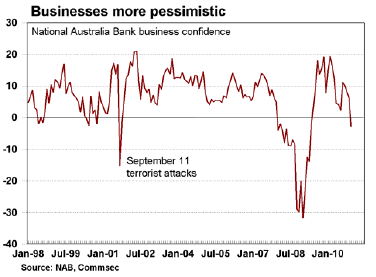
- The NAB business confidence index fell from +6.2 to -2.7 in December – the weakest reading in 20 months. The business conditions index rose from +3.7 in November to +5.8 in December. Excluding Queensland the confidence reading fell to +1.0, while conditions rose to +9.0.
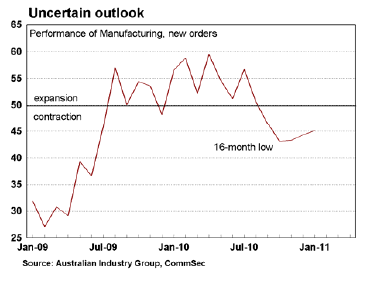
- Forward looking sub-indices remained decidedly weak despite modest improvements. Profits ticked marginally higher as did employment, however the pace of contraction in new orders increased.
- The Performance of Manufacturing index improved from 46.3 to 46.7 in January. Any reading above 50 means the manufacturing sector is expanding. Key sub-indexes were mostly weak with new orders, exports and employment still contracting.
What does it all mean?
- The latest NAB business survey highlights the inherent level of caution that is being shown by corporate Australia. Rapid fire rate hikes and the devastating floods have robbed businesses of much needed optimism. In fact business confidence has now fallen to the weakest levels in just shy of two years. It’s important to highlight that the survey was conducted from January 10-14, and as such the effect of the floods on the latest reading is likely to be more profound.
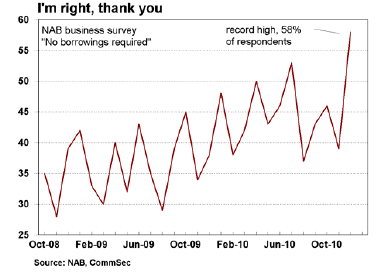
- Interestingly a record 58 per cent of businesses surveyed confirmed that they are not looking for additional finance at this time. The November rate hike is having a lasting impact given the additional increase in borrowing costs. Clearly until activity levels improve and growth picks up pace, businesses are likely to sit on the sidelines.
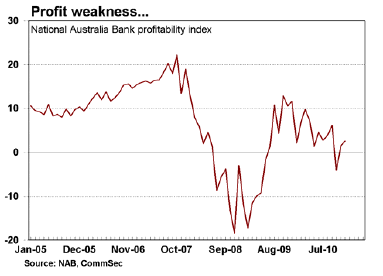
- More concerning is the added weakness in forward looking indicators. Business owners continue to trim future orders, while profitability is still relatively weak. Given that retailers are aggressively discounting, borrowing costs are rising, and the higher Aussie dollar is curbing manufacturing exports, it is likely that activity will remain subdued in the near term. The negative momentum is clearly worrying, meaning that the Reserve Bank could face an extended stay on the interest rate sidelines.
- It is not all bad news, business conditions have shown signs of improving, rising for the last couple of months – albeit it from a very low base. No doubt the fact that interest rates have been on hold for a couple of months has been helping sentiment. The rebuilding phase following the floods should also provide a degree of stimulus and improve business conditions.
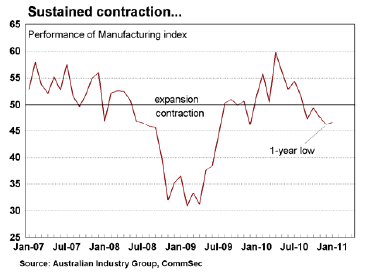
- The latest reading on the manufacturing sector highlights the lacklustre activity levels in the domestic economy. The manufacturing sector has now contracted for five consecutive months and is holding just shy of the one year low reached last month. In fact the key sub indices of new orders and exports put into perspective just how tough times are for the sector. New orders continue to contract while the higher Australian dollar is making exports less competitive on the global stage and keeping selling prices depressed – a concerning sign given the forward looking aspect of these indicators.
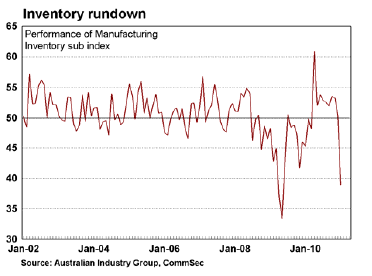
- Interestingly inventory levels have been run down to the lowest levels in 20 months. It may be that the reduction in production has been caused by the floods, resulting in businesses running down inventories. And it just might be what the manufacturing sector needs. An inventory rebuilding phase would need to take place, replenishing stockpiles and supporting activity in coming months.
What do the figures show?
National Australia Bank Business Survey:
- The National Australia Bank business confidence index fell from +6.2.to -2.7 in December – marking the weakest reading in 20 months.
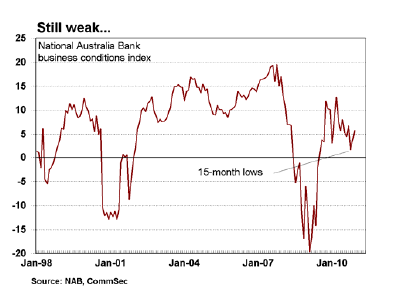
- The business conditions index rose for only the second time in ten months, rising from +3.7 to +5.8 in December.
- Excluding Queensland the confidence reading fell to +1.0, while conditions rose to +9.0.
- The index of trading conditions improved, up from +4.1 to +8.7; profitability recorded a marginal improvement from +1.6 to +2.6; employment rose from +4.4 to +5.1; and forward orders remained weak sliding from -2.0 to -2.6.
- The monthly reading of labour costs fell from 1.1 per cent to 0.8 per cent in December. NAB noted that annual growth of labour costs stands at 4.2 per cent.
- Inflationary pressures are well contained. Retail prices rose at a 0.4 per cent annual rate in December. Purchase costs jumped by a 0.5 per cent quarterly rate, however the annual rate of increase edged lower to 2.0 per cent.
- Capacity utilisation rose from 80.9 per cent to 82.3 per cent in December – above the decade average of 81.6 per cent.
Performance of Manufacturing Index
- The Performance of Manufacturing index rose modestly from 46.3 to 46.7 in January, marking the fifth straight month that the PMI has been below 50, indicating that the manufacturing sector is contracting.
- Key activity components of the PMI were mostly weaker in December. New Orders recorded a modest improvement (despite still contracting), while production moved back into expansion territory. Employment still contracted however at a more modest pace.
- The production sub index rose 3.7 points to 50.3; new orders rose by 0.8 points to 45.1; the employment index rose 4.9 points to 44.1; exports rose by 0.3 points to 48.9; the index of selling prices rose modestly from 48.2 to 50.7, while input prices rose by 7.5 points to 71.2 and wages eased marginally.
- In seasonally adjusted terms just three of the 12 sectors recorded a decline in activity in January.
What is the importance of the economic data?
- The monthly Performance of Manufacturing Index is the Australian equivalent of the US ISM manufacturing gauge. The PMI is one of the timeliest economic indicators released in Australia. The PMI is useful not just in showing how the manufacturing sector is performing but in providing some sense about where it is heading. The key ‘forward looking’ components are orders and employment.
What are the implications for interest rates and investors?
- Looking forward, business confidence and conditions should improve to a modest degree as long as the Reserve Bank remains on the interest rate sidelines.
- Given the sustained contraction in the manufacturing sector and weakness in other indicators such as housing activity and business confidence, the Reserve Bank would be hard pressed to justify a near term rate hike, especially considering the tame inflation environment.
arising from the use of this report.
The report has been prepared without taking account of the objectives, financial situation or needs of any particular individual. For this reason, any individual should, before acting on the information in this report, consider the appropriateness of the information, having regard to the individual’s objectives, financial situation and needs and, if necessary, seek appropriate professional advice. In the case of certain securities Commonwealth Bank of Australia is or may be the only market maker.
This report is approved and distributed in Australia by Commonwealth Securities Limited ABN 60 067 254 399 a wholly owned but not guaranteed subsidiary of Commonwealth Bank of Australia. This report is approved and distributed in the UK by Commonwealth Bank of Australia incorporated in Australia with limited liability. Registered in England No. BR250 and regulated in the UK by the Financial Services Authority (FSA). This report does not purport to be a complete statement or summary. For the purpose of the FSA rules, this report and related services are not intended for private customers and are not available to them.
Commonwealth Bank of Australia and its subsidiaries have effected or may effect transactions for their own account in any investments or related investments referred to in this report.


