
Lending finance; ABARE Crop Report; RBA Board minutes
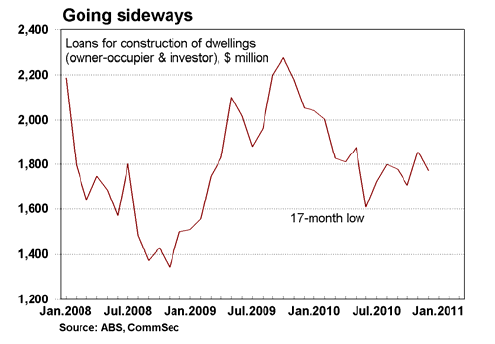
- Lending rose in December. Total lending finance rose for the fourth consecutive month up by 2.4 per cent in December. Lending totalled $54.9 billion in December, up 4.1 per cent over the year but up a much healthier 10.5 per cent in the past four months.
- The Government’s commodity forecaster has downgraded its crop forecasts. ABARES has revised lower its forecast for the 2010/11 winter crop by 2.5 per cent. The flooding on the east coast was the driver behind the modest downgrade.
- While the latest forecast has been downgraded, ABARES still tips a record wheat crop with production up 20 per cent on a year ago.
- RBA Board on interest rate sidelines. The decision to leave interest rates on hold in February was due to an array of factors. The floods are expected to slash growth in the near term, while the subdued consumer spending and the lower-than-expected inflation outcomes have provided Board members additional time to assess economic conditions.
What does it all mean?
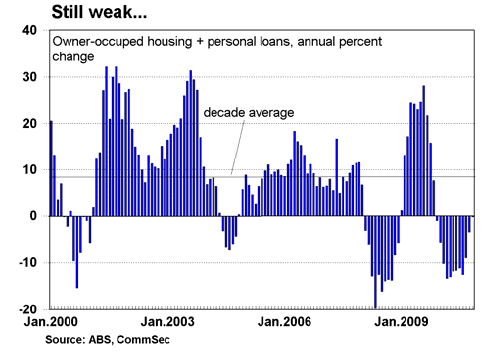
- Lending finance is effectively a forward looking indicator of economic activity – given that any rise in borrowings will eventually translate to a pickup in spending and activity. And while the conservative attitudes of consumers and businesses have kept borrowings weak, there are signs that things are thawing. Lending finance has risen for the fourth straight month with healthy growth of over 10 per cent in that period.
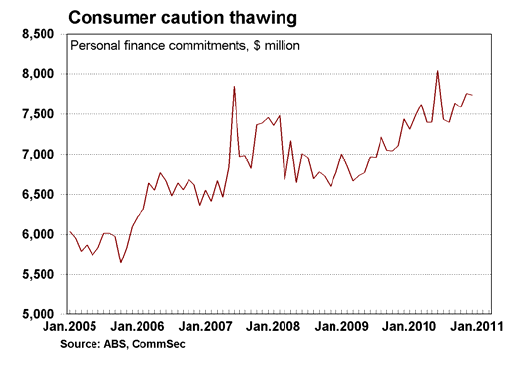
- No doubt a longer term historical view suggests that it is still early days. The pickup in activity is off a low base and in annual terms the growth rate is not looking overly flash at just 4.1 per cent. More importantly the weakness in consumer borrowings is still a major concern, especially given that consumer finance has fallen for four out of the last six months.
- The overall improvement in lending is only in its infancy, and given the November rate hike is yet to have a full impact on the economy, the argument for a period of interest rate stability remains the best outcome. CommSec would expects the Reserve Bank is likely to stay on the interest rate sidelines – especially given that inflation looks to be well contained at present.
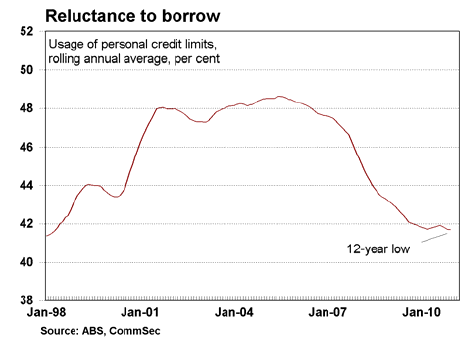
- The release of the latest Reserve Bank Board minutes have highlighted that the weakness in consumer activity was a key factor in rates remaining on hold in February. And as the Reserve Bank has noted on recent occasions the lack of consumer activity, is not all bad news ensuring that inflationary pressures are contained in the near term. Even the Governor admitted at his testimony to parliament that “it is a difficult environment for retailers. But not entirely unwelcome in the current circumstances” – given it would be harder to avoid the economy overheating if all sectors of the economy were firing.
- The minutes revealed that Board members were generally optimistic about the outlook, noting upward revisions to the near term outlook for Australia’s terms of trade and sustained improvement in labour market conditions. However given that interest rate were “mildly restrictive” – in other words tapping the breaks on the Australian economy – a rate pause seemed the most logical outcome. CommSec expects rates to remain on hold until mid year.
- Despite the devastating natural disasters, the Government’s chief commodity forecaster still believes that Australia will produce a record wheat crop this year. Overall ABARES has revised lower its forecast for 2010/11 winter crop production by a relative modest 2.5 per cent as the excessive rainfall flooding in the Eastern states were partially offset by an increase in the production estimate for Western Australia and South Australia.
- As always, conditions are far from uniform across the country but the outlook for the summer crop is also decidedly positive with cotton farmers to be amongst the key beneficiaries of abundant irrigation and higher prices. Overall there will be more money in the rural economy over the coming year, courtesy of the breaking of the drought – boosting the outlook for retail, manufacturing and services businesses in regional centres.
What do the figures show?
Lending Finance:
- Total new lending commitments (housing, personal, commercial and lease finance) rose by 2.4 per cent in December after rising 1.6 per cent in November. Lending totalled $54.9 billion in December, up 4.1 per cent over the year but up a much healthier 10.5 per cent in the past four months.
- All housing finance (owner occupier & commercial) rose by 2.5 per cent in December, the fourth straight monthly gain.
- Commercial finance rose by 3.3 per cent in December. Within commercial commitments, fixed lending rose by just 0.5 per cent but revolving credit surged by 9.7 per cent. Commercial loans are up 7.7 per cent on a year ago.
- Personal finance fell by 0.2 per cent in December – marking the fourth fall in the past six months. Within personal commitments, fixed lending fell by 0.4 per cent while revolving credit fell by 0.1 per cent. Personal loans are up 4.1 per cent on a year ago.
- Lease finance slumped by 8.7 per cent in December and loans are down 10.8 per cent over the year.
ABARES Crop Report:
- The Australian Government’s commodity forecaster, ABARES, has revised lower its forecast for 2010/11 winter crop production by 2.5 per cent to 42.1 million tonnes (Mt). The crop is now seen 19 per cent higher than 2009/10. ABARE highlighted that “Downgrades were applied to New South Wales, Victoria and Queensland, largely as a result of the widespread excessive rainfall and some flooding in late 2010 and early 2011. This
decrease has been partially offset by an increase in the production estimate for Western Australia and South Australia, where harvest results have been better than earlier expected.” - ABARES has also lifted its forecast for summer crop production by 66 per cent to 4.8Mt. Production of the summer crop in 2010/11 is expected to be the highest in nine years. Cotton production is tipped to soar by 117 per cent in 2010–11, to 839 000 tonnes, with reductions from floods in Queensland more than offset by higher production in New South Wales. ABARES notes that “High cotton prices and abundant supplies of irrigation water in most cotton growing regions” are the key driver of what will result in the largest Australian cotton harvest on record.
- ABARES expects that wheat production will hit a record high of 26.3Mt in 2010/11, up 20 per cent on the previous year. However the forecast is around 1.9 per cent lower than ABARES December forecast largely due to the extreme weather conditions on the east coast. Similarly Barley production is estimated to rise by 18 per cent to 9.3 million tonnes (5 per cent downgrade to December forecast) and canola production is estimated at 2.1 million tonnes (5 per cent upgrade on previous forecast) – 11 per cent higher than last year.
Minutes from the February 2011 Reserve Bank Board meeting
Consumer spending
- Members discussed developments in the household sector, where the restraint in spending was continuing despite solid growth in household income. Data on retail spending in October and November were soft and liaison suggested that this had continued for most of December.
Business conditions
- Another large LNG project in Queensland had received final investment approval in January and conditions in the resources sector remained positive. More broadly, overall business conditions in late 2010 were at around average levels, though there were significant differences across sectors. Non-residential construction remained weak. Business credit outstanding continued to contract, although other forms of external financing were growing.
Employment
- The labour market remained strong, with employment increasing by nearly 60,000 over November and December, and the unemployment rate falling to 5 per cent. Employment was estimated to have grown by 3.3 per cent over 2010. Forward-looking indicators of labour demand, including job vacancies and hiring intentions, continued to point to solid employment growth and some further tightening in labour market conditions.
The decision
- Given the medium-term outlook for the economy, and the limited amount of spare capacity that existed, members judged that this slightly restrictive policy stance remained appropriate. The continuation of subdued growth in consumer spending and the lower-than-expected inflation outcomes provided additional time for the Board to assess at future meetings the evolving balance of risks to both output and inflation.
What is the importance of the economic data?
- Lending Finance is released monthly by the Bureau of Statistics and contains figures on new housing, personal, commercial and lease finance commitments. The importance of the data lies in what it reveals about the appropriateness of interest rate settings, confidence and spending levels in the economy.
- ABARE releases its Crop Report four times a year. The report contains the latest estimates of crop conditions, yields as well as expected exports. The information is useful in gauging the health of the rural sector.
- The Reserve Bank releases minutes of its monthly Board meeting a fortnight after the event. The minutes give a guide to Reserve Bank thinking on interest rate settings.
What are the implications for interest rates and investors?
- Overall the latest minutes provide the Reserve Bank a degree of flexibility on the interest rate front. And while the near term domestic data looks patchy the Reserve Bank remains confident about the outlook. CommSec believes that interest rates are unlikely to be raised until May.
- Our CBA equity analysts indicate that GrainCorp is likely to benefit from the higher grain prices and volumes “East coast grain volumes are the far more important to GNC than rising grain prices, but higher global grain prices will continue to support east coast grain exports over the next 12-18 months. Farmers usually respond to high grain prices and GNC will also likely benefit from a 3-5% increase in crop planted area on the east coast for FY12 (planting in May-June).” Our analysts still have recommended a hold rating for Grain Corp.
- Of other stocks in the sector the analysts note: “Ridley Corporation (RIC) remains our preferred exposure in Food & Agribusiness sector and is set to benefit from strong protein demand as a result of herd rebuilding, and ample feed grain supply over the next two years. Strong rainfall / flooding over the past few months – while has negatively impacted both 1H11 and 2H11 overall – is a significant medium-term positive for all stockfeed demand (incl. supplementary feed). The FY12-13 outlook is strong for both AgriProducts and Salt divisions.”
Produced by Commonwealth Research based on information available at the time of publishing. We believe that the information in this report is correct and any opinions, conclusions or recommendations are reasonably held or made as at the time of its compilation, but no warranty is made as to accuracy, reliability or completeness. To the extent permitted by law, neither Commonwealth Bank of Australia ABN 48 123 123 124 nor any of its subsidiaries accept liability to any person for loss or damage arising from the use of this report.
The report has been prepared without taking account of the objectives, financial situation or needs of any particular individual. For this reason, any individual should, before acting on the information in this report, consider the appropriateness of the information, having regard to the individual’s objectives, financial situation and needs and, if necessary, seek appropriate professional advice. In the case of certain securities Commonwealth Bank of Australia is or may be the only market maker.
This report is approved and distributed in Australia by Commonwealth Securities Limited ABN 60 067 254 399 a wholly owned but not guaranteed subsidiary of Commonwealth Bank of Australia. This report is approved and distributed in the UK by Commonwealth Bank of Australia incorporated in Australia with limited liability. Registered in England No. BR250 and regulated in the UK by the Financial Services Authority (FSA). This report does not purport to be a complete statement or summary. For the purpose of the FSA rules, this report and related services are not intended for private customers and are not available to them.
Commonwealth Bank of Australia and its subsidiaries have effected or may effect transactions for their own account in any investments or related investments referred to in this report.


