
The Second Liberty Bond Act of 1917 placed a limit on the amount of public debt that the US Government can have outstanding. This Statutory Debt Limit, or debt ceiling, prevents new debt being issued once the limit has been reached. However, the debt limit can be, and has often been, raised with approval from the US Congress. Obtaining that approval is, at times, a more tortuous process than at others; this is one of those times.
x
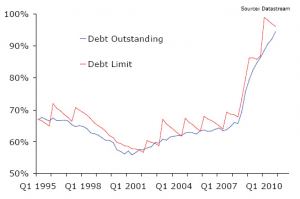
During the 2009 financial crisis, Congress raised the debt ceiling to $12.4trn, an increase of $290bn and then, in February last year, the statutory ceiling was lifted by $1.9trn to $14.3trn. This was the single greatest increase in allowable debt outstanding both in absolute terms but also as a percentage of the economy (see Figure 1). Figure 1 also portrays a public sector balance sheet soaring out of control. Current projections suggest that the US will hit the debt ceiling no later than May 16 2011.
x
x
Figure 1: US Debt limit and debt outstanding as % of Nominal GDP
x
x
As total outstanding debt approaches 100% of GDP, investors naturally become concerned. Although outstanding Japanese government debt is nearly twice GDP, Japan is hardly a solid role model.
x
Negotiations are ongoing to resolve the impasse over the federal government budget for the current fiscal year, but the chances of a government shutdown have risen. To operate normally, federal agencies etc need funding from either a full-year or interim funding measure. The current continuing resolution, funding the government, expires today.
x
Preparations for an actual government shutdown, akin to that which occurred in 1995, are taking place in earnest. ‘Officialdom’ has started to identify those employees who will be placed in a temporary non-duty, non-pay status – and which employees will continue to work. Capital constraints, it seems, are not just a peripheral European phenomenon.
x
As the government nears the debt ceiling, the US Treasury does have authority to take extraordinary measures to postpone the date on which the United States would default on its obligations. These measures offer nothing more than a (short) stay of execution; they cannot be an answer in themselves. The operative word here is ‘default’.
x
Ex ante, the question of the US entering into a default situation is a matter of judgement and inevitably involves a debate surrounding long-term gain versus Short-term pain. It is inconceivable that US politicians will conclude that actual non-payment of liabilities is in the nation’s long-term interest and so – inevitably and at the ‘eleventh hour’ – a compromise in the political haggling will be found. [Note that ‘those that be’ have concluded that we can’t afford any of the little PIIGS to default and so a US default is likely to be judged as having unimaginable consequences]. However to focus on the prospect of actual default is to miss the point – there are other ways to default.
x
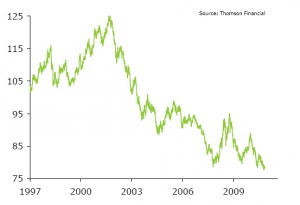
To your domestic creditors the best means of lessening your debt burden is by generating inflation. If you can safely engineer a lower currency then, in isolation, you lessen the value of your obligations to external creditors. We know that the Federal Reserve is currently actively pursuing a higher run rate for US inflation and, as Figure 2 highlights, the US dollar is weakening and no one – in the US at least – seems to be greatly bothered. While inflation remains benign, pursuit – by design or neglect – of a soft dollar is both safe and expedient. That will not always be the case.
x
Figure 2: US$ Trade weighted index
x
US politicians will doubtless agree a package to take forward the working of government. There may need to be a period of shutdown before this happens and is probably for the good. Last year, the Administration was expected to introduce UK-style policies for fiscal recovery, in the end they cut taxes; short-term gain, long-term pain.
x
The current difficulties should ensure that they don’t similarly renege this time around. If not, then a sharp slump in the US dollar is likely in 2012. Default will be avoided but the cheques may not be worth much more than the paper on which they are written.
x
Important Notice – The Asset Allocation Service (AAS) This document relates to the AAS provided by AEGON Asset Management UK plc (AAM). The AAS is subject to the terms of an investment management agreement between AAM and a pension fund selecting the AAS and subject to such disclaimers, notices, warnings or separate agreements, including those set out below, as AAM may communicate to you or agree with you.THE CONTENT OF THIS DOCUMENT IS DESIGNED FOR THE PROFESSIONAL PENSION FUND MARKET. IF YOU ARE NOT AN INVESTMENT PROFESSIONAL OR A PERSON PROFESSIONALLY INVOLVED IN OR HAVING RESPONSIBILITIES RELATING TO PENSION FUND MANAGEMENT YOU SHOULD NOT ACT UPON IT. This document is directed only at persons having professional experience in matters relating to investments falling within article 19 of the Financial Services and Markets Act 2000 (Financial Promotion) Order 2005 and high value entities or trusts falling within article 49 of that Order. Consequently, AAM has not approved the content of this document for the purposes of section 21 of the Financial Services and Markets Act 2000. No other person should act upon this document or any information contained in it. AAM has procedures in place to ensure that no instrument or investment activity referred to in this document is available to any other person. The content of this document has been prepared solely for information purposes. Any statements, forecasts, past performance data, estimates or projections included in the document are for illustrative purposes only and may be provided by AAM or third parties. Any view, opinions or statements made in or in relation to this document should not be interpreted as recommendations or advice. Past performance is not a guide to future performance. The value of investments and the income from them may fall as well as rise and there is no guarantee that the AAS will achieve the objectives described in this document. No investment advice or tax advice is being given in this document. Nothing in this document should be regarded as an offer to provide investment services or products or as a comment on the merits of engaging in any investment transaction or activity or an inducement to do so. The content of this document is subject to change and correction without notice. AAM does not represent that (i) the content of this document; (ii) any investments or investment services referred to in this document; or (iii) any oral or written statements provided by or made by AAM or persons connected with it are suitable for or relevant to you. AEGON Asset Management UK plc provides segregated and retail funds and is the Authorised Corporate Director of AEGON ICVC, an Open Ended Investment Company. AEGON Asset Management UK plc is authorised and regulated by the Financial Services Authority, (FSA reference no: 144267). AEGON Investment Management UK ltd provides investment management services to AEGON, which provides pooled funds life and pension contracts. AEGON Investment Management UK ltd is an appointed representative of Scottish Equitable plc, an AEGON company, whose Registered office is 1 Lochside Crescent, Edinburgh Park, Edinburgh, EH12 9SE (FSA reference no: 165548).


