Risk assets have absorbed an awful lot of bad news over the past month and their resilience can be ascribed partly to the attractive valuations that have long underpinned our positive view. A number of factors have changed since last month’s update, but arguably the most significant for economies and markets are the geopolitical premium in the oil price and the impact of the Japanese earthquake on short- and long-term activity. We spent some time considering the implications of these changes for our economic forecasts and ultimately made few changes to our 2011 numbers. Indeed, the only adjustments were to cut our Japanese growth forecast from 1.5% to 0.9%, reflecting short-term plant closures and supply chain interruptions, and to increase our inflation estimates to 0% for Japan and 3.25% for the UK.
x
We have also pencilled in some forecasts for 2012 and, in most cases, we anticipate similar levels of growth and inflation next year to this, with interest rates only modestly higher as Western central banks seek to balance inflationary pressures with fragile growth. Japan is the exception, as here we expect the short-term disruption to production over the next few months to be made up in 2012. With reconstruction efforts also likely to support activity, we are forecasting 2.5-3.0% growth in Japan next year.
x
The end of the second phase of quantitative easing in the US is approaching and we believe that the Fed will allow this important stimulus measure to expire without replacement. The impact on markets is hard to discern, but a key risk is that the removal of a major price-insensitive buyer of Western government bonds could drive yields meaningfully higher. The knock-on effect of such a move on the cost of capital could damage the bull case for equities but, at present, we believe that the power of attractive valuations outweighs this risk. As such, we remain overweight equities versus bonds and, within fixed income, we continue to favour higher-yielding areas. Although corporate and emerging market yields have fallen a long way over the past two years, the fundamental backdrop for these issuers remains positive and spreads still offer a degree of insulation against any setback in government bonds.
x
Within equities we note that the market cycle is maturing. As a result, we continue to take selective profits in early cycle areas that have performed strongly and now look fully valued. Proceeds are being carefully recycled into later cycle stocks, or companies that offer a healthy mix of early and late cycle businesses. We made two changes to our global sector model this month, moving autos to overweight as a result of attractive valuations and ongoing strong emerging market demand for premium brands, and reducing technology hardware to neutral on the back of lacklustre consumption and rising input prices.
x
Meanwhile, our expectations of a modest, income-driven return from commercial property over the coming year support a neutral positioning in real estate.
x
Looking ahead, the market faces more headwinds now than it did a month ago, but on balance we believe that valuations of risk assets remain attractive. The economic backdrop described by our forecasts should allow companies to generate healthy cash flows and this cash is likely to be used in a range of shareholder-friendly ways. The resilience of equities in recent weeks gives us confidence in the scope for good medium-term returns.
x
x
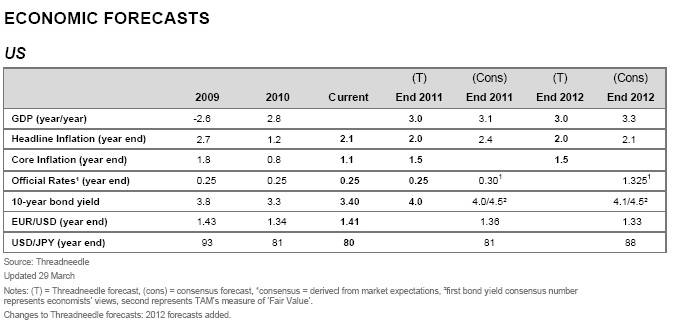
Fed members signal little chance of QE3
Oil is 8% higher than a month ago. The Libyan situation still rages, and there are plenty of other pockets of unrest bubbling away to keep energy prices firm. Growth forecasts for 2011 are being reduced accordingly, so consensus moves gently towards our call. Whilst the jump in gasoline prices has caused an immediate hit to consumer confidence, spending has not yet suffered. Although a $1 rise in gasoline is estimated to be a $40 hit per month to the average driver’s disposable income, clearly it is the low income sector that feels the pain.
x
The manufacturing sector continues to punch above its weight, as the demand for Western products from Asian economies continues. There is anecdotal evidence to suggest that the price of goods coming into the US from these very same countries has stopped falling, and is now rising. The big test will be to see whether retailers have any pricing power on Main Street.
x
Core inflation has bottomed, and rising input costs at the production level and the higher price of imported goods would imply that the fear of deflation has passed. That is not to say that we are on the cusp of a hyper-inflation period, but it won’t take much to have core CPI back around 1.5% (currently 1.1%). Fed members are watching, and recent rhetoric strongly suggests that QE3 seems an unlikely path. Clearly the behaviour of financial markets (namely stocks) is all important to Bernanke, as the end of QE2 nears and policy reversal becomes the theme of conversation. Improved transparency in the form of press briefings following every other FOMC meeting will be an opportunity for the Chairman to steer or calm market participants.
Our first stab at 2012 growth is the same as 2011 at 3%. Growth should see some uplift from the creation of private jobs over the remainder of this year, but is likely to feel the headwinds of less monetary and fiscal stimulus.
x
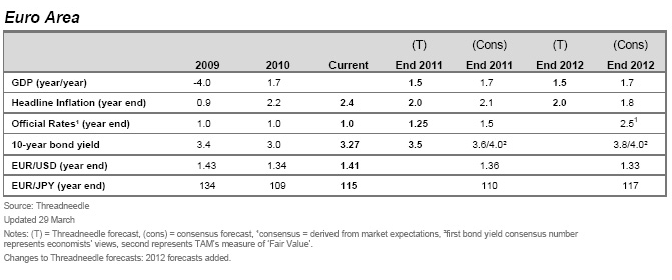
Tighter policy perhaps, but not a trend
The economic expansion is well established in the core, and the German economy, in particular, continues to benefit from stimulative monetary conditions, a weak exchange rate and robust growth in the developing economies. Although the ECB is expected to live up to its promise and tighten monetary policy in the near future, we are reluctant to forecast a prolonged tightening cycle and, as such, feel that current market pricing overstates ECB tightening risks.
x
The situation in the peripheral economies, including Spain, remains very fragile and the economies of Ireland, Portugal and Greece will contribute nothing to growth in the region in the coming years. However, the dominance of the core and the momentum in these economies suggest that a GDP print of about 1.5% is likely for 2012. In the short term, we believe that inflation will run slightly ahead of the 2% target but in the medium term the target should be achieved. The economic performance of Spain and the associated stresses in the banking system in the coming quarters remain a key risk to the financial sector and the region as a whole.x
x
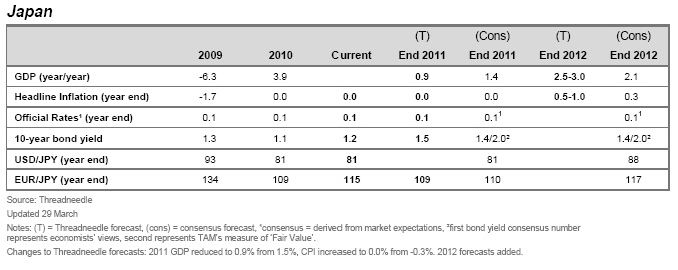
The shocking natural disaster leaves us unable to forecast with any certainty
At this stage, following such a catastrophic natural disaster, it is impossible to forecast growth and inflation for 2012, let alone this year. Clearly there will be a large, immediate hit to GDP in H1 (estimate -0.5%) but this will be followed by the rebuild. If history is a guide, this will add strongly to growth over the following 12-18 months. It is likely to bring about the first string of positive CPI prints since early 2009.
x
The rebuild will be costly – as high as $300bn at the more extreme end of estimates. The debt-ridden government must find alternative ways of paying, other than the obvious move to print money. A VAT increase of 2% seems likely, the cancellation of the reduction in corporation tax a given, and a rumoured 10% income surtax over 3 to 5 years a possibility.
x
If our upper end of forecasts for GDP and CPI are anywhere close to reality in 2012, then the previously anchored JGB yield curve may look to break higher. If the move in yields is large, the government may find its debt servicing costs becoming untenable. But that is for another day.
x
 x
x
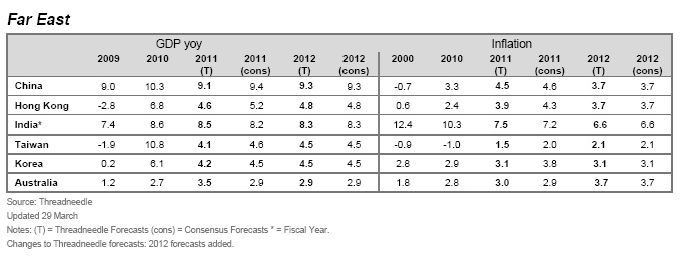
Inflation still high
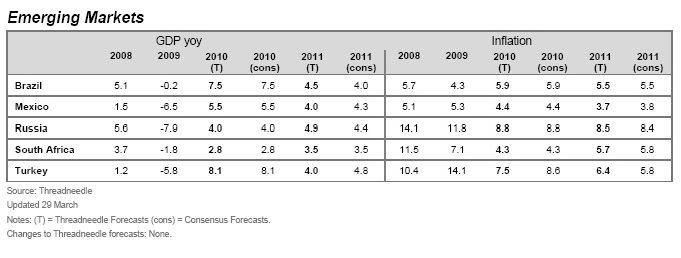
We remain concerned about recent inflationary developments in China and India. Indeed, it is striking to note that consensus estimates for 2011 inflation in China have increased from 3% three months ago to 4.5% now. Higher food prices, which can account for as much as 60% of some consumer price indices in the region, are increasingly being validated by high levels of wage growth. Oil above $100 is also a real problem for India, and the unrest in areas of North Africa and the Middle East is likely to keep oil elevated.
x
The five-year plan delivered by the Chinese government acknowledged the need to rebalance the expansion away from exports and more towards domestic consumption. To do this, they accept that more has to be done for the poorer community, so a vast investment in affordable housing will drive residential investment over the coming years. Further investment in education and healthcare will continue the path of recent years. Incomes need to rise to combat the rising costs of food, while at the same time companies need to look to productivity gains to keep their competitive edge in the global marketplace.
x
Inflation on the rise
Higher energy prices are good for most of Latin America and Russia as these countries are predominantly net exporters. In Europe (apart from Russia and Kazakhstan), countries are net importers of oil. Turkey, Romania, Hungary and Bulgaria, among others, would be negatively impacted. Note that some countries (e.g. Turkey) are already running a significant current account deficit, which will be aggravated by high oil prices and will have an impact on macroeconomic fundamentals.
x
In Asia, the situation is similar to Europe. Indonesia and Malaysia are beneficiaries while most Asian countries are net importers of oil. Nevertheless, a significant portion of EM countries are normalising rates, with some even accelerating the pace of tightening (Chile, Israel). The normalisation will be important to counteract the recent surge in food prices and oil.
x

*All funds managed by Threadneedle, including segregated accounts/portfolios but excluding Managed Funds. The data does not include funds sub-advised by third parties or guest funds on a Threadneedle platform. All figures are as at 31 Dec 2010, in GBP. Total value of funds outperforming their relevant benchmark expressed as a percentage of total assets under management. Past performance is not a guide to future performance. Where fund performance is relative to the Peer Group Median (source: Morningstar), performance of funds is calculated using official prices with income reinvested, and is net of assumed fees and expenses but does not include any initial charges. Where fund performance is relative to an index, performance is gross of total expenses and uses global close authorised valuations based on in-house calculated transactions with cash flow at start of day. Index returns assume reinvestment of dividends and capital gains and unlike fund returns do not reflect fees or expenses. The index is unmanaged and cannot be invested in directly. This information aims to demonstrate the overall performance capabilities of Threadneedle’s asset management team. It is not intended to indicate the performance of individual funds or products. Please refer to product specific documentation in relation to individual funds. Issued by Threadneedle Asset Management Limited. Registered in England and Wales, No. 573204, 60 St Mary Axe, London EC3A 8JQ. Authorised and regulated in the UK by the Financial Services Authority. Threadneedle is a brand name, and both the Threadneedle name and logo are trademarks or registered trademarks of the Threadneedle group of companies. The research and analysis included in this document has been produced by Threadneedle for its own investment management activities, may have been acted upon prior to publication and is made available here incidentally. Any opinions expressed are made as at the date of publication but are subject to change without notice.


