
TD Securities monthly inflation gauge; Job Ads; Weekly petrol price
- Job market slows. The ANZ job advertisement index slumped by 6.5 per cent in May with internet jobs down 6.6 per cent and newspaper job ads down 2.7 per cent. It was the second monthly drop in job ads –the first back-to-back declines in almost two years (since July 2009).
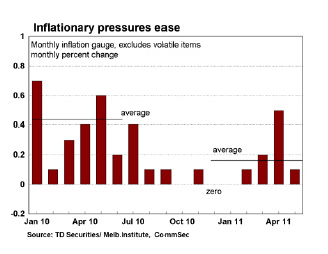
- Inflationary pressures ease. The TD Securities-Melbourne Institute monthly inflation gauge rose by 0.2 percent in May after a 0.3 per cent rise in April. The annual rate fell from 3.6 per cent to 3.3 per cent. The trimmed mean (underlying rate) was flat in May to stand just 2.4 per cent (within the Reserve Bank’s 2-3per cent target band).
- Excluding volatile items, the annual inflation rate was just 1.7 per cent – the lowest result in around five years.
What does it all mean?
- There is no smoking gun, so interest rates are almost certain to remain on hold for another month. Not only has the latest data shown an easing of inflationary pressures but hiring intentions have slumped as businesses join consumers in adopting a conservative posture.
- The timeliest reading on inflation in the economy – the TD Securities/Melbourne Institute inflation gauge –confirms that underlying inflation remains stuck in the lower end of the Reserve Bank’s 2-3 per cent target band. In fact, based on trends over the past five months, underlying inflation is tracking closer to 1.5 per cent – well below the RBAs target band.
- The slump in job advertisements is a clear wake up call for those that still believe the economy is in solid shape. Consumers aren’t spending, the housing market is becalmed and now businesses aren’t taking on more staff.
- Could the next move in interest rates be down, rather than up? Clearly the Reserve Bank Board would need to make an almost 180 degree turn, so it most likely will stick to the view that the economy will recover later this year. However it is obvious that the economy is only marking time at present with underlying inflation holding below the key 2-3 per cent target band. We expect the Reserve Bank to remain on the sidelines until it has a clearer read on the economy.

What do the figures show?
Inflation gauge:
- The monthly inflation gauge rose by 0.2 per cent in May after a 0.3 per cent increase in April. The annual rate of inflation eased from 3.6 per cent to 3.3 per cent.
- The underlying rate (trimmed mean) was flat in May after a 0.2 per cent increase in April. The annual rate stands at 2.4 per cent, but it has tracked at a 1.4 per cent annual rate over the past five months.
- Excluding volatile items like petrol and fruit & vegetables, the inflation gauge rose by 0.1 per cent in May with the annual rate falling from 2.2 per cent to 1.7 per cent.
- TD Securities noted that “Contributing most to the overall change in May were price rises for fruit and vegetables, rents, and books, newspapers and magazines. These were offset by falls in holiday travel and accommodation,alcohol and tobacco, and household appliances, utensils and tools. In the month, the price of fruit and vegetables rose by 3.0 per cent; the price of rents rose by 1.5 per cent; and fuel rose by 0.5 per cent.”
Job advertisements:
- The combined number of internet and newspaper job advertisements, as tracked by ANZ, slumped by 6.5 percent in May. It was the second monthly fall in job ads – the 1.0 per cent lift in April job ads was revised to show afall of 0.4 per cent. Newspaper job ads fell by 2.7 per cent with internet job ads down by 6.6 per cent. Job advertisements are still up 8.3 per cent on a year ago.
What is the importance of the economic data?
- The TD Securities/Melbourne Institute Monthly Inflation Gauge is designed to “provide a timely and accurate monthly measure of inflation in Australia”. The Bureau of Statistics only releases the Consumer Price Index on aquarterly basis.
- The monthly Job Advertisements release is a leading employment indicator. Employers only seek additional staff if business activity is strong, and more importantly, if they expect that conditions will remain favourable incoming months. It takes around 5-6 months for the new staff to be added to the payrolls. But a fall in job advertisements would have a more immediate impact on monthly employment estimates.
What are the implications for interest rates and investors?
- It is clear that the headline rate of inflation peaked three months ago, with fruit and vegetable prices boosted in response to floods and Cyclone Yasi. So the headline inflation rate is coming down and adding further downward pressure on the underlying rate. As long as the new mood of conservatism continues with Aussie consumers then businesses will continue to discount prices to move stock, keeping inflation low.
- For retailers, the bad news is that there are few signs that consumers are set to ditch their conservative ways. But the good news is that rates are poised to remain on hold for yet another month, giving consumer sentiment levels a boost.
- If consumers don’t spend, then businesses have to trim margins and profits, and finally this trend is hitting the jobmarket. The last card has fallen into place with the job market slowing. If current trends continue, the Reserve Bank may be set for an extended stay on the interest rate sidelines.
x
Produced by Commonwealth Research based on information available at the time of publishing. We believe that the information in this report is correct and any opinions,conclusions or recommendations are reasonably held or made as at the time of its compilation, but no warranty is made as to accuracy, reliability or completeness. To the extent permitted by law, neither Commonwealth Bank of Australia ABN 48 123 123 124 nor any of its subsidiaries accept liability to any person for loss or damage arising from the use of this report. The report has been prepared without taking account of the objectives, financial situation or needs of any particular individual. For this reason, any individual should, before acting on the information in this report, consider the appropriateness of the information, having regard to the individual’s objectives, financial situation and needs and, if necessary, seek appropriate professional advice. In the case of certain securities Commonwealth Bank of Australia is or may be the only market maker.This report is approved and distributed in Australia by Commonwealth Securities Limited ABN 60 067 254 399 a wholly owned but not guaranteed subsidiary of Commonwealth Bank of Australia. This report is approved and distributed in the UK by Commonwealth Bank of Australia incorporated in Australia with limited liability. Registered in England No. BR250 and regulated in the UK by the Financial Services Authority (FSA). This report does not purport to be a complete statement or summary. For the purpose of the FSA rules, this report and related services are not intended for private customers and are not available to them. Commonwealth Bank of Australia and its subsidiaries have effected or may effect transactions for their own account in any investments or related investments referred to in this report.


