
Asia & emerging countries vulnerability to European debt crisis
The European debt crisis is still far from resolved and while we see growth in the US avoiding a return to recession, the risk is significant.
With fears Europe and the US are on the brink of a return to recession and the European debt crisis still out of control and threatening to trigger a re-run of the 2008-09 GFC it’s natural to wonder how the emerging world, particularly Asia, would fare in the event of another recession in advanced countries. This is particularly important because the emerging world is now more than 50% of world economic activity. It’s also critically important for Australia given our key export markets in Asia.
Lessons from 2008-09
During first half 2008 there was much talk that the emerging world could decouple from the deteriorating economic environment in advanced countries. This helped push commodity prices to record highs into mid-2008. Ultimately the blow to confidence and trade following Lehman’s demise saw the emerging world pulled into recession along with advanced countries, commodity prices fall 60% and emerging market shares fall more than advanced country shares through the associated bear market (with a 59% fall in emerging market shares and a 61% fall for Asian, ex Japan, shares versus 56% for developed market shares). So those looking for decoupling were disappointed.
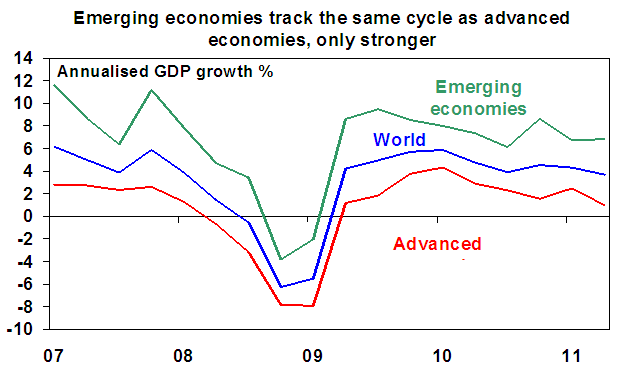
Or were they? While there is no doubt those who thought the emerging world could just sail on through despite the problems in advanced countries were wrong, emerging countries did do much better than advanced countries through the downturn and in the subsequent recovery. And their share markets rebounded by much more – up 118% from their GFC low to this year’s highs versus a gain of 82% in developed country global shares. The key lesson seems to be that emerging countries remain coupled to the global economic cycle, but can continue to outperform over time.
Similarities to 2008
There are a number of similarities to the situation in 2007-08 before the GFC for the emerging world. Now like then emerging countries have been battling an inflation problem, which in large part reflects higher food prices but also a rise in underlying inflation. This has resulted in rising interest rates and, as was occurring before the GFC, a slowing in growth, with leading indicators suggesting a further slowdown ahead.
What’s more, budget deficits are worse than was the case in 2007, suggesting less scope to respond with stimulus. In 2007 emerging countries had a budget surplus equal to 0.1% of GDP on average, whereas now they have a budget deficit equal to around 2% of GDP on average. This is highlighted by the problems Chinese local governments now face with much higher debt following their participation in the Chinese stimulus programs of 2008-09.
And emerging countries don’t appear to have significantly reduced their export exposure to developed countries since the GFC. So far, so bad. This all suggests that if advanced countries slide into a recession, the emerging world is vulnerable.
But it’s not that simple – the emerging world is in much better shape
However, a number of considerations are different this time around, or at least suggest the emerging world will continue to perform much better than advanced countries.
First, emerging countries are structurally sounder. Budget deficits of around 2% of GDP in emerging countries compare to average budget deficits of around 8% of GDP in developed countries. Public debt levels are low at around 35% of GDP on average, compared to around 100% of GDP in developed countries. Households are not under pressure to reduce debt in the emerging world. While the scope to provide further fiscal stimulus is reduced compared to 2008-09, it is nevertheless much stronger than is the case in developed countries. This also applies to China – while its higher level of public debt today (gross public debt is around 50% of GDP) means it is more constrained than in 2008, it still has scope to provide fiscal stimulus if need be as its public debt is low by global standards and in any case it would simply be borrowing from itself. (China is the world’s biggest creditor nation & its net public debt is zero.)
Second, just as inflation subsided in Asia and other emerging countries in 2008, clearing the way for monetary easing, the same is likely to occur this time around as weaker economic activity takes the pressure off food and oil prices and underlying inflation. Once inflation starts to fade in response to slower growth, monetary policy is likely to swing from tightening to easing. Brazil seems to have led on this front, but China and India are likely to follow suit in the next 6-9 months.
Third, the transmission to emerging countries of the 2008-09 recession was made worse by the GFC which resulted in a drying up of trade finance. While the risks of a GFC re-run emerging out of Europe is high, right now we are a long way from a drying up in trade finance.
Fourth, leverage and credit growth was rising in the run up to the GFC in Asia and other emerging countries. Over the last year credit cycles have been much more subdued.
Fourth, leverage and credit growth was rising in the run up to the GFC in Asia and other emerging countries. Over the last year credit cycles have been much more subdued.
Finally, Asian and emerging markets shares are trading at similar valuations to global shares compared to a premium in 2007. This all suggests that if the advanced economies roll over again, Asia and other emerging countries are vulnerable. But if a dry up in trade finance is avoided then the economic fall out is likely to be far milder than 2008-09. Either way, Asia and other emerging countries are likely to come through in better shape than advanced countries. Our base case is for growth of around 1% over the year ahead in advanced countries (comprising recession in Europe, but the US managing to narrowly avoid it) and around 5% growth in the emerging world, resulting in global growth of around 3%.
Who is most vulerable in the emerging world?
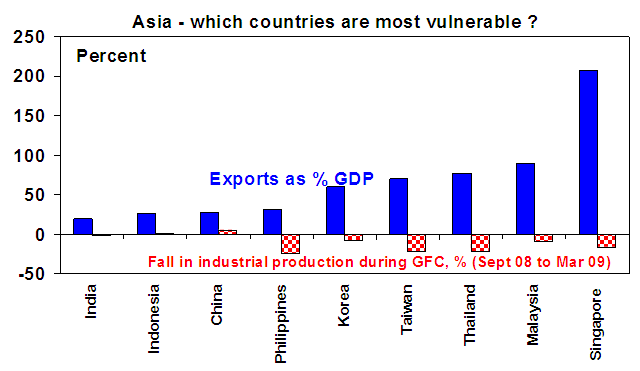
The experience of the GFC indicates the countries most vulnerable are small countries with big export sectors in relation to their economy. In the case of Asia this means Singapore (which may already be one quarter into a technical recession), Thailand, Malaysia and Taiwan, as opposed to China, Indonesia and India where the export sector is far less important.
Concluding comments
The next chart compares share market indices for emerging markets and developed world shares over the last twenty years. The clear message is while emerging market shares are not immune to the swings in advanced country shares the trend has been up over the last decade even though it’s been flat in traditional global share markets. The same has been apparent in Asian shares. There is little reason to see this changing.
While emerging market shares are vulnerable in the event of a return to recession in advanced countries, the longer term trend is likely to remain up on much stronger growth potential, driven by rapid industrialisation and urbanisation. At the same time, emerging countries generally lack the macro economic risks that come with the excessive levels of debt in advanced countries.


