
It is not only investors that are tiring of this interminable EU saga – it continues to bear down on activity levels across the world as illustrated by the recent fall in Japanese exports. Are we any closer to a resolution?
It is becoming increasingly clear that no amount of ECB bond-buying, support programmes or austerity plans are going to end this crisis: these are mere palliatives incapable of resolving the underlying issue. Weak economic growth is exposing gaps in the structure of the economic union and although the return of a more vibrant global economy may buy the eurozone some time, the damage to investor confidence has been done.
Currently, the euro project is dying a death of a thousand cuts. The market turmoil is not the product of speculator attack; if it were, then the average macro hedge fund would not be down 3% this year (Source: Barclays Hedge). Rather it is the consequence of the decision of many long-term international investors who have chosen not to maintain or renew euro investments. Major pension funds are known to, only now, be
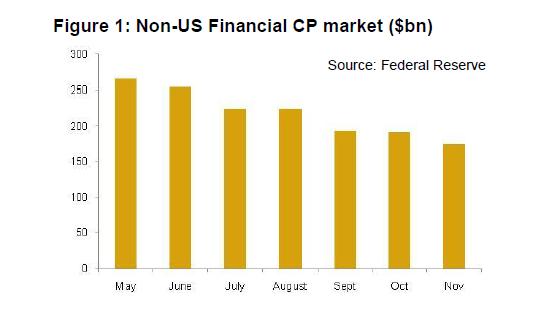
reducing their exposure to French and Italian bond markets. The size of the US commercial paper market issued by non-US borrowers has fallen by 25% in recent months (Figure 1). The burden of proof required from the eurozone to encourage these investors to return has risen sharply.
 Greece is clearly on life support. Italy and Spain are effectively now denied access to the global bond market – the only ‘investment’ is coming from the ECB support programme. France is now seeing its cost of capital rise relentlessly in a move which, if left unchecked, must see the crisis escalate out of control. Can we be that far away from a major game-changer?
The only durable resolution is one where the fault-lines are addressed, i.e. where all the eurozone states pool their credit risk and each government agrees to guarantee the debt of every other government. Under this model, all new government bond issues would be Eurobonds, and existing national government bonds would be converted into these bonds. The recent move by Merkel and Sarkozy to regard any Greek referendum as a vote for retention of the euro is a clear indication that EU leaders have crossed a Rubicon. The delivery of a proper bond market is only likely after member states agree to Treaty changes which deliver reforms that mean more than Germany agreeing to bankroll every other nation in Europe. These reforms are still generally regarded as a step beyond what each member state will concede, but what if a new ‘big bang’ is at hand?
The EU will publish a report tomorrow on a possible Eurobond market. Perhaps the groundwork is being laid for the mother of all news announcements.
Various forms of Eurobond structures have already been mooted e.g. the formation of a two-tier ‘red’ and ‘blue’ market which sees national issuance of Eurobonds up to a limit, of say 60%, of a country’s gross domestic product having full EU guarantee; beyond that limit, governments would still have to issue national bonds. But what if they are ready, quickly, to build a case for fiscal union and put it to the electorate in a ‘shape up or ship out’ move; the prospect of catastrophe is great for focusing attention. Everyone has known that the institutions of the EU have required reform; no one believed that the politicians could deliver those reforms. So strong are the issues of self-interest, that only a crisis would likely deliver the concessions required. If that is the case then this is that crisis – it’s hard to imagine one greater.
Germany has made very clear that it will only consider more ambitious pooling of eurozone resources if strict rules are first created that prevent countries from running up large deficits or allowing their banking systems to become sources of regional instability. The proposals out today should tighten Brussels’ control over the budget policies of eurozone member states. These proposals would see struggling governments forced to submit to frequent reviews of their policies and accounts, and could see eurozone governments effectively forced to seek financial assistance by a vote of their peers. [Note: Ireland and Greece are already involved in such a process.] In all but name, this is de facto fiscal union on Germany’s terms.
What would a fast-tracked fiscal union in Europe mean for investors? A single Eurobond market means, of course, a single yield. Although the current weighted eurozone average yield is above 4%, the harmonised yield would likely be much less than that. Although the principal casualty may appear to be the German bond market (yields are currently less than 2%), all those external investors who claimed to be willing to buy
European bonds if only Europe had sorted out its problems will have no reason not to buy.
The adjustment process resulting from the fiscal disciplines accepted will probably condemn Europe to an extended period of poor economic performance; again helpful for bond markets. The US bond market is likely to be the long-term casualty. The euro probably weakens as the ECB would, potentially, be sanctioned to pursue a more overt expansionary policy mix. Equity investors can get back to worrying about cyclical rather than systemic factors and should find support from an expansionary policy stance.
The journey towards a robust Europe may be about to accelerate. It may be a (very) rough ride but the alternative is much worse (and imminent).


