Swotting up
Welcome to the second in our AdviserVoice mini-series of CPD sessions that are designed to get you straight to the heart of key business management issues with learning outcomes in a timely manner.
In this edition, Ray discusses the benefits and ‘how to’ of conducting a SWOT analysis on your business (or your planned business) as a means of getting a deeper insight into what’s working in the business and what’s not.
SWOT Analysis
One business tool often used to assist both with initially going into business and post-establishment is the so-called ‘SWOT’ analysis which has been used to varying degrees in both large and small businesses since the 1960s. The process of understanding your business Strengths – Weaknesses – Opportunities and Threats is designed to get business owners and managers closer to the truth about the status of their business be it already operational, or in planning mode.
While other, sometimes more complex, businesses measurement tools have been developed since the SWOT process first appeared, it remains a very useful aid for a hundreds of thousands of businesses around the world.
In its simplest form, a SWOT analysis is a one page chart laid out as follows:
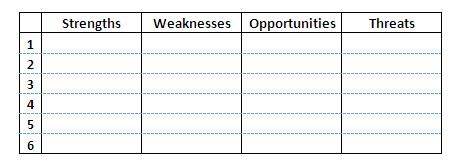
Broadly speaking, there are two environments which affect businesses and they are Internal and External. Strengths and Weaknesses fall under the Internal environment whereas Opportunities and Threats are External to the business.
In every respect this is an exercise in honesty – an exercise in being honest with yourself about what you are good at in business, or at least what you think you will be good at (your strengths), along with admitting your weaknesses. Next is to open your mind to what opportunities might there be outside of the business.
A successful SWOT usually reveals new services or ideas to enhance existing services which can help grow the business. Finally, it’s important to identify what threats are emerging or have already emerged externally which could impact on your business planning and we’ll look at each of these in more detail shortly.
If you are already in business, ideally, a SWOT analysis should be conducted away from the business premises. You need to free your mind of ringing telephones, staff questions and chatter, emails and all other day to day work related matters. You need clear thinking time which is uncluttered in order to get the best, most honest, outcomes from such an analysis.
For existing business owners, a SWOT is often a good way to start a review of where the business is and where you would like to take it over the next one, two and five years. But to get the best results from the process you need to be free of distraction with an open mind.
One more point for existing business owners about to embark on a SWOT analysis is to ensure that your employees are part of the process. You should require your staff to attend such processes and impress upon them the need to be open and honest about their views on, among other things, what’s ‘right’ and what’s ‘wrong’ with the business.
As a business owner, you can be sure that your employees will see things in the business that you cannot and there should be a workplace atmosphere in which everyone feels free to openly express their views.
It could be confronting but you might well be surprised what you cannot see. This requires your leadership skills to ensure the meeting environment is conducive to open discussion.
Existing business owners might also wish to consider arranging for a specialist consultant to lead the SWOT analysis as part of a strategic planning exercise which, again, should involve all employees. This allows the business owner(s) to participate without the need to ‘chair’ the discussion.
If you’re not already in business, it’s a good idea to sit down at the ‘kitchen table’ at a time when you can be free of interruptions and just ‘white board’ your honest assessment of the various components of your business planning at this point in time.
If you are able to, you should ask your spouse or an experienced and trusted colleague to review what you have compiled in your analysis and ask them to critique it from his/her perspective. Again, this person is likely to see things that you cannot.
Strengths
Your strengths should be both intangible (personal) and tangible. That is to say, an intangible strength might be that you are a good communicator – someone who is a ‘good with people’ as the expression goes. Note that, among other traits, many successful business people are good at understanding people; ideally you need to be that type of person.
While financial planning businesses are intensely focussed on financial matters they are equally, intensely, businesses which are very much about people. Other strengths might include that you are a good public speaker and/or a good writer. Note that both of these are also ‘communication’ skills.
If you don’t already know, you need to find out about your personal strengths and the personal/behavioural profiling discussed in the first edition of our Mini-Series of CPD is an ideal way to acquire a science based, unbiased, assessment of yourself. It will reveal all that which is strong in your personality type along with other areas where you perhaps are not so strong.
Another strength which is not necessarily a personal strength but is nevertheless a tangible strength is that you could be well capitalised in your business planning, be that for a start-up or expansionary phase. This could mean, for example, that you have sufficient capital to pay for all business expenses for say the first six months.
Or you have enough capital available to cover the office costs for a new branch of your business for the first twelve months. Note however that, in this example the strength is also a weakness because unless sufficient income can be generated within the first six months, the cash will simply run out and your business journey could come to an abrupt end.
Yet another strength might be that in the suburb or town you are going to establish your business, there is very little competition from other financial planning businesses although it must be said that this not such a high probability. However, you could be a specialist at what you do against which other financial planning businesses cannot compete. An example could be that you are a specialist Self Managed Superannuation Fund planner whereas your competitors might not be. This gives rise to marketing ‘opportunities’ – see later.
Weaknesses
This is where you really need to be honest with yourself. What aren’t you good at and/or what is the business (business planning) not strong on? By having an understanding of these issues – and be certain in the knowledge that you/the business does have weaknesses – you are able to identify what additional skills you might need to acquire personally, or resources such as staffing for the business generally.
A personal weakness could be that you, as intelligent as you otherwise are, are not good on administrative detail or good on following through on such detail. It might simply be that you don’t enjoy such tasks and find your job satisfaction in other aspects of business. This is nothing to be ashamed of but it is important to be aware of it so that your business planning can take account of it. Again, if you don’t already have such self-awareness, a good way to find out is via a personal profiling exercise.
A business weakness for a start-up is likely to be that you have no clients or very few. If you’re a relatively new financial planner you probably won’t have many, if any, clients. If you’re already in business and looking to expand, a weakness could be that you don’t yet have systems established to cope with processing administrative matters which would arrive in opening/acquiring an external office.
Or you could be exposed to compliance issues which cannot be properly managed from a distance. Again, for existing business, you could be understaffed and you need to be aware of the effects on work-flow and efficiency along with the often quite deleterious human effects of overworked employees.
All such weaknesses need to be addressed and actions planned and implemented to ameliorate the situation. While not all weakness can be turned into strengths the vital issue is to become aware of and fully accept that you/your business will have weaknesses. And recognise that every – every – business has weaknesses at every stage of the business life cycle from start-up to maturity and beyond.
Opportunities
In some respects this the time in the SWOT analysis where more creative thinking can take place. It’s the section where ideas and thoughts on how to establish and/or grow the business can bubble to surface. It’s the time when – to some extent – you can unshackle your thinking from the day to day planning or management and contemplate what could be in the business.
An opportunity could be to, for example, approach your local community radio station to suggest you could comment on financial news items (we’ll have more information on this in a later edition). For those still planning the establishment of their business, an opportunity might be to use the very fact that you are establishing your own business as a reason to send a short letter to that effect to other professionals in your suburb or town. (note that this will likely have little initial impact for you however it’s an important step in announcing your business).
Another opportunity could be that a change to retirement income legislation has just been announced which will affect all retirees. This gives you the opportunity to plan a communications programme to a target audience be that potential clients or existing clients and other professionals.
Threats
Firstly on threats, please note that they are not weaknesses. Threats are external to the business and are issues or aspects which could damage your business. Such a threat in a financial planning business could be the onset of new regulation which increases the cost of providing financial advice. The recent concern regarding the impact of the Future of Financial Advice (FOFA) legislation is a perfect example.
In this regard, in the very early years of the first decade of this century, the looming threat of the Financial Services Reform Act (2001) related to a more imposing legal compliance environment for financial planning businesses commencing March 2004, and was cited by many financial planning business owners as a very large threat. Another recent legislative threat which remains prominent for those yet to make changes in their financial advice business banning of commission payments to financial planners. In such an environment, business owners should have been conducting a SWOT analyses as a first step in understanding how to deal with the threat.
Another threat could be declining levels of consumer confidence such as those that beset the Australian economy at the height of the global financial crisis in early 2009 and which in many respect continue to this day. This has generally resulted in decreased numbers of new clients for financial planning business plus the loss of existing clients.
The preceding examples in the discussion on SWOT give rise to a table as follows in Table 1:

Typically in a SWOT process each column will initially have quite a few entries or items listed however a reality check should tell you that you cannot work on every item. Ideally, you need to refine the lists to perhaps a maximum four – no more than six – items of the highest priority or importance in each segment. The overriding emphasis in a SWOT analysis should be to reveal the most important issues that relate to the primary business objective.
SWOT – it’s not the end of the story
A SWOT is really only a tool to look at what’s happening and what’s not happening in/to your business. It alone cannot action changes and improvements in a business. That falls to you as the business owner and you have to convert the revelations from the SWOT into actions – otherwise you’ve wasted your time if nothing changes in the business.
In actioning the decisions which arise from the SWOT findings you will need to develop a timeline of – What (has to be actioned)– When (must it be started and completed) – Who (will action it and who has primary responsibility) and How (will the action be taken – what resources required). This is the actual planning which will put the changes in place to improve the business.
As the business owner, you will need to monitor and review the implementation of agreed actions from the SWOT process and we’ll look at this in the next edition of AdviserVoice CPD Mini-series.
This is not set and forget
With your first SWOT analysis done you might be tempted to let things rest for a while however I suggest you conduct a SWOT analysis at least once a year. You can be sure Strengths can weaken over time – some Weaknesses can get even weaker – Opportunities will not be actioned and new ones will arise – and new Threats will emerge while this year’s threats might become less of an issue.
Take some time now to plan your first SWOT analysis even if it’s just you sitting down with a pen and paper on a Sunday morning at home, thinking deeply about your business. Better still think about holding a formal business planning event, which kicks off with a SWOT analysis, as part of your annual calendar.
To see the first article in this series, click here.