

Clifford Lau – Head of Fixed Income, Asia Pacific, Threadneedle Investments
Keep calm and carry on – a wise statement to inspire during war times, and for post-crisis investment in the financial markets.
Keep calm when market turbulence sets in again; carry on, even when technical factors take markets in a direction that goes against your well-researched fundamental views. The aftermath of the 2008 global financial crisis has resulted in the Asian fixed income market gaining not only new status in terms of its risk-reward profile versus equities, but more importantly has led to a much higher core portfolio allocation in Asian bonds by international investors.
As a result, the Asian fixed income market has become sufficiently sizeable in terms of its capitalisation, and geographic and industry coverage, to become a distinctive asset class for global investors in its own right.
2012 was a defining year for Asian fixed income, especially the hard currency market. Not only did it record the highest amount of new issuances within a single year; the diversity of industry groups represented by new issues was also unprecedented. The significance of those new entrants in the bond market made 2012 a truly remarkable year for Asian hard currency bond trading.
In the Asian sovereign market, we saw Sri Lanka returning with a 10-year new issue, and Mongolia’s debut issuance of two USD-denominated benchmark bonds. These new sovereign issues, together with supply from their quasi-sovereign peers (Bank of Ceylon from Sri Lanka, Vietnam Joint Stock Commercial Bank, and Development Bank of Mongolia) opened up a new arena for Asian sovereign and quasi-sovereign bond trading.
For Asian high-grade corporates, we saw a good number of both regionally and internationally well-known names, such as CNPC, Sinopec, Baidu and Tingyi from China, and Samsung from Korea, which took advantage of the exceptionally low interest rate environment to raise money for capex programmes and re-financing.
In contrast, Asian high-yield corporates had a relatively subdued year from a supply stand point, with only a handful of benchmark bonds coming to the market last year. However, a very attractive relative valuation post the May/June market sell-off (due to increased European headline risk) enabled Asian high-yield corporates to deliver strong total returns for the year. Overall, the JPMorgan Asian Credit High-Yield Corporate Index returned 25.4% (Source: Bloomberg) in 2012 as event risks from developed markets subsided and credit fundamentals exhibited signs of bottoming out into the year end.
Certainly, 2012 was a year full of policy surprises. Consensus trading views on economic fundamentals and technical flows on the one hand and forward-looking opinions from rating agencies on the other were moving almost in opposite directions. With so much appreciation already priced into risk assets (the JPMorgan Asian Credit Broad Index tightened 123bps, returning 14.3% in 2012 – see Chart 1), thanks to rhetoric from policy makers in the developed world and high expectations that politicians will ultimately deliver what they have promised, financial markets are now set up for a make-or-break scenario in 2013.
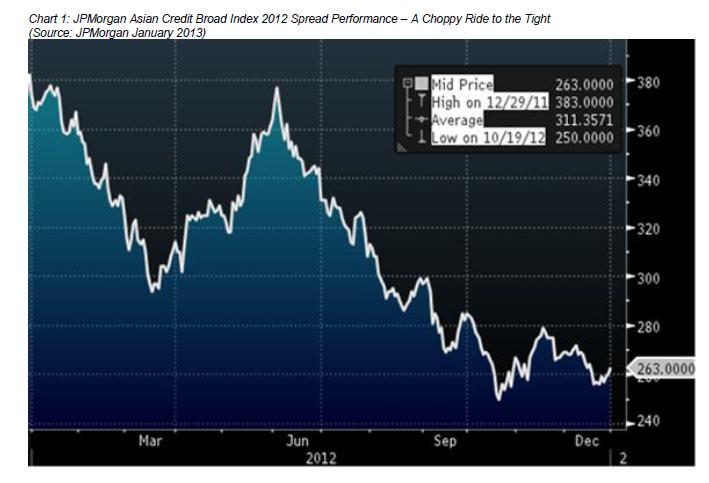
JPMorgan Asian Credit Broad Index 2012 Spread Performance
Asian high-yield sovereigns
The love-hate relationship between investors and Asian benchmark high yield sovereigns (Philippines and Indonesia) has deepened further in 2012. These markets represent everything to love in terms of liquidity, but everything to hate in terms of valuation (especially the Philippines).
Tight valuation aside, we do however believe the Philippines earned a well-deserved upgrade from the rating agencies with its better public finances, sustained growth of overseas remittances, and disciplined government budgeting which allowed the central bank to exercise a buyback program last year and refinance maturing debt at attractive terms.
Rightly or wrongly, the Philippines has now comfortably secured its safe-haven status at a time when the developed world is still in trouble. Philippine sovereign debt will be the most preferred asset to accumulate during volatile times. However we believe the underperforming Indonesia and new bonds from frontier markets such as Sri Lanka, Mongolia, and Vietnam offer better upside during a risk-on market.
Regardless, it is important to highlight a number of near-term risks:
- Vietnam’s banking sector de-leveraging is currently underway, which will be headline negative over the coming months
- Sri Lanka has vulnerable external finances, a structural current account deficit, low FX reserves and disappointing FDI
- there is the high dependency of Mongolia’s economy on the mining sector
- Indonesia’s poor commodity pricing market leading to a widening out of the current account deficit and high inflationary pressure in anticipation of fuel subsidy reform.
Overall, we prefer to go flat Philippines and Indonesia using their respective quasi-sovereign bonds as proxies, and outright long Sri Lanka and Mongolia in anticipation of their stronger economic performance this year. For a long-only, total return type of portfolio, partially or fully hedged, the treasury components will be important to protect downside risk given the probability of rising treasury yields in the New Year.
Asian high-grade corporates
The investment-grade corporates market was full of life last year. There was a big jump in high-grade corporate new issuance in 2012, up 189% on a year-on-year basis in terms of the total amount issued, representing 45% of all US dollar-denominated bonds issued. Investors seeking safer fixed income assets added to positions last year as the global backdrop remained gloomy.
This intensified demand and encouraged supply, helping Asian high-grade corporates to rally 85 basis points over 2012, according to the JPMorgan Asian Credit High-Grade Corporates Index. We believe this will continue to be a core theme for investors this year. Despite spreads having tightened a lot (the weighted average spread closed the year at +240 basis points), peer comparisons show that Asian high-grade spreads still offer a 50-90 basis points pick-up compared to similarly rated bonds in the US.
We think the Asian premium is too high in the investment-grade category. Our favorable outlook on Asian high-grade corporates is also an expression of our view that market volatility is going to be less detrimental to Asian high-grade compared to high yield, as people are still generally cautious about the heightened risk from the uncertain global growth outlook and political tensions in 2013.
The valuation of high yield also appears more expensive from a historical standpoint. While we are not suggesting the liquidation of any high-yield investments, we do however believe that the Asian high-grade market is more suited to a spread compression trade versus global peers in the medium term.
We believe that the best opportunities can be found in Singaporean, Malaysian and Thai bank subordinated debt, all Lower Tier II bank capital (except in India) due to cheap valuations relative to senior paper; Hong Kong properties for their stable rental incomes; issues from the consumer sectors which should benefit from the expectation of stronger consumer spending across the region; and systemically important Chinese state-owned enterprises where spreads have been oversold due to M&A concerns and high capex risk this year. Korean paper looks fairly valued after last year’s sovereign upgrade, so we would accumulate only when the market sells off.
Asian high-yield corporates
It would require investors to take a leap of faith to believe the Asian high-yield market can deliver the kind of exceptional returns seen in 2012. Discussions about the high-yield market outlook have to move beyond the generic assumption that spreads will close the gap versus global peers. After all, the Asian high-yield market is a collection of bonds with very diverse backgrounds, with some as tight as 2.9% YTD (Citi Pacific 2014) to as wide as 55% YTD (Bakrie Telecom 2015).
The very strong performance of high quality high-yield credits last year has now made them as sensitive to treasury risk as investment grade credits. What we have also observed is that the strong outperformance of Asian high-yield corporates has resulted in the spread pick-up from Asian high-grade corporates compressing from 623 basis points to just 270 basis points throughout the course of 2012.
Is the current valuation of the high-yield market providing fair compensation for the perceived higher fundamental credit risk? Should we be just content with the higher carry return we can obtain by investing in the high-yield market? Should we be worried that the market could have already reached its tipping point, or can we expect Asian high-yield corporates to rally non-stop like the sovereign market in the Philippines?
These are big questions and difficult to answer as we all know macroeconomic trends are as important a driver of high-yield market performance as credit fundamentals. To be clear, however, we think the market now has very little tolerance of high-quality high-yield credits underperforming given their expensive pricing. So long as they maintain their stable credit profiles, the inclination is to stay strategically invested in high yield credits while the global market backdrop remains conducive.
For a technical risk-on play we would engage in trading the high Single-B names such as those from the Chinese property markets. This year, the Chinese property sector should see a ‘tug of war’ between strong consumption growth and the increasing operating cost of raw material and land bank replenishment.
The potential call risk for 2013 callable bonds is also worthy of attention. Chinese industrials had a bad year in 2012 in terms of profitability, and represent an investment opportunity should market optimism about China’s infrastructure spending be well-founded while the return of the Chinese consumption story would also help to revive their businesses.
Finally, on Indonesian resources names, the near-term risk from disappointing results is high but we are also aware that the coal price has started to rebound since Q4 2012.
One credit which may benefit from this rebound is Bumi Resources (Bumi 2017). The market has partially priced in the downside due to its high leverage and heavy refinancing needs in late 2013 and early 2014. Management has been discussing the sale of non-core assets, and if the company makes good progress and manages to raise cash to improve liquidity, this should provide a catalyst for the bonds to rally.
Asian economies and inflation
Asian economic growth has entered into a transformational phase where the strong export-led model will be sidelined further while domestic demand should become the more dominant force driving GDP growth.
Given the competitiveness of the region’s economies has also been weaker due to the strong appreciation of Asian currencies in recent years, the rapid growth of GDP and fast accumulation of FX reserves could be a thing of the past. For 2012, Asian GDP growth was below average as the consolidation of trade balances between emerging markets and developed markets led to weaker emerging market exports, which hurt current account positioning.
For 2013, we think the recovery in the US economy and the elimination of tail risk (thanks to aggressive central bank policies from the Eurozone) should help to lift export growth and hence we forecast GDP growth of around 5-6% (ex-China) for Asia in the New Year.
However, as mentioned earlier, the transformation of the growth model for the Asian economies would make the outlook for domestic demand as important as export trends in driving bottom-line GDP growth. China and India could see their hands tied with regard to further credit expansion to fuel domestic demand, due to the recent build-up of excess leverage and up-tick in inflationary risk.
The other developed and emerging Asian countries should see a steady recovery but the overall outlook is benign rather than anything too positively surprising. The Philippines appears to be the most resilient, while Indonesia is going to face more headwinds to resolve the current account deficit. Developed markets such as Hong Kong, Singapore, and Korea should benefit from a recovery in global trade. Finally, we think the frontier Asia economies such as Sri Lanka, Vietnam and Mongolia are going to attract a lot of attention from investors in 2013.
In terms of inflation, we expect the broad trend to be modestly higher in most Asian countries, given our anticipation of a recovery in global trade. The lagged effect of quantitative easing will also help to drive capital inflows. Asian inflation risk is mostly food related, but so far there are no signs indicating that food prices are under any inflationary pressure.
However, tensions in the Middle East would increase the risk of an oil price shock, and the potential rebound in coal prices during 2013 is also a wild card that could take inflationary trends in an undesirable direction, especially for those countries where retail fuel prices are still heavily subsidised by the state.
China and India
The Chinese government is now going through a period of leadership transition. While the process has completed at party level with the changeover to be completed by March 2013, new economic reforms have taken place before the political handover began. The senior leadership, be it the outgoing or incoming one, have consistently reiterated the priorities of sustainable economic growth with urbanisation, infrastructure investments (urban and railway transport, social housing) and accommodative monetary policies being the main pillars to achieve the GDP growth target of 7%.
Construction-related sectors will most likely benefit more from this policy direction. We will also be keen to see more progress made by the government in opening up the private sector (especially in the service sector), better regulation of the banking sector (trust financing and shadow banking pose a very high risk to the health of the Chinese banking sector), a reassessment of exchange rate policy, further development of domestic bond markets, and a further push towards consumption demand as a driver of sustainable of growth.
For India, what worried investors the most last year was its fiscal slippage. S&P revised India’s outlook of its BBB- rating from ‘stable’ to ‘negative’ in early 2012, highlighting lower GDP growth forecasts, the risk of external liquidity and eroding fiscal flexibility. The government has taken steps to address those weaknesses since then.
In particular, a series of measures were proposed in September last year to buy time and hopefully avert the potential ratings downgrade. There are now heavy economic and political pressures on the Indian government to deliver on the reform front, but the political reality in India means that it will be difficult for reform bills to be passed smoothly by both the lower and upper houses.
Separately, due to the inelastic demand for both gold and oil, the current account deficit would only be eased in the near term by the successful implementation of capital account liberalisation and reform measures. Recently, both the lower and upper houses passed a retail FDI bill, which is a step in the right direction. Overall, we think there will be more difficult times ahead for India and therefore we are not conducting’ risk on’ trades in both hard and local/FX markets until we see a clearer path towards external account improvement and commitment to reform implementation.
Conclusion
Given the new era of high volatility in financial markets, we have limited our views on the outlook to an investment time frame of three months. Whether or not people like or dislike the deal struck in the US over the New Year, fiscal cliff concerns are now temporarily behind us. In the short term, the market should enjoy ‘risk on’ rally until oversupply of new issues starts to overwhelm investors.
We favour overweighting risk as the new year starts, but will stay vigilant while medium-term risks are unfolding. These risks include the economic impact following the last-minute US fiscal deal, ongoing banking reforms, the recessionary and unemployment outlook in the eurozone, the economic and fiscal prospects for India, and more updates from China as the leadership transition is finalised.
We think the Asian fixed income market has the potential to generate a mid-single digit positive return in 2013, but we will place the emphasis more on active portfolio management, and are wary of chasing carry returns (from high yield) at this stage.


