
A new Index launched today by TAL, Australia’s leading specialist life insurer, has uncovered how Australians view their financial protection.
The results suggest that Australians believe they don’t have enough of each form of personal life insurance [1] – life, illness, disability and income protection insurance.
In a new approach to measuring perceptions of underinsurance, the TAL Australian Financial Protection Index calculated a national score out of 100 to measure financial protection.
Through Galaxy Research, TAL questioned more than 1200 Australians on the types of life insurance they held, as well as if they felt they had enough cover if they or their partner could no longer work.
The results were modelled to calculate a score from 0 to 100 where 100 indicates that people have each form of life insurance and that they believe they have adequate coverage [2].
The inaugural TAL Australian Financial Protection Index calculated a national score of 24.2.
Jim Minto, TAL Managing Director, commented: “The take up of life insurance over recent years has increased markedly through superannuation so we were surprised that the national index score was just 24 out of 100.
“While most Australians have some form of life insurance through super, some people are simply not aware of it, while many do not know if the types and level of life insurance cover they have are adequate.”
The perception-based index is higher among certain demographics, such as those with mortgages and children, indicating a higher level of awareness among those groups.
“Awareness of the well-documented underinsurance problem in Australia is increasing but our new index demonstrates further work is needed.”

State comparisons
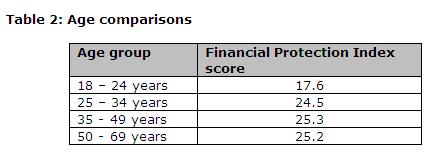
In addition to state differences, the index indicates that take up and awareness of life insurance among generational groups is highest amongst Gen X, those aged 34 to 49 years, while some people have no coverage at all and others indicating a more full level of protection, scoring an index figure of over 70.
Other key findings of the TAL Australian Financial Protection Index include:
- Three in ten Australians (30%) recorded a score of zero, saying they do not have any personal insurance.
- One quarter of all Australians had a score of between 30 and 70.
- 8% of Australians recorded a score of over 70.
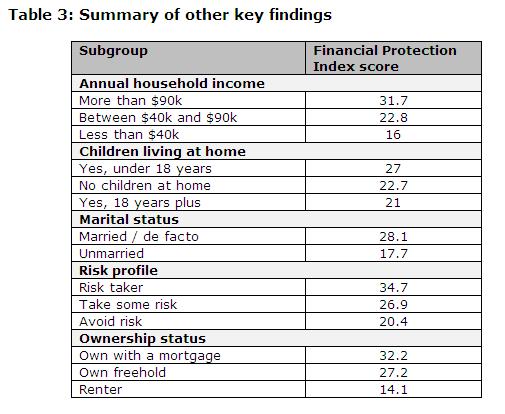
- Those with children under the age of 18 years recorded a score of 27, compared to parents of children over 18 who scored 21 and those without children who scored 23.
- Mortgage holders had a score of 32. This is more than double the index score for renters (14.1) and significantly more than those who own their home outright who scored 27.
- Index scores were also calculated for three household types: single person households (21), family households with a single income earner (25) and households with two earners (23).
“What we are finding from the TAL Australian Financial Protection Index is that some people report having either all or most forms of life insurance, while others have just some cover and others none at all. Overall most people believe they do not have an adequate financial protection safety-net,” Mr Minto said.
The index also looked at life insurance coverage according to risk profiles. It found that those who take the most financial risks record a higher score. Risk takers achieved an index of 35 compared to those taking lower levels of risk (27), while somewhat ironically the risk avoiders scored just 20.
Mr Minto expands: “It seems there is a greater appreciation of the value of life insurance among those with the most to lose, particularly people with mortgaged assets. But even among these groups, penetration is still low and they are only relatively better off compared to the average score.
“It is hoped that greater awareness of life insurance and the strengthening of the provision of life insurance products within superannuation funds, along with the life industry’s own education efforts through Lifewise and other initiatives, will continue to help close the financial protection gap in Australia.”
[1] Definition of the four main forms of life insurance: Life – lump sum upon death; Illness – lump sum for defined illnesses; Disability – lump sum upon permanent and total disability; and Income Protection – regular income payment upon defined illness/disability.
[2] The model didn’t require stay at home parents, the retired and those over 65 to have income protection.


