A daring experiment is under way in the world’s second-biggest modern economy.
“Abenomics”, formulated by a group of “reflationists”, is about firing “three arrows” at Japan’s economy with the aim of pulling it out of two decades of deflation-ridden, stop-start growth. These three shots include full bore monetary policy, aggressive fiscal policy and a big slug of structural reform. If successful, policymakers around the world could adopt the strategy.
Second-time Prime Minister Shinzo Abe, whose Liberal Democratic Party prevailed in lower-house elections in December, is hoping his revolutionary brand of economics will end Japan’s time as the textbook model of how asset bubbles can debilitate an economy.
Since these bubbles popped in the early 1990s, Japan’s economy has remained in the doldrums despite near zero interest rates, the invention of quantitative easing in 2001 and massive fiscal stimulus that has boosted net public debt to about 130% of output (and gross debt beyond 230% of GDP).
The reflationists (who mainly comprise academic economists) believe a major reason behind successive government failures to remedy the situation has been the half-hearted and muddled application of monetary and fiscal stimulus to date. They want to end these errors with a three-pronged strategy.
The first arrow revolves around bullying the traditionally cautious Bank of Japan into adopting an inflation target of 2% within two years. The second arrow is already-announced fiscal stimulus that amounts to about 2% of GDP in 2013. The third arrow is microeconomic reform, which includes dismantling protectionist practices and trimming red tape for businesses.
The reflationists are aiming for sustained GDP-per-capita growth of 1% to 1.5%, in line with the targets for most developed economies. While the experiment is off to a promising start with the public and investors (the Topix has surged 36% in the first four months of this year), its long term success is far from assured.
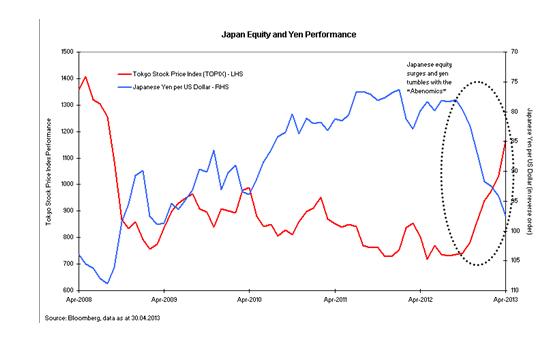
Japan equity and yen performance
Three arrows
With monetary policy, the Bank of Japan under the Abe-appointed reflationist Haruhiko Kuroda is implementing the world’s most-aggressive quantitative easing, whereby a central bank buys assets from banks to boost the monetary base, which comprises bank reserves with the central bank plus cash in circulation.
The Bank of Japan unexpectedly announced in April that it intends to double the monetary base over the next two years.
The economic theory behind the move is that a rise in asset prices tied to easier monetary policy will reduce real interest rates and thereby fan economic growth, tax receipts and inflation. An added benefit for export-tilted Japan is that looser monetary policy also has the effect of weakening the yen, which slid 11% in the first fourth months of this year – a decline that will stir inflation via higher import prices.
The Bank of Japan’s revolutionary move has its doubters. The core challenge is that because deflation is so entrenched, it’s questionable whether the quantitative-easing efforts will create the negative real interest rates that Japan needs to encourage the investment and spending that fan economic growth. The opposite danger is that Japan could stagger from deflation of minus 0.5% in the 12 months ended March (for a total price decline of about 20% since 1997) to an out-of-control price spiral.
As part of the second arrow, Abe’s government in January announced a supplementary budget containing stimulus worth 10.3 trillion yen that widens the fiscal deficit for the year close to 10% of GDP. The first risk with this strategy is that it adds to government debt. The second problem is that any short-term gain in economic activity could be nullified further down the line if the government imposes austerity in an attempt to reduce the country’s debt pile.
Abe’s third arrow is a commitment to business deregulation and vague support for a US-led trade pact for the Pacific that would include Australia. A reduction of tariffs among Pacific-rim countries could open protected areas of Japan’s economy, especially agriculture. However, many would argue that this third policy strand needs more meat on the bone to be effective.
A huge gamble
Critics of Abenomics say the strategy fails to address core problems within Japan’s economy and holds unintended risks. Japan’s aged population won’t enjoy seeing their savings lose value if inflation rises; it might even make them save harder. Nor will workers like a drop in their spending power if inflation accelerates.
Trading partners might react adversely when faced with a lower yen and implement protectionist measures. Japanese savers might look overseas to invest if bond yields drop, which will shrink a major pool of government funding and, if there is a large enough stampede, could torpedo the yen and trigger runaway inflation.
Tokyo’s debt commitments, which already gobble up at least one quarter of tax revenues, will soar if bond yields rise with inflation. Japan’s banking system would wobble if government yields jump, so stuffed are they with these securities.
This has led many observers to dub Abenomics a huge gamble. It largely assumes that deflation is a monetary phenomenon rather than a demand-driven or structural problem. Much of Japan’s lethargy is due to a lack of business investment and consumer spending – a persistent lack of domestic demand.
On the investment side, Japan’s problem is that companies save too much of their excessive oligopoly-driven profits because they have been scarred by the popping of bubbles in the early 1990s and Japan’s ageing society presents few new business opportunities.
Consumer spending remains subdued in Japan because of the rise in the number of Japanese who exist on part-time or temporary contracts. Lack of job security means the Japanese are not big spenders and the poor economic environment means they are forced to work for low wages. It’s estimated that 35% of Japan’s workforce are either part time or casual workers while wages have fallen about 10% since 1997.
So Abenomics is a high risk strategy, with many potential flaws, but it’s also fair to say Japan’s policymakers are making their best effort since the bubble burst over 20 years ago to escape stagnation. They could well succeed in stirring their economy. If they do triumph, all over the world newly-converted reflationists will be clamouring to fire three arrows at their limp economies. If they fail, Japan will enter uncharted territory.
This document is issued by FIL Responsible Entity (Australia) Limited ABN 33 148 059 009, AFSL No. 409340 (“Fidelity Australia”). Fidelity Australia is a member of the FIL Limited group of companies commonly known as Fidelity Worldwide Investment.
Prior to making an investment decision, retail investors should seek advice from their financial advisers. This document has been prepared without taking into account your objectives, financial situation or needs. You should consider these matters before acting on the information. You should also consider the relevant Product Disclosure Statements (“PDS”) for any Fidelity product mentioned in this document before making any decision about whether to acquire the product. The PDS can be obtained by contacting Fidelity Australia on 1800 119 270 or by downloading from our website at www.fidelity.com.au. This document may include general commentary on market activity, sector trends or other broad-based economic or political conditions that should not be taken as investment advice. Information stated herein about specific securities is subject to change. Any reference to specific securities should not be taken as a recommendation to buy, sell or hold these securities. While the information contained in this document has been prepared with reasonable care, no responsibility or liability is accepted for any errors or omissions or misstatements however caused. This document is intended as general information only. The document may not be reproduced or transmitted without prior written permission of Fidelity Australia. The issuer of Fidelity’s managed investment schemes is FIL Responsible Entity (Australia) Limited ABN 33 148 059 009. Reference to ($) are in Australian dollars unless stated otherwise.

 CPD: Growth holds, risks widen
 CPD: Intergenerational wealth – When the responsibility transfers before the money
 CPD: Why market structure rewards active management in local currency EMD
 CPD: A practical system for building client confidence – Value of Advice (Part 1)
 CPD: When a little knowledge is dangerous – countering the financial ‘guidance’ your clients are getting from AI
Will ‘Abenomics’ work?
A daring experiment is under way in the world’s second-biggest modern economy.
“Abenomics”, formulated by a group of “reflationists”, is about firing “three arrows” at Japan’s economy with the aim of pulling it out of two decades of deflation-ridden, stop-start growth. These three shots include full bore monetary policy, aggressive fiscal policy and a big slug of structural reform. If successful, policymakers around the world could adopt the strategy.
Second-time Prime Minister Shinzo Abe, whose Liberal Democratic Party prevailed in lower-house elections in December, is hoping his revolutionary brand of economics will end Japan’s time as the textbook model of how asset bubbles can debilitate an economy.
Since these bubbles popped in the early 1990s, Japan’s economy has remained in the doldrums despite near zero interest rates, the invention of quantitative easing in 2001 and massive fiscal stimulus that has boosted net public debt to about 130% of output (and gross debt beyond 230% of GDP).
The reflationists (who mainly comprise academic economists) believe a major reason behind successive government failures to remedy the situation has been the half-hearted and muddled application of monetary and fiscal stimulus to date. They want to end these errors with a three-pronged strategy.
The first arrow revolves around bullying the traditionally cautious Bank of Japan into adopting an inflation target of 2% within two years. The second arrow is already-announced fiscal stimulus that amounts to about 2% of GDP in 2013. The third arrow is microeconomic reform, which includes dismantling protectionist practices and trimming red tape for businesses.
The reflationists are aiming for sustained GDP-per-capita growth of 1% to 1.5%, in line with the targets for most developed economies. While the experiment is off to a promising start with the public and investors (the Topix has surged 36% in the first four months of this year), its long term success is far from assured.
Japan equity and yen performance
Three arrows
With monetary policy, the Bank of Japan under the Abe-appointed reflationist Haruhiko Kuroda is implementing the world’s most-aggressive quantitative easing, whereby a central bank buys assets from banks to boost the monetary base, which comprises bank reserves with the central bank plus cash in circulation.
The Bank of Japan unexpectedly announced in April that it intends to double the monetary base over the next two years.
The economic theory behind the move is that a rise in asset prices tied to easier monetary policy will reduce real interest rates and thereby fan economic growth, tax receipts and inflation. An added benefit for export-tilted Japan is that looser monetary policy also has the effect of weakening the yen, which slid 11% in the first fourth months of this year – a decline that will stir inflation via higher import prices.
The Bank of Japan’s revolutionary move has its doubters. The core challenge is that because deflation is so entrenched, it’s questionable whether the quantitative-easing efforts will create the negative real interest rates that Japan needs to encourage the investment and spending that fan economic growth. The opposite danger is that Japan could stagger from deflation of minus 0.5% in the 12 months ended March (for a total price decline of about 20% since 1997) to an out-of-control price spiral.
As part of the second arrow, Abe’s government in January announced a supplementary budget containing stimulus worth 10.3 trillion yen that widens the fiscal deficit for the year close to 10% of GDP. The first risk with this strategy is that it adds to government debt. The second problem is that any short-term gain in economic activity could be nullified further down the line if the government imposes austerity in an attempt to reduce the country’s debt pile.
Abe’s third arrow is a commitment to business deregulation and vague support for a US-led trade pact for the Pacific that would include Australia. A reduction of tariffs among Pacific-rim countries could open protected areas of Japan’s economy, especially agriculture. However, many would argue that this third policy strand needs more meat on the bone to be effective.
A huge gamble
Critics of Abenomics say the strategy fails to address core problems within Japan’s economy and holds unintended risks. Japan’s aged population won’t enjoy seeing their savings lose value if inflation rises; it might even make them save harder. Nor will workers like a drop in their spending power if inflation accelerates.
Trading partners might react adversely when faced with a lower yen and implement protectionist measures. Japanese savers might look overseas to invest if bond yields drop, which will shrink a major pool of government funding and, if there is a large enough stampede, could torpedo the yen and trigger runaway inflation.
Tokyo’s debt commitments, which already gobble up at least one quarter of tax revenues, will soar if bond yields rise with inflation. Japan’s banking system would wobble if government yields jump, so stuffed are they with these securities.
This has led many observers to dub Abenomics a huge gamble. It largely assumes that deflation is a monetary phenomenon rather than a demand-driven or structural problem. Much of Japan’s lethargy is due to a lack of business investment and consumer spending – a persistent lack of domestic demand.
On the investment side, Japan’s problem is that companies save too much of their excessive oligopoly-driven profits because they have been scarred by the popping of bubbles in the early 1990s and Japan’s ageing society presents few new business opportunities.
Consumer spending remains subdued in Japan because of the rise in the number of Japanese who exist on part-time or temporary contracts. Lack of job security means the Japanese are not big spenders and the poor economic environment means they are forced to work for low wages. It’s estimated that 35% of Japan’s workforce are either part time or casual workers while wages have fallen about 10% since 1997.
So Abenomics is a high risk strategy, with many potential flaws, but it’s also fair to say Japan’s policymakers are making their best effort since the bubble burst over 20 years ago to escape stagnation. They could well succeed in stirring their economy. If they do triumph, all over the world newly-converted reflationists will be clamouring to fire three arrows at their limp economies. If they fail, Japan will enter uncharted territory.
This document is issued by FIL Responsible Entity (Australia) Limited ABN 33 148 059 009, AFSL No. 409340 (“Fidelity Australia”). Fidelity Australia is a member of the FIL Limited group of companies commonly known as Fidelity Worldwide Investment.
Prior to making an investment decision, retail investors should seek advice from their financial advisers. This document has been prepared without taking into account your objectives, financial situation or needs. You should consider these matters before acting on the information. You should also consider the relevant Product Disclosure Statements (“PDS”) for any Fidelity product mentioned in this document before making any decision about whether to acquire the product. The PDS can be obtained by contacting Fidelity Australia on 1800 119 270 or by downloading from our website at www.fidelity.com.au. This document may include general commentary on market activity, sector trends or other broad-based economic or political conditions that should not be taken as investment advice. Information stated herein about specific securities is subject to change. Any reference to specific securities should not be taken as a recommendation to buy, sell or hold these securities. While the information contained in this document has been prepared with reasonable care, no responsibility or liability is accepted for any errors or omissions or misstatements however caused. This document is intended as general information only. The document may not be reproduced or transmitted without prior written permission of Fidelity Australia. The issuer of Fidelity’s managed investment schemes is FIL Responsible Entity (Australia) Limited ABN 33 148 059 009. Reference to ($) are in Australian dollars unless stated otherwise.
Print
email
Tags:economic update Fidelity Worldwide Investment Japan
Latest Articles