
Speech to FSC Annaul conference: The future of financial regulation
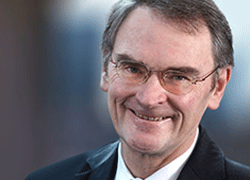
Greg Medcraft
The following is a speech by Greg Medcraft, Chairman, Australian Securities and Investments Commission delivered at the Financial Services Council (FSC) Annual Conference, 31 July 2013:
“Thank you Martin (Codina) for the kind introduction. It’s always a pleasure to attend the FSC Annual Conference. It’s an important forum in which we can discuss key issues affecting industry, and work towards a common solution.
Today I’d like to talk about an issue is relevant for many countries, as it affects how future growth will be funded. There is a significant structural shift that is occurring towards market-based financing. That is, debt and capital markets as opposed to traditional bank lending.
This issue is occurring worldwide and is gaining recognition as Governments are focusing on economic growth:
- the Australian Centre for Financial Studies (supported by Treasury and the RBA) recently launched a project on the Funding of Australia’s Future
- at the International Organization of Securities Commissions (IOSCO) we’ve been discussing this issue
- and last month, the Association for Financial Markets in Europe commissioned Oliver Wyman to produce a report on unlocking funding for European investment and growth.
Market-based financing is increasing and is now seen as a key source for funding economic growth.
This structural change is being driven by:
- increased banking regulation
- the growth of the pension and superannuation sectors.
New rules to strengthen the banking system are imposing higher capital and liquidity requirements. The net effect of this is often a decreased access to debt capital and an increased cost to business. As a result, many businesses are turning to market based financing to source their capital.
The second driver of market-based financing is the continuing global growth of the pension and superannuation sectors – much of which is invested in debt and equity capital markets.
This global growth is expected to continue in the coming decade as:
- governments in emerging markets start or expand retirement savings programs
- there is a demographic shift underway in many developed countries, as the population ages and people start to contemplate how to fund their retirement.
A good example is the growth in super in Australia:
- The rate of super is rising from 9% to 12%.
- Funds in superannuation are expected to grow from A$1.5 trillion to A$3 trillion by the end of the decade.
- Baby boomers are beginning to plan their retirement.
The growing importance of market-based financing presents a challenge for financial services and markets regulators to ensure we have the right tools and resources in place, so that debt and equity capital markets can perform their critical role in funding economic growth.
This increase in activity in our capital markets will have a flow-on effect to financial service providers such as financial advisers, investment managers, custodians, research houses, credit rating agencies, and auditors and accountants.
This presents a major challenge to financial services and markets regulators globally. We will need to remain proactive in order to address emerging risks. Maintaining a dialogue with industry to better understand what is happening in the markets, is fundamental in this regard.
It will challenge our strategic objectives of:
- ensuring financial markets are fair, orderly and transparent
- ensuring investors are confident and informed when they participate in the market
- mitigating systemic risk in the financial system.
These strategic objectives are critical in having an efficient financial system where business has access to cost effective capital in order to fund economic growth.
With the right people and infrastructure and the right level of cooperation, I am confident that we will meet the challenge.
Thank you.”


