
For years the challenge when talking about investing in Japan was to stop people’s eyes glazing over.
Today, everyone wants to know where next for Tokyo. A week after the award of the 2020 Olympics and two weeks before a decision on a controversial consumption tax, there’s no simple answer.
Edging out rival Olympic bids from Madrid and Istanbul was undoubtedly good news for Japan and Prime Minister Shinzo Abe will enjoy the opportunity to reprise 1964’s “Japan is back” message, presented coincidentally by his grandfather Nobusuke Kishi.
Back then, the Games were a focus for massive investment in Japan’s infrastructure, so it was not surprising that the biggest beneficiaries of the announcement a week ago have been construction stocks. Unsurprising but premature given that any increase in activity will be spread over the next seven years and optimistic given that part of Japan’s pitch was the limited need to build new facilities. SMBC Nikko predicts construction investment worth around 400bn yen, about a tenth of what the Chinese spent in 2008.
Japan spent around 3.5pc of its much smaller economic output on its first Games and will probably spend less than 1pc this time round but the associated benefits of hosting the Olympics could nevertheless provide an extended shot in the arm to an economy battling to emerge from 15 years of deflation, with horrible demographics and a dearth of investment or much appetite for consumption.
Far more relevant to the immediate outlook, however, is whether Mr Abe sticks to his guns and pushes through a proposed hike in Japan’s equivalent of VAT. Along with Canada, Japan enjoys the lowest consumption tax among the OECD countries at 5pc and so the plan to raise it to 8pc from next April and then to 10pc a year later seems on the face of it a reasonable response to public debt standing at more than twice Japan’s GDP, far and away the highest in the developed world.
The argument for pressing ahead with the tax hike is that if investors in Japanese government bonds lose faith in the administration’s ability to control its debt, rising yields will increase the already onerous burden of servicing the borrowings, the bond market will go into a tailspin and, most likely, drag the equity market with it.
The counter argument is that global investors are coming round to the view that the best way to pay down debt is to stimulate growth. Far from spooking the market, a delay in implementation might actually be welcomed. The fact that the equity market is moving in lock-step with the yen-dollar exchange rate is evidence that investors are more focused on corporate earnings (which benefit from a weak currency in an export-dominated economy) than on the fiscal position.
Japan certainly has form here. Back in 1997, it increased its sales tax by 2 percentage points to the current 5pc, with the tax applying to retail sales and house purchases. As my chart shows, it was a disaster. Quite rationally, consumers went on a spending spree in the run up to the tax increase and then spending fell off a cliff. Japan’s retail sales index has never regained its late-1990s level and tax revenues fell by more than 20pc over the subsequent 15 years. Prime Minister Abe will be only too aware that his predecessor, Ryutaro Hashimoto, was forced from office on the back of this policy blunder.
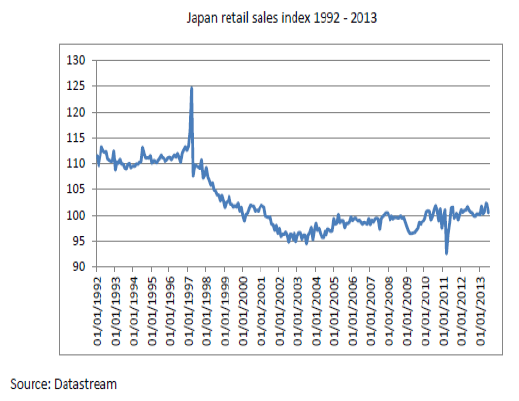
Again, there is a counter argument to this pessimistic scenario, which is broadly-speaking that 1997 was a different world. The Asian crisis was getting underway and Japan’s banking system was teetering on the brink of collapse after the excesses of the 1980s. Today, Mr Abe’s advisers point to second quarter growth of an annualised 3.8pc and tell him that consumers can take the tightening in their stride.
A decision is expected on or soon after 1 October and for investors who have enjoyed a 60pc rise in the Nikkei over the past year the stakes could hardly be higher. Fortunately, Mr Abe is the first Japanese politician to really grasp the importance of digging the country out of its deflationary slump.
He will have noted the evidence from the US, the UK and the Eurozone that achieving the sustainable growth needed to escape a debt trap is best achieved when monetary and fiscal policies pull in the same direction.
The benefit of the Olympics will unfold gradually over the next seven years. That looks like a sensible timetable for doubling the consumption tax as well.
By Tom Stevenson, Investment DIrector, Fidelity Worldwide Investment
————–
This document is issued by FIL Responsible Entity (Australia) Limited ABN 33 148 059 009, AFSL No. 409340 (“Fidelity Australia”). Fidelity Australia is a member of the FIL Limited group of companies commonly known as Fidelity Worldwide Investment. Prior to making an investment decision, retail investors should seek advice from their financial advisers. This document has been prepared without taking into account your objectives, financial situation or needs. You should consider these matters before acting on the information. You should also consider the relevant Product Disclosure Statements (“PDS”) for any Fidelity product mentioned in this document before making any decision about whether to acquire the product. The PDS can be obtained by contacting Fidelity Australia on 1800 119 270 or by downloading from our website at www.fidelity.com.au. This document may include general commentary on market activity, sector trends or other broad-based economic or political conditions that should not be taken as investment advice. Information stated herein about specific securities is subject to change. Any reference to specific securities should not be taken as a recommendation to buy, sell or hold these securities. While the information contained in this document has been prepared with reasonable care, no responsibility or liability is accepted for any errors or omissions or misstatements however caused. This document is intended as general information only. The document may not be reproduced or transmitted without prior written permission of Fidelity Australia. The issuer of Fidelity’s managed investment schemes is FIL Responsible Entity (Australia) Limited ABN 33 148 059 009. Reference to ($) are in Australian dollars unless stated otherwise. © 2013 FIL Responsible Entity (Australia) Limited. Fidelity, Fidelity Worldwide Investment and the Fidelity Worldwide Investment logo and F symbol are trademarks of FIL Limited.


