
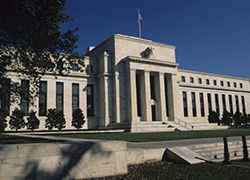
Federal Reserve building, Washington DC.
Let’s jump to this note’s conclusion: Past is not prologue for the projected path of the Fed’s policy rate. Expect the Federal Reserve to keep its policy rate low for a very long time. A baby born today will probably be in kindergarten by the time the Fed adopts a neutral stance on monetary policy.
Back in the day, when the Federal Reserve decided it was time to unwind its easy money policies, it would raise its policy rate, the federal funds rate, persistently until it moved above 4%, the level the Fed believes is consistent with a neutral stance on monetary policy. The central bank’s past three rate hike cycles – 2004 to 2006, 1999 to 2000, and 1994 to 1995 – ended at 5.25%, 6.50%, and 6.00%, respectively.
Whereas the Fed in the previous three cycles increased the federal funds rate within 18 months of last cutting it, today nearly five years after the Fed lowered its policy rate to zero, the Fed is still easing, providing new monetary accommodation each time it buys bonds through its so-called quantitative easing program. No end to purchases appears likely before at least the middle of next year, if not later, given that the Fed announced in its September 18th policy statement that it had decided against reducing, a surprise to markets.
Importantly, a considerable time will pass before the end of the Fed’s bond buying and its first rate hike. The Fed said as much in its policy statement, which, along with the “no taper” decision, contained the clearest indications yet that the path to a normalisation of interest rates will be anything but normal. Call it a new normalisation – for rates, that is.
Investment Implications
For bond investors, the Federal Reserve’s decision to delay a taper will relieve some of the upward pressure on longer-term interest rates, where the Fed’s buying is greatest as a percentage of overall issuance.
Other parts of the yield curve may fare better, however, owing to the Fed’s enhanced forward guidance and its 2016 rate projection. We believe intermediate maturities should benefit most, as rate hikes were disproportionately priced into that part of the curve during the summer turbulence.
Elsewhere in markets, prospects should improve for forward rates (as seen in eurodollar futures), where large speculators had done a big “Switcheroo,” and had moved from long to short, to price in rate hikes that PIMCO believes are improbable given our forecast for the first hike to occur in 2016.
Finally, as we have stressed for some time now, stay focused on three things most of all when thinking about the Fed and why the normalisation of monetary policy is anything but normal:
The policy rate,
the policy rate,
and the policy rate!
Written by PIMCO’s Tony Crescenzi and has been used with permission from PIMCO Australia Pty Ltd.


