
Effective manager selection is an increasingly important element of investment success for investors today.
In this article, Fidelity’s Nick Peters discusses the art of selecting the right manager, why monitoring performance is critical, and why it could make a difference to your overall returns.
Why is choosing the right manager important ?
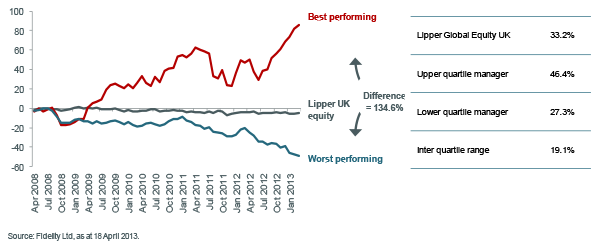
Indeed, in recent years, the level of dispersion between top and bottom quartile managers has risen from around 10% to nearer 20%. The chart below shows, over five years, that the differential between the best and worst manager in the UK is extremely significant. Theoretically, it is entirely possible for an investor to be completely correct in their asset allocation decision, only for them to lose money as a result of picking the wrong investment vehicle. Picking the right managers is critical.
No particular style of investing works over all time periods, so combining managers with different styles and processes can help investors to reduce their risk and smooth their investing journey. But finding the right manager is just the start; managers need to be monitored on an ongoing basis, with changes made in a timely and efficient manner when required.
The bedrock of successful manager selection is a rigorous research process. In terms of technology and resources, a broad global capability is important to ensure that good managers are not overlooked. It takes considerable time and effort to gain a deep understanding of each manager’s investment process and the drivers of their likely performance. The most effective approaches to manager selection will invariably combine both qualitative and quantitative analysis.
Running the Numbers
This is a vital part of the process and involves looking at both historic performance and fund holding data. The volatile markets of recent years have provided investors with a rich source of data for analysing fund manager behaviour. While past performance is no guarantee of future returns, it seems reasonable to approach a large universe of funds by screening out those which, for example, have never added significant alpha. It is important to assess performance during different market environments. For instance, for a manager with a more defensive philosophy, it is reasonable to expect them to preserve capital in difficult markets and to perhaps lag in strongly rising markets.
Meeting the Manager
The importance of detailed qualitative analysis of managers through regular face to face meetings conducted by professional investors should not be underestimated and forms the cornerstone of any manager selection process. Qualitative analysis usually targets three main factors – people, philosophy and process, and portfolio construction, as well as trying to assess softer factors such as passion, focus and organisational fit.
Investment management is a people business and assessing the fund manager, his team and wider resources is essential in understanding whether past returns can continue. Because every manager has a different investment process, there is no right size of team or organisational structure. What is important is that the organisation provides the necessary level of support for the fund manager. An alignment of interests between the fund managers, their teams and clients is also a positive sign as well as succession planning to mitigate the reliance on one key individual. Another important aspect is length of tenure within the team; a rapid turnover of analysts raises questions.
Identifying a manager’s edge versus similar funds is an important part of the discussion on philosophy and process. In other words, what is it about the process that is likely to lead to consistent performance in the future?
Alongside obvious factors that should be considered such as research process and portfolio construction, there are other intangible factors that need to be looked at in order to understand how a manager makes their investment decisions. A skilled manager has a differentiated perspective and hence tends to act differently on the same information. Crispin Odey is a good example of a manager with such skill. His interpretation of the various cross-winds impacting global stock markets since the Financial Crisis has boosted his fund’s overall performance.
Another important indicator is a culture of continued innovation to maintain the performance edge. The UK equity boutique Heronbridge has an annual meeting specifically to discuss what went wrong in the previous year and what improvements can be made to the process to reduce the chances of errors (and underperformance) in the future.
Other indicators of success include signs of commitment, high internal standards and involvement in the investment process. Alken, another boutique investment manager has an innovative approach to analysis: they literally let research analysts do what they want. Their team of six analysts are well aware that they are remunerated on ideas getting into the final portfolio. However they are given as much time as they require to analyse an idea before presenting it to the portfolio manager. This leads to well researched and thorough stock due diligence. Most Alken analysts have a batting average (number of outperforming recommendations/total number of recommendations) of well over 50%. Many active managers have a success rate of below 50%.
The Devil is in the Detail
Looking at the historic exposures within a fund over time allows an investor to conduct the “Ronseal test” on a manager – does the fund do what it says on the tin? It is important to identify those managers who not only have a solid process, but who apply that process consistently over time and do not change their style. It is important to verify the performance is consistent with the manager’s process and style.
For example, warning bells should sound when looking at a manager with a value style has a portfolio full of expensive stocks. Managers who invest outside their core area of expertise may be lucky and pick the stock that does work, but it is skilled managers who will provide consistent performance over time.
Of equal importance as finding the right manager is the ongoing monitoring. The aim is to make sure the process continues to be consistently applied over time and to identify inconsistencies between the process and what is subsequently happening within the portfolio. Understanding the key drivers of underlying stock holdings is an advantage when assessing the manager as this makes it easier to understand the rationale for buying a stock and to make sure this is consistent with the fund manager’s approach.
For example, a small cap manager who has always focused on finding growth companies with robust balance sheets could be tempted to sacrifice the “quality” requirement as the growth stocks become expensive. This could have negative implications for performance, but more worryingly from an investor’s perspective is the fact that it represents a move away from the manager’s successful historic investment process, making it more difficult to have comfort that the pattern of strong past performance can continue.
It is difficult to overplay the importance of the qualitative aspects of manager selection and the advantages of building a long term relationship with fund managers. This is especially true of managers with short track records or those who work at boutiques. Investing in the right vehicle, as we are all aware, can have significant implications so finding the right manager and monitoring them is critical.
By Nick Peters, Portfolio Manager within Fidelity’s Investment Solutions Group
——————–


