
Slice 2 Survey results: planners have their say
The aim of the SLICE survey is to provide financial planning practices with an opportunity to share their views and insights with their peers and build an understanding of the most effective approaches to a broad range of hot button topics that challenge practices’ efficiency, profitability and viability.
The SLICE survey is conducted nationally in March, July and November to canvass the opinions of independent financial planners on a broad range of industry and business issues. The first SLICE survey was conducted by Peter Dawson of The Dawson Partnership and Susan Rochester of Balance at Work in November 2013. Here’s a small sample of the results that survey uncovered:
- 32% of practices increased their headcount in 2013, with 13% expecting the implementation of FOFA would lead to them employing more staff in the future;
- 18% use social media as part of their recruitment process;
- In selecting staff, 21% of respondents always use behavioural profiles and 20% always use knowledge based test.
- Half the practices surveyed increased their training spend in 2013, but 13% spent less on training;
- 23% rated the support they receive from their licensee for recruitment and people management as ‘good’ (16%) or ‘excellent’ (7%). A further 25% rated it as ‘satisfactory.’
The latest SLICE survey, ‘SLICE 2’, has focused on three key areas confronting financial planners:
- Business growth
- Succession planning
- The proposed FOFA amendments
We would like to thank all survey participants who took the time to answer our questions so thoughtfully. You have generously added your voice to a deeper understanding of the issues that affect your profession.
1. Business growth
Sources of revenue growth
The vast majority of respondents (96%) intended to grow their business revenues in 2014. When asked how they will grow their businesses, 65% of respondents stated that their focus is on organic growth. None of the respondents to this survey plan to grow their businesses through buying a book of clients or through acquiring or merging with another practice.
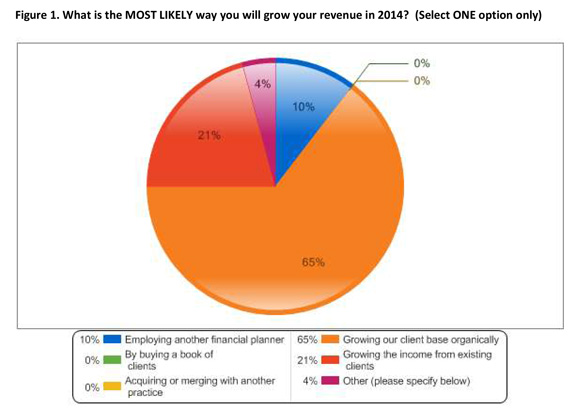
Follow up interviews revealed that most respondents who favoured organic growth did so due to
there being no negative legacy issues that could prove a distraction to the business tying up resources and adding unforseen costs. There was also a concern that there could be ‘client slippage’ and the book could shrink over time reducing the value of the initial investment.
Growth strategies
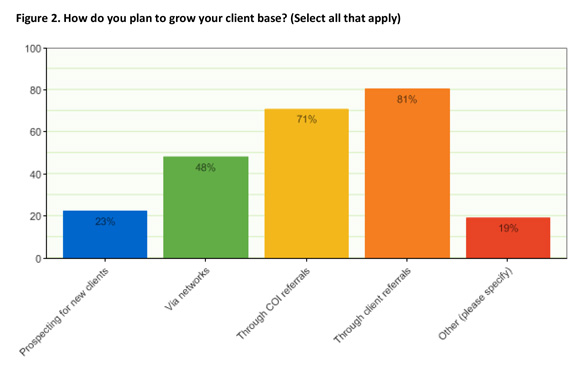
The dominant growth strategy for those planning to grow their client base is referrals from clients (81%) and centres of influence (71%) while prospecting for new clients outside of referrals accounted for 23%. Almost half (48%) intend to attract more clients through networking. Other ways respondents plan to grow their client base are through social media, seminars, publishing and corporate services.
Staffing for growth
When asked who is responsible for generating business growth in the practice 81% of
respondents stated that the business owners are directly involved in planning for growth in the
business and take a hands-on role in implementing the growth strategy. Only 52% of the
respondents have staff other than the owner(s) with the capacity to bring more revenue into the business.
Given this, it was interesting to note that recruiting another financial planner to help grow their
business is in the plans of 10% of respondents. When they were asked what was most important
to them when hiring 60% selected skills with 20% each indicating attitude or reputation as most
important.
When we asked what respondents considered would be the minimum qualification for a financial planner they would hire, there was a wide variety of responses, with 40% citing DFP as a minimum while others expected the advanced diploma (ADFP), a degree in financial planning or a degree in a related discipline with a DFP (20% each).
‘We are not planning to hire however would accept nothing less than a degree qualification, or worst case, working towards a degree.’ – Survey respondent
Servicing growth
There was a high level of confidence from respondents in their ability to service growth (92%) while 94% were confident that growing the business would lead to increased profitability. Those that didn’t pointed to the need for increased infrastructure that would initially increase costs that would absorb any potential increase in profit.
When asked if respondents will change the ways they operate to increase the potential to increase profitability, 69% stated that they would, with most stating that this wouldn’t require a major overhaul of their business. Scaled advice figured in the plans of 52% of respondents with most adding that they would do so mainly for family and friends of existing full service clients and that this would not be seen as a core part of their business.
‘To grow substantially I need to build capacity by employing an adviser and additional staff. In regional areas the level of skills / knowledge of potential recruits is below the level I need for my business. These potential recruit also believe they are at a level that will attract a remuneration that exceeds their capability to bring in the necessary income. Recruitment of suitably qualified staff is an issue in the regional areas.’ – Survey respondent
Target client demographics
‘The backbone of our practice is small business owners who come to us for their accounting work which gives us a chance to explain the value of our financial planning services. Our strike rate is high in converting our accounting clients to financial planning clients and they then refer business to us.’ – Survey respondent
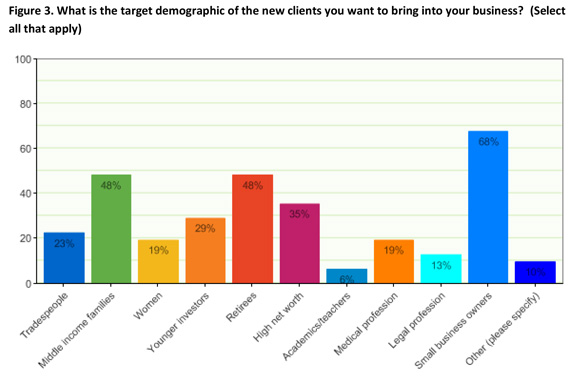
The four main demographic targets identified by survey respondents were small business owners (68%), retirees (48%), middle income earners (48%) and high net worth clients (35%). See graph.
2. Succession planning
When asked about the current status of their succession planning, only 20% of respondents have a comprehensive plan in place. Of those who had a comprehensive plan, 60% said that they had put it together with the assistance and advice of a business consultant and/or their licensee. In contrast, 30% of respondents haven’t started planning for succession. (See graph.)

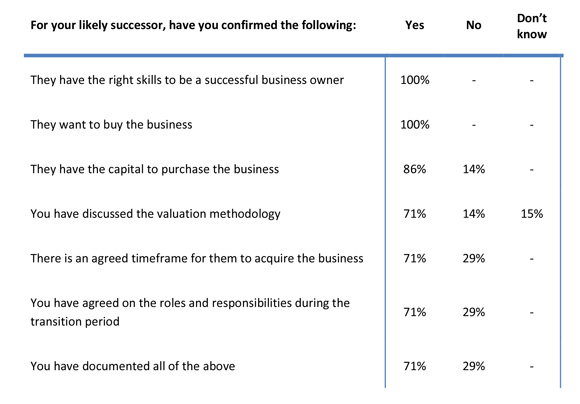
Drilling down into existing succession plans revealed that although in 100% of cases a likely
successor had been identified who had the confidence of the business owner in terms of their
ability to run a successful practice, the process was not complete in every case. The table below
show the gaps in terms of other factors, such as valuation methods, finance, timeframes, transition roles and responsibilities and documentation. All these factors are critical to a smooth exit plan.
‘Succession planning is a critical business issue with three business owners who are in their midfifties. We have an agreement in place that allows for a smooth transition as each of us exits the business over the next five to ten years.’ – Survey respondent
3. FOFA reforms
Asking if the proposed changes to FOFA (before the current freeze on those changes) will have a positive impact on business generated a spread of response. Half of the respondents answered ‘yes’ while 28% answered ‘no’. A ‘don’t know’ response was received from the remaining 22%.
‘We have geared our business to the original legislation and the changes will lighten the load in terms of administration and compliance but not to a considerable extent.’ – Survey respondent
Of those respondents expecting the change to have a positive impact on their financial planning practice, 52% stated that the positive effect was due to ending client confusion. Several commented that their clients had seen considerable commentary on television and print media and were unsure what the effect of the proposed amendments would be.
Favourable comments from respondents about the impact of the proposed changes on individual practices included: ‘Increased consumer awareness and ability to understand why we are unique in the marketplace’; ‘It supports our value proposition’ and ‘Highlights differences between the majority of the industry (controlled by institutional product providers) and niche advisory businesses which will focus on client relationships’.
44% of respondents expecting a positive impact on their businesses thought the amendments would end industry confusion while 40% expected they would lead to less administration resources being needed and 32% indicated the amendments will free up business owners time to attend to their clients’ needs.
The responses to a second question about FOFA that asked ‘Do you believe the proposed changes to FOFA will be positive for the public perception of financial planners?’ indicated a wide range of opinions and a level of uncertainty about the likely outcomes.
A total of 48% of respondents said they believe changing FOFA will be positive for the industry while a significant minority (36%) expect the changes to have a negative impact and 16% were not sure. While some believed the public don’t know or care about the changes, several of the comments in the survey expressed frustration with the media handling of proposed amendments.
‘The proposed changes to FoFA will only have a positive impact on the public if/when the media stops being so ignorant about what financial planners do, and how they interact with product providers. The media should also become a little more conversant with legislation as it currently exists. It would be nice to think that financial publications actually vetted their articles for correctness, or where they are too time poor to do that, clearly label them as OPINION ONLY.’ – Survey respondent
Further comments
Respondents were given the opportunity to add some general comments at the end of the survey. Many of these have already been reported above. We also recorded the following:
‘It would be extremely helpful for the development of the financial planning profession if the Industry Super Network would embrace the value professional financial planning can bring as opposed to continuing to demonise commission and virtually all other participants. I live in hope!’
and
‘The FPA needs to lift the education level which I feel is too low at this stage before it thinks about being classed as a profession. Also more effort needs to be taken to counter the Industry Super advertising. All they seem to be worried about is increasing member fees and there glossy magazine.’
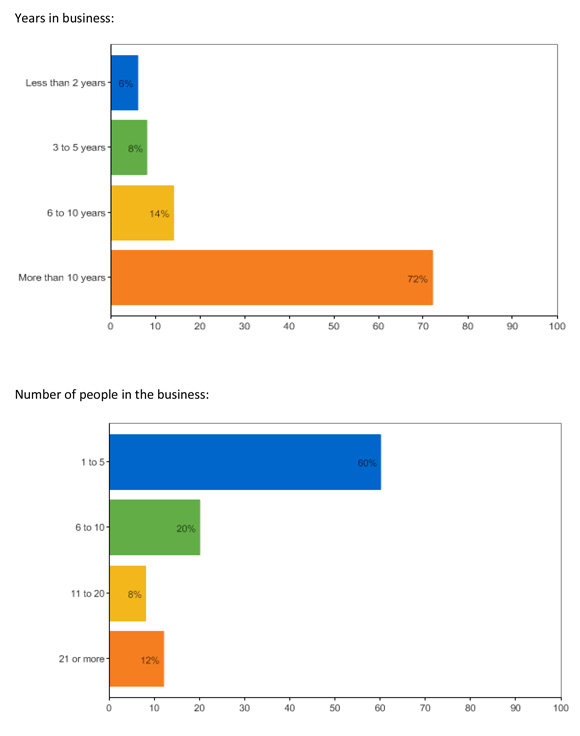
Respondents to the SLICE 2 survey
Concluding remarks
The SLICE2 survey has revealed that financial planners’ core focus is on building sustainable
growth in their practices derived predominantly from referral business from existing clients. This
is not good news for business brokers as none of the respondents said that they were looking to acquire client books and or buy or merge with other practices.
The FOFA ‘roll-back’ amendments to legislation, proposed prior to the survey then frozen, are
seen as a positive for planning practices with a number of principals stating that the legislation will help differentiate their businesses from institutionally owned businesses.
While there has been a significant push by licensees and practice management consultants to raise awareness for the need for succession planning only 20% had a comprehensive plan. This indicates there is still more work to do although it is encouraging that 26% said that they are in the process of putting a succession plan together.
It will be interesting to see what financial planners tell us as we revisit these issues annually in future surveys.
——–
Peter Dawson is the Director of The Dawson Partnership and Susan Rochester is the Director of balance at Work.


