
Economic & financial events; Imports
- Volatility ahead of key events: Currency and share markets have exhibited volatility in recent days ahead the Scottish referendum and the US Federal Reserve meeting to decide interest rate settings.
- Less volatile Aussie shares over time: While the sharemarket has proved weaker and a little more volatile in recent days, volatility is still historically low. Over the past year the ASX 200 has only traded up or down by more than 1 per cent on only 30 days, the lowest result since January 2006 – almost 9 years.
- Chinese stimulus: There are reports that China’s central bank has boosted liquidity at the biggest five banks.
- Imports down: Imports of goods fell by 3 per cent in seasonally adjusted terms in August.
The US central bank decision and Scottish referendum have implications for currency-sensitive businesses. The Chinese stimulus is important for resource companies. The imports data provide insights on retailers. The Chinese coal decision has implications for Australian coal producers.
The US, Scotland & China
- Up until recent days, there had been growing speculation that the US central bank could signal an earlier start to the rate hiking cycle. But that perception appears to have been turned on its head in the last 24 hours, in part due to the views of a prominent Fed watcher, Jon Hilsenrath of the Wall Street Journal. Hilsenrath believes that the Federal Reserve won’t dramatically change the language in the statement that outlines the interest rate decision. In particular, Hilsenrath believes there will be no change in a key paragraph:
- “The Committee continues to anticipate, based on its assessment of these factors, that it likely will be appropriate to maintain the current target range for the federal funds rate for a considerable time after the asset purchase program ends, especially if projected inflation continues to run below the Committee’s 2 percent longer-run goal, and provided that longer-term inflation expectations remain well anchored.”
- Central banks have in the past have used certain “mouth-pieces” in the media to signal future intentions in order to reduce uncertainty and volatility. But the views of the Wall Street Journal Fed watcher are in line with a number of other key analysts. CBA strategists are in accord with these views, believing the Federal Reserve is unlikely to start lifting interest rates until around mid-2015.
- The Fed decision will be crucial for the short-term outlook of share and currency markets. Overnight, the US Dow Jones went within seven points of closing at record highs, lifting almost 101 points over the session.
- The other news overnight were reports that China’s central bank, the People’s Bank of China, was set to add 500 billion yuan in liquidity for the top five banks through standing lending facilities. The Aussie dollar rose from lows near US90 cents to highs around US91.10 cents.
- Uncertainty about the Scottish referendum result also remains a key factor influencing financial markets at present. But given the result is on knife’s edge, the referendum is more a background issue, making investors less keen to take on fresh positions until the final outcome is known, potentially on Friday.
- The Aussie dollar hit the lowest levels in around six months on Monday, below US 90 cents. But the foray below the psychologically-important level has proved brief for now. While the Aussie dollar has come under pressure from a stronger greenback (on rate hike fears) and softer Chinese economic data, the longer-run pressure has come from lower commodity prices. The key CRB futures commodity index hit a 9-month low on September 15, before recovering modestly overnight, up by 0.9 per cent.
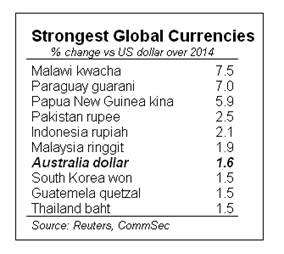
- Many analysts would argue that the Aussie dollar is now at a more appropriate level given recent trends of commodity prices. But the Aussie is by no means the weakest global currency in 2014. The Aussie is actually up 1.6 per cent from the start of the year, making it the seventh best performing currency against the greenback.
Aussie dollar: Big picture
- The Aussie dollar hit the lowest levels in around six months on Monday, below US 90 cents. But the foray below the psychologically-important level has proved brief for now. While the Aussie dollar has come under pressure from a stronger greenback (on rate hike fears) and softer Chinese economic data, the longer-run pressure has come from lower commodity prices. The key CRB futures commodity index hit a 9-month low on September 15, before recovering modestly overnight, up by 0.9 per cent.
- Many analysts would argue that the Aussie dollar is now at a more appropriate level given recent trends of commodity prices. But the Aussie is by no means the weakest global currency in 2014. The Aussie is actually up 1.6 per cent from the start of the year, making it the seventh best performing currency against the greenback.
More bad news for coal
- China’s National Development and Reform Commission said that the country will ban the import and local sale of coal with high ash and sulphur content starting from 2015 in a bid to tackle air pollution. While Australia’s Mineral Council believes that mines can adapt to meet the restrictions, there are significant exports and regional economies affected. According to consultants Wood Mackenzie, China imported 54 million tonnes of thermal coal and 30 million tonnes of metallurgical coal from Australia in 2013. Wood Mackenzie says all the thermal coal exceeded the new ash limit, while the metallurgical coal was below the limit.
- Given that a high proportion of economy-wide spending is on imported goods, the latest data is worth noting. The Australian Bureau of Statistics report that “In seasonally adjusted terms, goods debits fell $677 million (3 per cent) between July and August 2014 to $21,423m. Intermediate and other merchandise goods fell $878m (9 per cent), consumption goods fell $65m (1 per cent) and non-monetary gold fell $25m (10 per cent). Capital goods rose $292m (6 per cent).”
- Annualised imports from Japan are currently at 3-year lows, down 5.4 per cent on a year ago, while imports from China are growing at the slowest annual pace for five months.
- There are a few balls in the air at present for investors. Still, for traders of shares or the Aussie dollar, the volatility is probably welcome – certainly sharemarket volatility is near 9-year lows. For longer-term investors, the good news is that once we move into a new week, a lot of uncertainty will be resolved. The Scottish issue will hopefully be settled, the next US interest rate decision won’t occur until October 28/29 and the next batch of Chinese economic data won’t occur until early-mid October. And in Australia, the profit-reporting season is out of the way while the Reserve Bank won’t be moving interest rates any time soon.
- In the coming week the major domestic focus is the Financial Stability Review on Wednesday while the key international events are “flash” manufacturing readings for the US, Europe and China on Tuesday.
Australian economic data: Imports
- Given that a high proportion of economy-wide spending is on imported goods, the latest data is worth noting. The Australian Bureau of Statistics report that “In seasonally adjusted terms, goods debits fell $677 million (3 per cent) between July and August 2014 to $21,423m. Intermediate and other merchandise goods fell $878m (9 per cent), consumption goods fell $65m (1 per cent) and non-monetary gold fell $25m (10 per cent). Capital goods rose $292m (6 per cent).”
- Annualised imports from Japan are currently at 3-year lows, down 5.4 per cent on a year ago, while imports from China are growing at the slowest annual pace for five months.
What are the implications for interest rates and investors?
- There are a few balls in the air at present for investors. Still, for traders of shares or the Aussie dollar, the volatility is probably welcome – certainly sharemarket volatility is near 9-year lows. For longer-term investors, the good news is that once we move into a new week, a lot of uncertainty will be resolved. The Scottish issue will hopefully be settled, the next US interest rate decision won’t occur until October 28/29 and the next batch of Chinese economic data won’t occur until early-mid October. And in Australia, the profit-reporting season is out of the way while the Reserve Bank won’t be moving interest rates any time soon.
- In the coming week the major domestic focus is the Financial Stability Review on Wednesday while the key international events are “flash” manufacturing readings for the US, Europe and China on Tuesday.


