Jobs up most in a decade, but record fall in mining
19
Sep
2014
From Craig James - Commsec
Employment by Industry
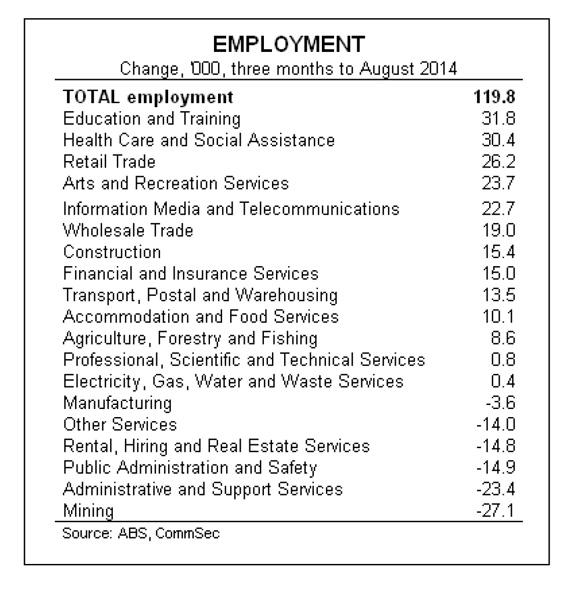
- Industry employment: Employment rose by 119,800 over the three months to August – the biggest quarterly increase in over almost a decade (since November 2004).
- Mining jobs fall: Mining employment fell by a record 27,100 jobs in the August quarter.
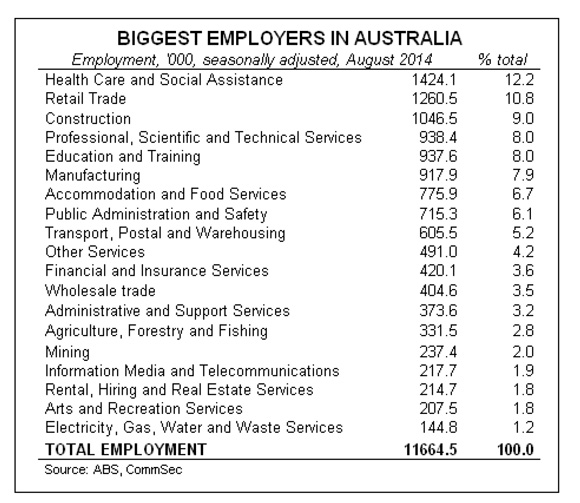
- More jobs in Education than Manufacturing. The number of people employed in the Education & Training sector now exceeds those employed in Manufacturing for the first time.
What does it all mean?
- The baton continues to be passed from mining to other parts of the economy. In the past three months, a record 27,100 jobs were lost in mining after falls in the previous six months. But more importantly, the jobs lost in mining and parts of the public service are being more than absorbed in other parts of the economy.
- The latest data confirms large scale job creation in the three months to August with more jobs created than at any three month period in a decade. More people in jobs, means more spending and therefore more momentum for the economy.
- Many Australians are still rubbing their eyes about the extent of job creation in the economy. But it is important to note that 97 per cent of businesses in the economy employ less than 20 people (88 per cent have less than four staff). And if small and medium-sized business picks up an extra worker here and an extra worker there, it all adds up.
- The Reserve Bank won’t be in a rush to change monetary policy settings. The RBA wants to ensure that the ‘baton change’ goes seamlessly and will make sure the baton isn’t dropped along the way.
- Australia continues to change from a manufacturing nation to that focussed on services. Thirty years ago manufacturing employed double the number of jobs as the education sector. Even a decade ago there were 30 per cent more people in manufacturing than education. Hopefully this new focus on education and training means a regular supply of productive staff for businesses.
What does the data show?
Industry employment:
- Economy-wide employment rose by 119,800 in the three months to August 2014 – the fastest growth in almost a decade (since the three months to November 2004). Over the year jobs rose by 252,500 – the most in three years.
- Employment rose in 13 of the 19 industry sectors. Employment rose most in Education & Training (up 31,800), followed by Health Care & Social Assistance (up 30,400) and Retail Trade (up 26,200).
- In the quarter, jobs fell the most in Mining (down by a record 27,100) followed by Administrative and Support Services (down by 23,400) and Public Administration and Safety (down by 14,900)
- Healthcare remains the biggest employer with 1.42 million employees (12.2 per cent of the total) followed by Retail Trade (1.26 million jobs or 10.8 per cent) and Construction (1.05 million or 9.0 per cent).
- Education & Training sector has passed Manufacturing for the first time in terms of people employed. Education & Training is the fifth largest employer with 937,600 jobs with Manufacturing at 917,900 jobs.
 What is the importance of the report?
- The Australian Bureau of Statistics (ABS) provides detailed labour market figures one week after releasing ‘top level’ statistics of employment & unemployment levels across states and territories. The detailed data is useful in identifying broader underlying trends and instructive about the health of the economy.
- In the broader (macro) economy, the job market trends are positive. More in jobs, and more businesses looking for staff. The lift in productivity and weak wage growth are further positives for the hiring of staff. And more people in work, means more spending. Jobs lost in some sectors are being picked up in others.
- But at a regional level, the changes in the job market mean a degree of pain is being felt. Mining regions are shedding jobs, causing workers to travel farther afield to get jobs or to shift into other industries such as construction.
- The Reserve Bank will continue to monitor the ‘baton change’ but it must be happy with what it sees. Rates clearly won’t be cut in coming months, but it is still too early to talk about rate hikes, especially with inflation well contained.
What are the implications for interest rates and investors?
- In the broader (macro) economy, the job market trends are positive. More in jobs, and more businesses looking for staff. The lift in productivity and weak wage growth are further positives for the hiring of staff. And more people in work, means more spending. Jobs lost in some sectors are being picked up in others.
- But at a regional level, the changes in the job market mean a degree of pain is being felt. Mining regions are shedding jobs, causing workers to travel farther afield to get jobs or to shift into other industries such as construction.
- The Reserve Bank will continue to monitor the ‘baton change’ but it must be happy with what it sees. Rates clearly won’t be cut in coming months, but it is still too early to talk about rate hikes, especially with inflation well contained.


