
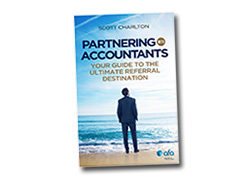
‘Partnering with Accountants’ by Scott Charlton
In this first instalment of a special three part series, guest contributor Scott Charlton provides some insights about how to make an accountant much more at ease in dealing with you. These insights are an extract from Scott’s recently released book, Partnering with Accountants.
Quick summary: To fast track confidence in you as a reliable business partner,help the accountants do their due diligence.
In this article, we are going to cover the first of a three-part system which will enable you to engage in meaningful dialogue with accountants much earlier than you likely have experienced to date. Having a professional process will provide you with confidence, create a good impression and let the accountant know you have value to add.
True story. I met an accountant via Linked In and in subsequent correspondence ascertained that he was looking for a referral relationship. A meeting with a planner located near the accountant’s office was duly arranged and the three of us met up for a discussion. The meeting proceeded well, with the accountant asking a range of questions of the planner. After the meeting I reflected upon the questions that the accountant had asked which thoroughly canvassed the issues I would have asked in his situation. It occurred to me – “If these questions are so predictable, not only can we prepare for them, but we can influence the outcome.”
As illustrated by the following case study, this realisation is quite significant.
True story. In a previous role I was part of a team which was endeavouring to recruit the financial planning arm of an accounting firm to our dealer group. The managing partner of the accounting firm organised a “beauty parade” of candidates and over the ensuing months conducted a series of meetings. The process dragged out endlessly and by the end I became convinced that he couldn’t remember what he had discussed with who. In the end, the accountant realised he’d spent way too long on the matter and made a decision. Happily, we got selected but it was a torturous process for all concerned.
So, for anyone who has invested meeting after meeting with an accountant without seemingly getting anywhere, this article is for you.
Cutting to the chase
Why not actively help accountants to do due diligence on you? Giving them the questions and helping them find the answers will quickly put the accountants in a position to make a decision. No longer will they be procrastinating, wondering what else they should have asked. No longer will they defer making a decision because they have forgotten what they have previously ascertained. Now it’s a case of if they would like to proceed. Whether they do or whether they don’t, at least you know where you stand. Quickly.
So here’s how this works in practice. Having ascertained that there is a degree of interest from the accountant in working with you, steer the conversation along the following lines –
You. Do you mind if I make a suggestion? I know that referring your clients to someone else is a responsibility you take very seriously. Before sending any clients to me, you will naturally want to check us out. To help you do this, I’ve taken the liberty of preparing this checklist of items that in your shoes, I’d want to know. (Hand over the checklist.)
Accountant: Thanks.
You. On the list I’ve included things like our web address and a prompter to look at my Linked In profile. I’ve also put together an information pack containing all the items referred to in the checklist such as our fee schedule, some case studies and testimonials. (Hand over the package.)
Accountant: OK.
You. I know that your time is precious so hopefully you will find this helpful in terms of making a decision about whether to entrust us with your clients.
An example due diligence checklist can be accessed from Scott’s website.
You will find the checklist to be self-explanatory. Naturally, you should add other items to the list where you have resources or a track record that will present you in a favourable light. This could include (say) links to video clips, details of your community involvement and/or fund raising for worthy causes. Equally, delete items on the list that don’t apply or where you don’t currently have resources.
The checklist covers approximately half of the items that accountants will either consciously or subconsciously want to know about you. The remaining items are covered by the document which will be introduced in the second instalment in this special series for AdviserVoice readers.
Action
The checklist referred to above picks up on a number of issues covered elsewhere in Partnering with Accountants. It’s likely that you will have some items to address before you actually put this into practice. Clearly, there is no sense giving an accountant the checklist if you don’t measure up!
- Consider any other aspects that will present your firm favourably and add these to the list
- Delete any items which are not relevant to your firm
- Compile an information pack consisting of all the items referred to on your checklist. Package this nicely in a bound report or presentation folder
- Role play the process of introducing the checklist and handing it to the accountant
That concludes the first of our three part series on fast tracking a relationship with an accountant. The next part of the series will explain how you can proactively address the concerns that accountants will inevitably have about referring their clients to you. Quite simply, the fewer doubts they have about entrusting you with clients the more likely they are to refer.
Formerly an accountant in practice, Scott Charlton is a business coach who works with both accountants and financial planners. Scott is the author of Partnering with Accountants, your guide to the ultimate referral destination.
To receive a free copy of Scott’s latest book, be one of the first five readers to email: [email protected], with “Partnering with Accountants” in the subject header.


