
Much has been written about the bleak medium-term outlook for euro-area growth. We agree with most of this. But that doesn’t mean the business cycle is dead. In our view, the conditions for a cyclical rebound in euro-area growth are currently better than they’ve been at any time since the global financial crisis struck. Consensus forecasts for 2015 growth are too low and likely to move higher.
Few investors are still unaware of the huge medium-term challenges facing the euro area—particularly the risk that it might be trapped in a period of very low nominal growth. But it’s important to realize that, this year at least, the economy is likely to benefit from powerful cyclical tailwinds.
The most obvious of these are the oil price and the exchange rate. In euro terms, the oil price is currently about 35% below its average level in the first half of last year, while the euro’s trade-weighted exchangerate index has fallen by almost 10% over the same period. Using standard rules of thumb, these two changes should add roughly 1% to economic growth in the coming year.
Real Income Boost
So far, the most visible impact of the lower oil price has been on headline inflation, which slipped to -0.6% in January. Not surprisingly, this has added to concerns that the region is slowly succumbing to deflation. But it’s important to remember that the drop in the oil price will have a positive impact on real income growth in the euro area—similar, in essence, to the fiscal impulse that would be provided by a reduction in value-added tax rates.
In the third quarter of 2014, the last period for which data are available, annual growth in nominal wage and salary income in the euro area rose to 2.3%. If, as seems likely, a similar growth rate is recorded in the first quarter of the current year, annual growth in real labor income should rise towards 3.0%. This would be close to the cyclical peaks seen in 2001 and 2006/07 (Display 1), when consumer-spending growth was considerably stronger than it is at present.
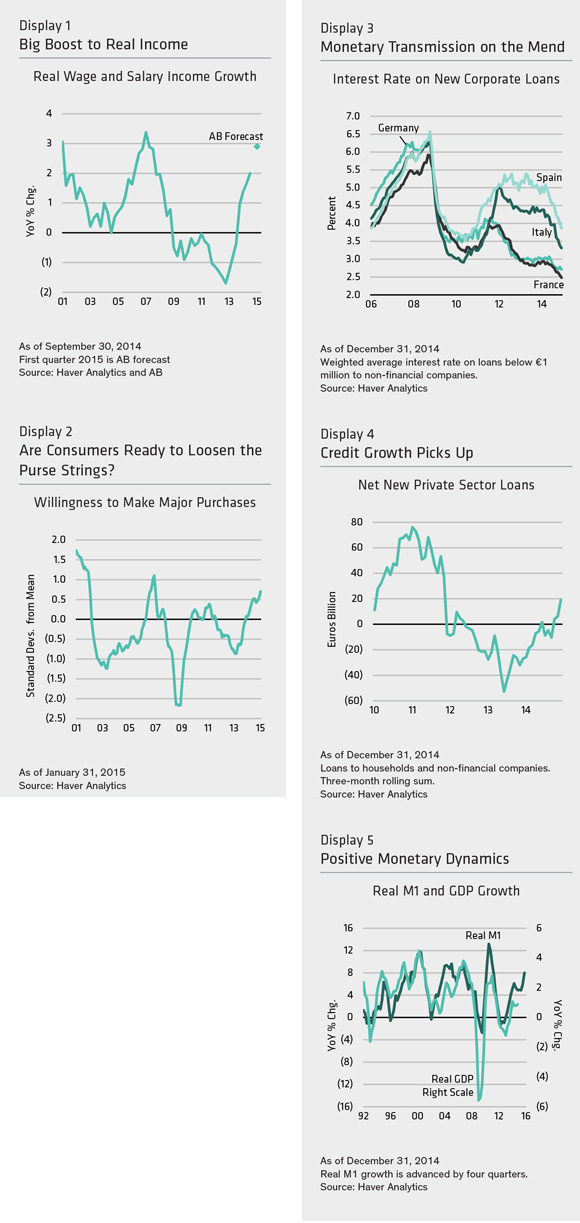
Much will depend on the extent to which consumers decide to spend or save the windfall gain from oil. It’s not certain which way they’ll swing. However, we’re encouraged by the recent pickup in consumer confidence, particularly indications that households may be more willing to make major purchases than they have been at any time since 2006 (Display 2). The theory that falling prices will encourage consumers to postpone purchases remains unproven, in our view: there’s certainly little evidence of it in the euro area at present.
Supportive Policy Mix
Importantly, these positive developments are occurring at a time when the policy mix in the euro area has become more supportive of growth. After a period of damaging austerity between 2010 and 2013, our estimates suggest that the overall fiscal stance for the region is likely to be neutral/mildly expansionary this year. Hardly the aggressive stimulus many observers would like to see, but an important step in the right direction (at least so far as economic growth is concerned).
Improved Money and Credit Dynamics
One of the euro area’s biggest problems in recent years has been the fragmentation of the single monetary policy. Among other things, this has led to companies in the periphery being charged considerably more to borrow money than those in core countries.
However, as Display 3 highlights, bank lending rates for Italian and Spanish companies have fallen sharply in recent months. Although rates are still higher than in Germany or France, this indicates that the single monetary policy is becoming less fragmented and that the monetarytransmission mechanism is starting to recover.
This is also the message from recent bank lending data. In the final quarter of 2014, net new loans to euro-area households and firms rose by €19 billion. Not only was this the best quarter since the beginning of the credit crunch in 2011 (Display 4), but the mix was also encouraging, with loans to nonfinancial companies finally starting to pick up (note that mortgage borrowing continued to grow throughout the crisis).
Recent monetary developments also point to brighter times ahead. The narrow money aggregate M1* has long been regarded as a possible leading indicator for euro-area growth. In December, real M1 growth was running at 8.0%, the fastest growth rate since May 2010. Moreover, with inflation falling steeply in January, it’s likely to rise even further in the new year. If M1 is any guide, a significant acceleration in output growth looks possible in the coming year (Display 5).
Cyclical Outlook
Brightens In recent years, much has been written about the bleak medium-term outlook for euro-area growth. We agree with a lot of this. But that doesn’t mean the business cycle is dead. In our view, the conditions for a cyclical pickup in euro-area growth are better today than they have been at any time since the onset of the global financial crisis. Against this backdrop, consensus forecasts for euro-area growth are probably too low and look set to move higher (we expect 1.5% growth this year compared with the current consensus estimate of 1.1%).
Of course, there are important caveats to consider. One relates to a possible breakdown in the bailout negotiations between Greece and its euro-area partners. However, so long as this doesn’t result in a default and/or euroarea exit, we doubt this will have a material impact on growth elsewhere in the region.
Another is that faster real growth is likely to come largely at the expense of lower prices. This means that nominal growth— the key for debt sustainability—is likely to be little changed this year at 1.8% after 1.6% in 2014. Still, this is likely to keep the European Central Bank firmly in accommodative mode—even if, as we expect, growth surprises on the upside.
By Darren Williams, Senior European Economist—Global Economic Research and Dennis Shen, Economic Associate—Global Economic Research,, AllianceBernstein
———-


