
The annual National People’s Congress broke little news, but it offered some clues on economic policy direction in 2015. On the whole, we expect Beijing to continue supporting growth to make sure its reform agenda remains on track. But the policymakers will be wary of excessive re-leveraging and will likely take a conservative approach, in our view.
Balancing Act Chinese premier Li Keqiang’s news conference after the annual session of the National People’s Congress (NPC) yielded no surprises, but he rehashed several important points that helped shape China’s economic outlook for 2015.
The big focus is on striking a balance between structural reform and growthsupport measures. Even though China has managed this quite deftly over the past few decades as it modernized its economy with great speed, the difference today is that the population has aged and labor supply has tightened markedly, while growth faces a more structural slowdown.
The premier acknowledged that the ongoing structural changes—e.g., fiscal reform, local government debt restructuring, interest-rate liberalization, state enterprise reforms, the retiring of excess capacity in various industries and stronger environmental controls—were generating a drag on near-term growth despite their longer-term benefits. He therefore emphasized the need to provide policy support to cushion the impact of the current economic slowdown. Importantly, Mr. Li stressed that the central government still had plenty of ammunition in its arsenal to avoid a hard landing, particularly as it has not used any major stimulus measures over the past two years despite decelerating growth.
In our view, this implies the policymakers’ recognition of the need for some policy easing—both monetary and fiscal—to mitigate some of the growth headwinds. Continued reductions in the reserve requirement ratio (RRR) for banks and cuts in lending rates should come through, in addition to “selective easing” targeted at specific sectors (e.g., small- and mediumsized enterprises) and industries (e.g., key infrastructure projects).
Mr. Li also touched on one of the market’s greatest concerns in 2015—credit defaults and local government debt restructuring— although the language remained balanced, basically saying that Beijing will allow more individual defaults, but only as long as they do not jeopardize systematic stability.
Beijing’s stance on tightening control on environment protection, meanwhile, was more straightforward. After all, the issue of health and the environment has become a top social concern in recent years.
Slowdown Continues Despite Policy Easing
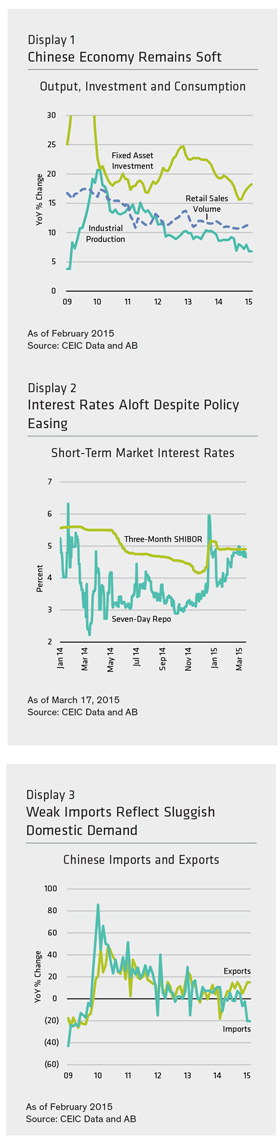
Latest data on January–February economic activity such as industrial output, fixed asset investment, retail sales and trade show continued weakness (Display 1). This is despite the fact that the People’s Bank of China (PBOC) has cut the RRR and lending rates, as well as easing credit for various sectors and industries. The credit easing has been more generous than in late 2014—mainly through the formal bank loan channel, as shadow banking was kept under tight security.
Indeed, overall liquidity conditions have actually remained quite tight, as indicated by the stubbornly high short-term market rates, where the seven-day repo rate and the three-month interbank rate have stayed aloft at 4.8% and 4.9%, respectively (Display 2). In our view, this suggests that the central bank, despite its monetary easing measures, is still mindful of the risk of injecting too much liquidity and triggering re-leveraging in an already debt-laden environment.
China Unlikely to Opt for QE…
We don’t put too much stock in recent rumors in the market that the PBOC may be considering a “quantitative easing (QE)” policy. As Premier Li mentioned, Beijing has numerous tools to directly adjust liquidity—cutting the RRR, lowering the 75% loan-to-deposit ratio, or relaxing banks’ loan quota, just to name a few. These options, if fully utilized, should be much more effective than the QE framework currently adopted in a number of developed economies.
Moreover, monetization of fiscal deficit is prohibited in China by the central bank law, which was implemented after bouts of hyperinflation in the 1980s and the early 1990s when the PBOC printed money to cover the expanding fiscal shortfall.
A more appropriate way to alleviate the systemic risks stemming from local government debt on banks’ balance sheets would be, as Beijing has already stated, to use bond swaps to spread out duration so that a concentration of maturities can be avoided and yields can be contained.
…or Imminent Widening of RMB Band
Latest trade data showed that Chinese exports grew 15% year on year in January and February, while imports contracted by 20%—with about a third of the decline attributable to lower oil prices. We would not read too much into these figures, as data for the first two months of the year tend to be choppy anyway because of the different timings of the Chinese New Year holidays. Furthermore, in recent years the figures for the first few months have been distorted by over-invoicing and under-invoicing problems (Display 3).
Essentially, the January–February trade data seem to suggest that exports have done better than expected, while the sharp import decline, except in oil, raises some concern that domestic demand is struggling. The stronger exports and weaker imports, resulting in another record trade surplus (US$120 billion in the first two months, compared with just US$9 billion a year earlier) argue for a stronger exchange rate policy.
Still, we are maintaining our view that the chances of a widening of the CNY/USD trading band are less than even in the foreseeable future, and that the PBOC will continue to use the combination of weaker fixing rates and intervention in the spot rate to defend the current regime.
by Anthony Chan, Asian Sovereign Strategist—Global Economic Research, AB


