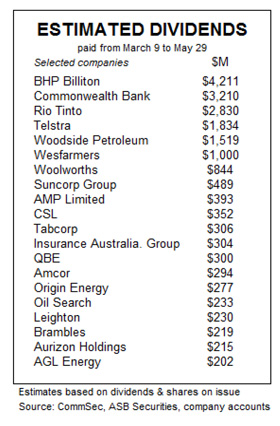
Dividend bonanza: Over the next two months, conservatively around $25 billion will be paid out by companies in dividends to shareholders, representing 1.5 per cent of the economy (GDP).
Dividends in vogue: The majority of companies reporting half-year earnings results (86 per cent) chose to pay a dividend and 75 per cent of these companies lifted or maintained dividends.
Injection into the economy: Over the week to April 3, almost $10.8 billion will be paid out by listed companies to their shareholders.
The Profit Reporting Season – Cash levels still high
Regular readers would be aware that each six months CommSec undertakes a detailed review of the profit reporting season – the time when companies report half-year or annual results for the period to June or December. (There is a far smaller proportion of companies with a different reporting year, such as March or September).
As a recap, the past reporting season was merely OK after two seasons in which Corporate Australia posted stellar results. Profits rose modestly, cash levels eased but companies were still keen to pay dividends to shareholders.
CommSec has assessed the results of all the ASX 200 companies that reported earnings for the six months to December 2014.
In aggregate, revenue grew by 0.2 per cent to $298.2 billion while expenses grew by 3.3 per cent to $241.4 billion, leading to a 26.2 per cent fall in net profit to $25.7 billion. (In the full-year earnings to June, profit rose 31.4 per cent).
But there was also a sharp lift in the variability of bottom-line earnings. That is highlighted by the fact that 58 per cent of companies lifted profits, just below the long-term average of 60 per cent. Stripping out ‘outliers’, aggregate profits rose by 4.4 per cent. Underlying earnings per share rose by 0.6 per cent.
The good news is that just over 86 per cent of companies reported a profit, in line with the long-term average but down from 89 per cent last season. Of companies reporting profits this season, 65 per cent lifted profits.
One of the features of the profit reporting season is what companies decide to do with earnings. Now companies clearly have a choice about the best way they put these dollars to work. The funds could be held for potential merger and acquisition opportunities. The cash could be ploughed back into the firm in internal investment (upgrade systems, equipment) or expand/modernise existing assets (buildings, mines). And the funds could be returned to shareholders.
Clearly shareholders are interested in how their funds will be used. If the funds were just held in bank accounts, then shareholders would question whether their money was being used for the best purposes. And while some shareholders value extra dollars in their pockets, others want the company to grow, lift assets and future profits, with the hope that this will lift the share price.
In the last earnings season (year to June) cash levels were up by 31.1 per cent. But cash levels in the year to December actually fell by 10.1 per cent to $70.5 billion. Just over 54 per cent lifted cash levels. However it’s important to note that four companies account for half of total cash levels and five of the top eight companies reported lower cash levels than a year ago. If the top eight companies are excluded, cash levels at December 2014 were largely the same as a year ago.
Cash holdings reported by all ASX 200 companies that issued earnings statements to December (that is, either interim or full-year earnings) fell by around 2 per cent over the year to $105 billion.
The Cash Conundrum
The high level of cash holdings continues to attract the interest of shareholders, analysts, and the Reserve Bank alike. Shareholders are no doubt happy that companies remain active in paying dividends. But even some of these shareholders and a number of the analysts may be starting to question company priorities. High and consistent dividends attract investors to a particular company’s stock, in preference to other stocks or even other investments. It is a competitive market. But if companies aren’t adequately investing in their own businesses (new computers, equipment or more efficient buildings) then this may affect future profitability and dividends.
Companies may also miss out on opportunities to grow through mergers or acquisitions by instead focussing on paying out dividends or engaging in other capital management measures.
Clearly the preference of the Reserve Bank is that businesses keep their eyes open to opportunities to grow and become more efficient. It is very much in Australia’s interest that companies are productive, efficient and profitable. Over the past year, the Reserve Bank has been critical about the cautious and financially conservative strategies of Australia’s largest companies.
As has been the case for over a year now, companies remain active in using high cash levels to lift or maintain dividends. In aggregate, dividends rose by 2.2 per cent despite variable profits and lower cash reserves. And 86 per cent of all companies chose to pay a dividend, down from 89 per cent in the last reporting period but above the long-term average of 83.7 per cent. Of all companies issuing a dividend, 68 per cent lifted dividends, 24 per cent maintained dividends while only 8 per cent cut dividends.
Of all companies (not just those choosing to pay a dividend), 56 per cent lifted dividends, 10 per cent cut payments, just over 19 per cent elected to leave dividend payments unchanged while just over 14 per cent chose not to pay a dividend at all.
And of all the companies reporting full-year results to December, all but three companies provided a dividend with 72 per cent of companies electing to lift or maintain dividend payments
One aspect of the accounts of listed companies that tends to be misunderstood is the issue of the payout ratio. That is, the proportion of profits that are paid out as dividends. Many companies have a target payout ratio to ensure that both adequate funds are retained for internal investment and that shareholders adequately share in the fortunes of the company.
A recent study by Henderson Global and highlighted by noted company director Don Stammer indicated that Australian companies pay out around two thirds of their earnings as dividends, “more than double the dividend payout ratio of US businesses.”
When large companies report significant profits, there can be an outcry from some parts of the community, largely from people that aren’t active sharemarket investors. But it is important to note that a significant proportion of the profits are returned to shareholders as dividends.
For instance, BHP Billiton reported an underlying attributable profit of US$5,352 million for the six months to June and interim dividends were lifted by 5 per cent to US62 cents per share, representing a payout of 62 per cent. Clearly a mining company needs to keep funds on hand for maintenance or expansion of resources or for future acquisitions. BHP Billiton noted though: “Following the proposed demerger of South32, BHP Billiton will maintain its progressive dividend policy and any dividends from South32 will represent additional cash returns to shareholders.”
Alternatively, Commonwealth Bank reported a cash profit of $4,623 million and indicated that “The dividend payout ratio (cash basis) of approximately 70 per cent of cash NPAT (net profit after tax) is in line with the prior year and consistent with the Board’s full year target of paying out between 70 and 80 per cent of cash NPAT”
Dividends can be paid to shareholders “fully franked” – where the company has already paid tax on the distribution – or partly-franked or unfranked.
And another key point when it comes to dividends is that they mean different things to different people. Some shareholders have elected to receive dividends as cash, others have elected that the dividends are reinvested (used to lift shares held). And of course the shareholders receiving the dividends are different – some are local investors, superannuation funds, listed investment funds or foreign shareholders – just to name some of the different groups.
ASB Securities provides a calendar showing the dates when companies go ex-dividend, that is, trade without the benefit of their dividends. ASB Securities also have a calendar detailing when companies are scheduled to pay out dividends. But the actual dollar value of dividends to be paid out by companies is generally less known.
Using iRESS data showing the number of shares outstanding, CommSec has estimated that almost $24.7 billion will be paid to shareholders from early March to late May 2015. The key period for dividend payments is the three-week period beginning March 23 and ending April 14.
Over the three week period to April 14 almost $20.8 billion will be paid out as dividends by listed companies: in the week to March 27, dividends totalling $4.8 billion will be paid, in the week to April 3, $10.75 billion will be paid out as dividends; and in the week to April 10 dividend payments of almost $5.2 billion will be made.
As noted before, some of these dividends will be put to work in the Australian economy while other dividends will be paid to offshore investors.
For some investors the dividends received over coming weeks will represent nice surprises. Certainly any payments received will cause shareholders to reflect on their investments and potentially seek new opportunities.
Other investors will put any extra dollars to work in retail therapy.
Other investors know exactly the payments to be received and have already worked out how the payments will be utilised.
But for all shareholders, the dividend payouts will serve to boost confidence levels and will highlight the strong position of Corporate Australia.
Companies have been reluctant to spend, invest or employ. But the redistribution of money from companies to consumers will put dollars in people’s pockets and hopefully provide useful stimulus to the Australian economy.
The Profit Reporting Season – Dividends flow freely
As has been the case for over a year now, companies remain active in using high cash levels to lift or maintain dividends. In aggregate, dividends rose by 2.2 per cent despite variable profits and lower cash reserves. And 86 per cent of all companies chose to pay a dividend, down from 89 per cent in the last reporting period but above the long-term average of 83.7 per cent. Of all companies issuing a dividend, 68 per cent lifted dividends, 24 per cent maintained dividends while only 8 per cent cut dividends.
Of all companies (not just those choosing to pay a dividend), 56 per cent lifted dividends, 10 per cent cut payments, just over 19 per cent elected to leave dividend payments unchanged while just over 14 per cent chose not to pay a dividend at all.
And of all the companies reporting full-year results to December, all but three companies provided a dividend with 72 per cent of companies electing to lift or maintain dividend payments
Dividends – Not all the same
One aspect of the accounts of listed companies that tends to be misunderstood is the issue of the payout ratio. That is, the proportion of profits that are paid out as dividends. Many companies have a target payout ratio to ensure that both adequate funds are retained for internal investment and that shareholders adequately share in the fortunes of the company.
A recent study by Henderson Global and highlighted by noted company director Don Stammer indicated that Australian companies pay out around two thirds of their earnings as dividends, “more than double the dividend payout ratio of US businesses.”
When large companies report significant profits, there can be an outcry from some parts of the community, largely from people that aren’t active sharemarket investors. But it is important to note that a significant proportion of the profits are returned to shareholders as dividends.
For instance, BHP Billiton reported an underlying attributable profit of US$5,352 million for the six months to June and interim dividends were lifted by 5 per cent to US62 cents per share, representing a payout of 62 per cent. Clearly a mining company needs to keep funds on hand for maintenance or expansion of resources or for future acquisitions. BHP Billiton noted though: “Following the proposed demerger of South32, BHP Billiton will maintain its progressive dividend policy and any dividends from South32 will represent additional cash returns to shareholders.”
Alternatively, Commonwealth Bank reported a cash profit of $4,623 million and indicated that “The dividend payout ratio (cash basis) of approximately 70 per cent of cash NPAT (net profit after tax) is in line with the prior year and consistent with the Board’s full year target of paying out between 70 and 80 per cent of cash NPAT”
Dividends can be paid to shareholders “fully franked” – where the company has already paid tax on the distribution – or partly-franked or unfranked.
And another key point when it comes to dividends is that they mean different things to different people. Some shareholders have elected to receive dividends as cash, others have elected that the dividends are reinvested (used to lift shares held). And of course the shareholders receiving the dividends are different – some are local investors, superannuation funds, listed investment funds or foreign shareholders – just to name some of the different groups.
The Dividend Timeline
ASB Securities provides a calendar showing the dates when companies go ex-dividend, that is, trade without the benefit of their dividends. ASB Securities also have a calendar detailing when companies are scheduled to pay out dividends. But the actual dollar value of dividends to be paid out by companies is generally less known.
Using iRESS data showing the number of shares outstanding, CommSec has estimated that almost $24.7 billion will be paid to shareholders from early March to late May 2015. The key period for dividend payments is the three-week period beginning March 23 and ending April 14.
Over the three week period to April 14 almost $20.8 billion will be paid out as dividends by listed companies: in the week to March 27, dividends totalling $4.8 billion will be paid, in the week to April 3, $10.75 billion will be paid out as dividends; and in the week to April 10 dividend payments of almost $5.2 billion will be made.
As noted before, some of these dividends will be put to work in the Australian economy while other dividends will be paid to offshore investors.
What are the implications for investors?
For some investors the dividends received over coming weeks will represent nice surprises. Certainly any payments received will cause shareholders to reflect on their investments and potentially seek new opportunities.
Other investors will put any extra dollars to work in retail therapy.
Other investors know exactly the payments to be received and have already worked out how the payments will be utilised.
But for all shareholders, the dividend payouts will serve to boost confidence levels and will highlight the strong position of Corporate Australia.
Companies have been reluctant to spend, invest or employ. But the redistribution of money from companies to consumers will put dollars in people’s pockets and hopefully provide useful stimulus to the Australian economy.
Share prices move every day. The underlying value of the businesses behind those prices does not move nearly as often, or as much. That distinction matters more than usual right [...]
For many years, investment bonds have occupied a relatively small corner of the Australian investment landscape. While familiar to some advisers, others may have had limited reason to consider them [...]
Key takeaways The global system is becoming more fragmented and policy-driven, leading to more uneven and less predictable market outcomes. Geopolitical risk is now persistent, showing up not just in [...]
The Financial Planners and Advisers Code of Ethics (Code) has sat at the centre of adviser conduct in Australia since it became mandatory on 1 January 2020. This article, proudly [...]
Complaints are so big right now 2026 has been a big year for financial services complaints, and not just numerically. Certainly, the volume of complaints is noteworthy. AFCA data[1] released [...]