
Next week probably represents the last chance for the Greek government and its official creditors to reach an agreement and prevent a default. If the negotiations fail, bankruptcy and capital controls are likely to follow. This would not necessarily lead to euro-area exit, but would certainly represent an important step in that direction.
 As widely expected, the latest meeting of euro-area finance ministers—the Euro-group—ended without an agreement between Greece and its official creditors. The mood of the subsequent press conference was somber, and hopes of a deal to avoid Greece defaulting on a payment to the International Monetary Fund (IMF) on June 30 are fading fast. Indeed, the head of the Eurogroup said that the disbursement of funds before the end of the month is now “unthinkable”.
That doesn’t quite mean Greece has reached the end of the road. As German Chancellor Angela Merkel said recently, “where there’s a will there’s a way”. If an agreement can be reached at an emergency European Union (EU) summit next Monday, there are still ways to avoid an immediate bankruptcy. But, for that to happen, Greece will have to make new concessions and, despite the high stakes involved, has given no indication that it’s willing to do so. Without Greek concessions, Monday’s summit might be as much about contingency planning as trying to avoid a default.
There are various interpretations of the Greek government’s negotiating strategy.
One is that it wants to take the negotiations down to the wire in the hope that its euro-area partners will “blink” and that it will be able to secure the best deal available (i.e. one that includes up-front debt relief). The other possibility, and one that we have long feared, is that the gaps between the two sides are simply too big to bridge.
It’s hard to know which of these interpretations is correct. Based on developments so far, there are few grounds for optimism. But we also recognize that both sides have a lot to lose and that the EU has a long history of flexible deadlines and last-minute compromises. One thing does seem clear, though. Unless euro-area leaders are willing to overrule their finance ministers (and risk losing the IMF’s involvement in the process), the main concessions will have to come from Greece.
Point of no return?
So what happens if Greece’s euro-area partners don’t blink and the Greek government doesn’t back down?
 In our view, it’s then reasonable to assume that Greece will default on the IMF at the end of the month and exit its international bailout at the same time (thus losing potential access to €18 billion of undisbursed funding). It’s also difficult to see where the government would find the funds to redeem a €3.5 billion bond, held by the European Central Bank (ECB), on July 20.
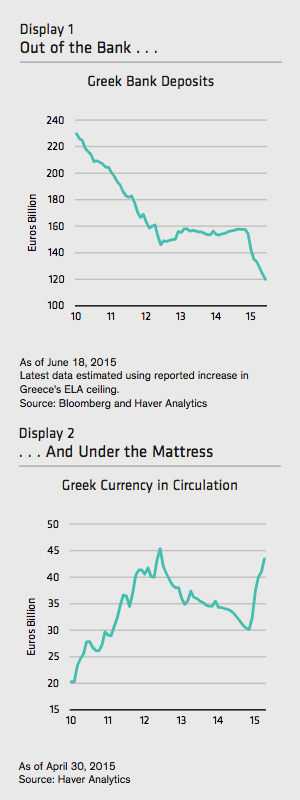
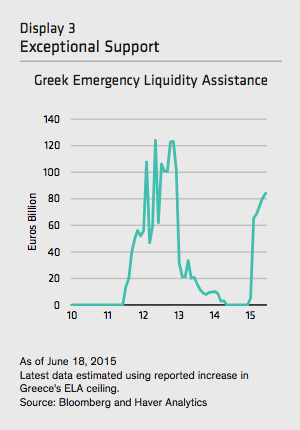
In recent months, the ECB has single-handedly kept the Greek banking system afloat in the face of huge deposit outflows (Displays 1 and 2). It has done so by providing the banks with enormous amounts of emergency liquidity assistance, or ELA (Display 3). In our view, this will no longer be possible if Greece defaults on the IMF. Capital controls would surely follow (if they’re not imposed before then to stem accelerating deposit/capital flight).
This would be a catastrophic scenario for the Greek economy, which would be plunged into an even deeper recession, pushing the public finances further off course. It would not necessarily lead to Greece leaving the euro—most Greeks are in favor of the single currency, though not the reforms that come with it—but it would clearly represent a step in that direction.


