Consumer confidence; ABS Home prices; Tourism data
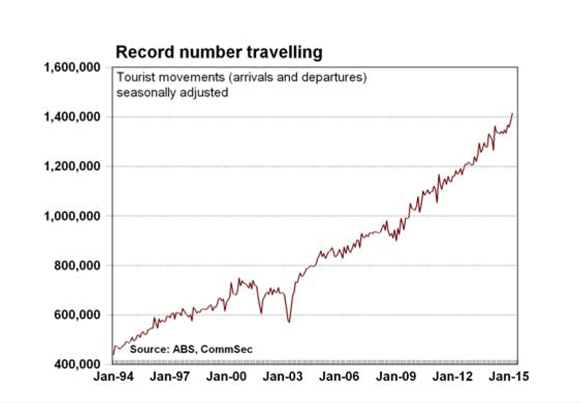
Tourism flows: Tourist arrivals rose by 2.4 per cent in March while departures also rose by 2.4 per cent. There were a record 1.41 million people either coming to Australia on holidays in March or travelling abroad. Tourism flows are up 11.9 per cent on a year ago – the strongest growth in three years.
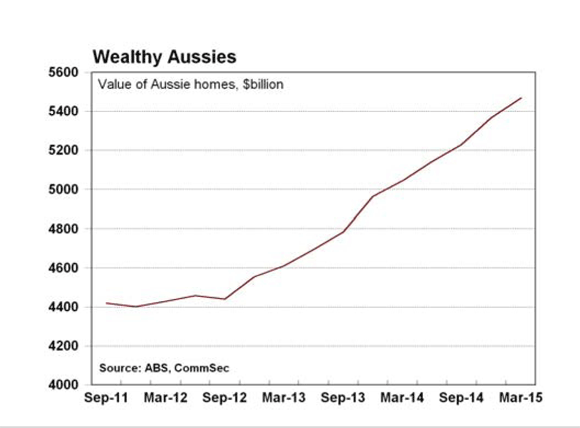
Valuable homes: The value of all Australian homes stood at $5,468.5 billion in March, up 8.4 per cent on a year ago. The more valuable homes have boosted the average wealth of each Australian family by $18,000 over the past year.
ABS home prices: Residential property prices rose by 1.6 per cent in the March quarter to be up 6.9 per cent on a year ago. The data is relatively old as CoreLogic RP Data home price figures for June are out next Wednesday.
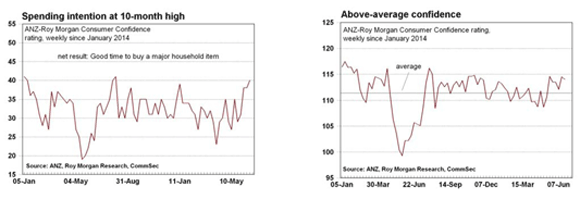
The weekly ANZ/Roy Morgan consumer confidence rating fell by 0.4 per cent last week after rising by 2.1 per cent in the previous week. Confidence is up 7.9 per cent over the year and still above short-term and long-term averages.
China manufacturing: The “flash” Chinese purchasing managers index for manufacturing rose from 49.2 to 49.6 in June, above forecasts of 49.4.
The consumer confidence figures have implications for retailers, and other consumer-focussed businesses. The tourism data is important for airlines, travel groups, transport companies and retailers.
What does it all mean?
A record number of Aussies went overseas on holidays in March and similarly a record number of foreigners visited our shores. For airport operators such as Sydney Airport the results are clearly encouraging. But the news is also good for airlines, travel-dependent companies and a raft of retailers. Travel is clearly in vogue.
The solid data on arrivals and departures doesn’t seem to gel with today’s profit downgrade by Flight Centre (FLT). But the company notes that total transaction value will hit record highs in 2014/15, rather it is lower gross margins that are weighing on FLT revenues.
The main value of the Bureau of Statistics data on residential property prices are the estimates of dwelling stock and value. And it is clear that the higher sales prices are serving to lift the value of all homes, and thus, household wealth. The value of all homes rose by $425 billion over the past year, adding $18,000 on average to the wealth of every household.
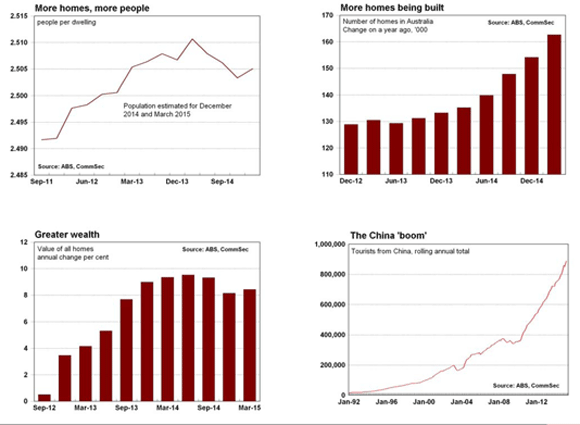
There is definitely no over-supply of homes in Australia. For the first time in a century, in 2007 the number of people per home started rising – more people occupying a dwelling. This trend only started to ease in the past year. And rental vacancy rates are still relatively tight.
There is little new to report on consumer confidence. Confidence to spend has lifted together with family finances. Those results gel with rising wealth levels and record low interest rates. But Aussie consumers are more circumspect on the outlook for the economy. Overall though, confidence levels remain above average.
What do the figures show?
Consumer sentiment
The weekly ANZ/Roy Morgan consumer confidence rating fell by 0.4 per cent to 114.0 in the week to June 21. Confidence is up 7.9 per cent over the year and up on the average of 111.4 since 2014.
Two of the five components of the index rose in the latest week:
The estimate of family finances compared with a year ago was up from +3 to +8;
The estimate of family finances over the next year was down from +25 to +24;
Economic conditions over the next 12 months was down from -2 to -7;
Economic conditions over the next 5 years was down from +9 to +5;
The measure of whether it was a good time to buy a major household item was up from +38 points to +40 points – a near 11-month high.
Averages:
Weekly ANZ-Roy Morgan Consumer Confidence 2015 Average 111.8
Monthly ANZ-Roy Morgan Consumer Confidence Average (1973 — September 2008) 107.4
Weekly ANZ-Roy Morgan Consumer Confidence Average (October 2008 — 2015) 114.5
·Overall ANZ-Roy Morgan Consumer Confidence Average (1973 — 2015) 108.8
Australian Bureau of Statistics Residential Property Prices:
The ABS measure of home prices rose by 1.6 per cent in the March quarter to be up 6.9 per cent on the year. The data is relatively old as CoreLogic RP Data home price figures for June are out next Wednesday.
The ABS reports that the mean dwelling price was $576,100 in the March quarter; and there were 9.49 million residential properties valued at $5.47 trillion.
The number of homes in Australia rose by 0.4 per cent in the quarter and by 1.74 per cent over the year. Meanwhile, the average value of all dwellings in Australia rose by 1.9 per cent in the quarter and by 8.4 per cent over the year.
The number of people per home was estimated at 2.505 in March 2015 – the first increase in a year.
Overseas arrivals & departures
Tourist arrivals rose by 2.4 per cent in seasonally adjusted terms in March to record highs. Arrivals are up 11.5 per cent over the year. Tourist departures rose by 2.4 per cent in March to record highs. Departures are up 12.3 per cent on the year.
Over the past year a record 888,400 tourists came to Australia from China, up 18.0 per cent over the year.
Over the past year, net permanent and long-term arrivals to Australia totalled 301,980 – the lowest level in 4 years (June 2011).
What is the importance of the economic data?
The ANZ/Roy Morgan weekly survey of consumer confidence closely tracks the monthly Westpac/Melbourne Institute consumer sentiment index but the former measure is a timelier assessment of consumer attitudes and is now closely tracked by the Reserve Bank.
The Australian Bureau of Statistics releases quarterly data on residential property prices each quarter. The data includes the value of all homes as well as the number of homes. The data is useful in monitoring wealth levels and changes in home prices with implications for consumer spending and home building.
The Australian Bureau of Statistics releases data on overseas arrivals and departures is produced monthly and is an indicator of the health of the tourism sector. The figures are also useful in understanding spending trends and tracking migrant numbers – an indicator with widespread implications for employment, housing and spending.
What are the implications for interest rates and investors?
Retailers will be encouraged by a number of today’s data releases. First, the value of homes continues to rise, boosting household wealth. Second, consumers think it is a good time to buy a major household item. And third, tourism numbers continue to soar, meaning there are plenty of people willing to spend.
In-bound migration is the lowest in four years, meaning that there is greater scope for unemployment to fall in the short-term before businesses need to resort to looking abroad for suitable staff.
CommSec expects no change to interest rate settings in coming months.
Share prices move every day. The underlying value of the businesses behind those prices does not move nearly as often, or as much. That distinction matters more than usual right [...]
For many years, investment bonds have occupied a relatively small corner of the Australian investment landscape. While familiar to some advisers, others may have had limited reason to consider them [...]
Key takeaways The global system is becoming more fragmented and policy-driven, leading to more uneven and less predictable market outcomes. Geopolitical risk is now persistent, showing up not just in [...]
The Financial Planners and Advisers Code of Ethics (Code) has sat at the centre of adviser conduct in Australia since it became mandatory on 1 January 2020. This article, proudly [...]
Complaints are so big right now 2026 has been a big year for financial services complaints, and not just numerically. Certainly, the volume of complaints is noteworthy. AFCA data[1] released [...]