
Football and finance: what Manchester United teaches us about the global economy and the business of sport
Peter Beer, Economist and Vice President at LA-based Payden & Rygel, manager of GSFM’s Payden Global Income Opportunities Fund, has peeked into the financial statements of the Manchester United Football Club. He’s found that elite sports team are among the organisations best positioned to profit from rising global wealth and interconnectedness.
The TV buzzes on in the living room. Pre-match pundits detail starting line-ups. You press open the microwave and gingerly remove a bag of popcorn. Beer foam bubbles out of a hand-chilling bottle. Dashing to the sofa, you are just in time to witness the first touches. Rooney kicks off. The Manchester United match is underway.
Now, we are not taking sides. Manchester United is but one example of a massively successful global sports team. Training kits and shirts struck in the infamous red and white are as popular in Kuala Lumpur as they are in Riyadh. Fans around the world huddle in smoky bars, craning their necks over friends’ shoulders to catch a glimpse of the action.
Manchester United is also one of the few global sports brands under public ownership, precisely why we’ve chosen to inspect it closely. The legendary English Premier League heavyweight must publish its financial statements for all eyes to see and scour.
For the many who wonder about the business of sports, here is a rare window into the numbers. For those curious about just how profitable such an ubiquitous sports brand actually is – we have some answers.
Like other elite sports franchises (read: Real Madrid), Man U’s financials tell of the profound impact wrought by globalisation and digitisation. No longer are packed stadiums the driver of sports profits.
Top performing sports teams capture massive gains from global sponsorship and broadcasting agreements, attract the best players from around the world, and reach fans everywhere on screens big and small. Few business models look as promising as those of great sports teams in the 21st century.
Money machine
Manchester United runs a profitable enterprise that pulls in significant revenue. In 2014, the team generated £433 million in sales. Of those sales, the club booked almost 15% as operating profit (for a total of £61 million). By way of rough example, that means for every £60 you spend on a shirt, £9 comes in as profit.
The football club breaks its revenues into three primary streams: commercial, broadcasting, and matchday. Commercial revenues (44% of the total) are from sponsorship agreements, merchandising agreements, and team tours.
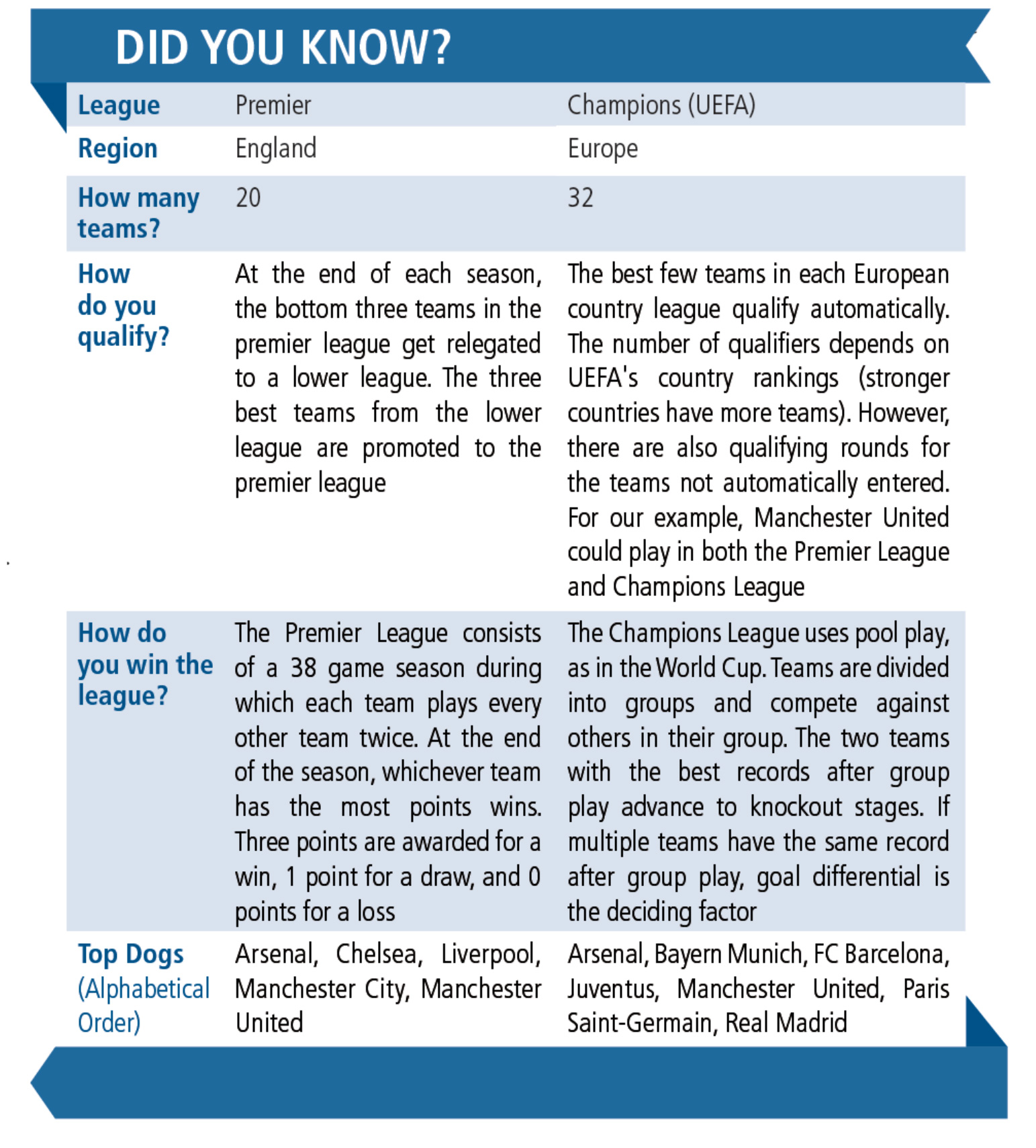
Broadcasting revenue (31%) is the result of media rights the club owns to televise Premier and Champions League matches (in case you are curious, two-thirds of broadcasting revenue is from the Premier League, while roughly one-third is from the Champions League–see the Did You Know Box).
Finally, the club earns matchday revenue (25%). Just as it sounds, this is the money made at the so-called Theatre of Dreams (Old Trafford Stadium’s sobriquet) on match days. Manchester United also gets a cut of “gate receipts” from other cup matches, even when it plays away from home.
2014 was a rough year for Manchester United. They finished seventh in the Premier League. It was the first year the club finished outside of the top three since 1991. Remarkably, though, despite their less-than-stellar performance, the club was still the world’s second largest revenue generating football squad (see Figure 1). Consider that FC Barcelona claimed first place in its league twice in the last four years and still collected less revenue than Manchester United.

What about those player expenses? Employee benefit expenses were fully 50% of total revenues, costing the club £215 million in 2014. New joiners like Ángel Di María, Ander Herrera, and Luke Shaw brought player costs up 19% in 2014 (see Figure 2). Not only does the club have to pay salaries to these prized players, they also have to pay transfer fees—the cost of buying a player out of his prior contract.
Man U’s transfer fees owed to other teams also rose, meaning their expenses could have been even higher. Transfer fees owed by Manchester United to other teams total just shy of £120 million as of December 2014. Talk about wage growth!

Going global
The key to Man U’s revenue generation is their global presence. As wealth rises around the world, internet access and television broadcasting will increase. The clubs with recognisable brands are those that stand to earn the most. In an age of binge-watching television shows and on-demand movies, live sports bring a special appeal to viewers.
Manchester United exemplifies the benefits of globalisation. Three pieces of evidence support such a claim: the comparative geographies of the team and its fan base, the specific ways in which United has made the lion’s share of its money lately, and the transformation of elite football rosters into world class all-star teams.
Manchester is a city of half a million people in northern England. With a town charter dating back to 1301, England’s unofficial second city however large, Manchester claims another distinction: it is home to two of the world’s most powerful football clubs.
Since the 1980s, United rode the wave of a globalising game that saw footballers from all over the world come to play in the Premier League. It was also Manchester United that led the English Premier League into European contests. It was the first English team to win the European Cup (now named the Champions League).
Manchester City more recently joined the global game, but has nevertheless quickly captured the imaginations of millions around the world.
An expanded fan base has coaxed open more pocketbooks than just those of supporters. Both Manchester United and Manchester City are currently under foreign ownership–a fact not universally celebrated, but a testament to the lure of these superlative teams.
In their annual filings from 2014, Manchester United boasted 659 million followers, a number equal to 10% of the world’s population. Such orders of magnitude are more fitting of religions. Only Christianity, Islam and Hinduism claim more followers.
Needing only a powerful brand and a history of thrilling football, the Red Devils faithful extend around the world. Given they have finished in the Premier League’s top three for 21 of the last 22 seasons (excluding 2014/15) and won the Premier League 13 times, it’s no surprise that the team garnered 64 million Facebook likes in 2013/14 alone.
The large fan base may be impressive, but you might wonder how Manchester United translates these dispersed supporters into a business. As mentioned above, the club earns a majority of its revenue from commercial agreements and broadcasting. But it hasn’t always been this way.
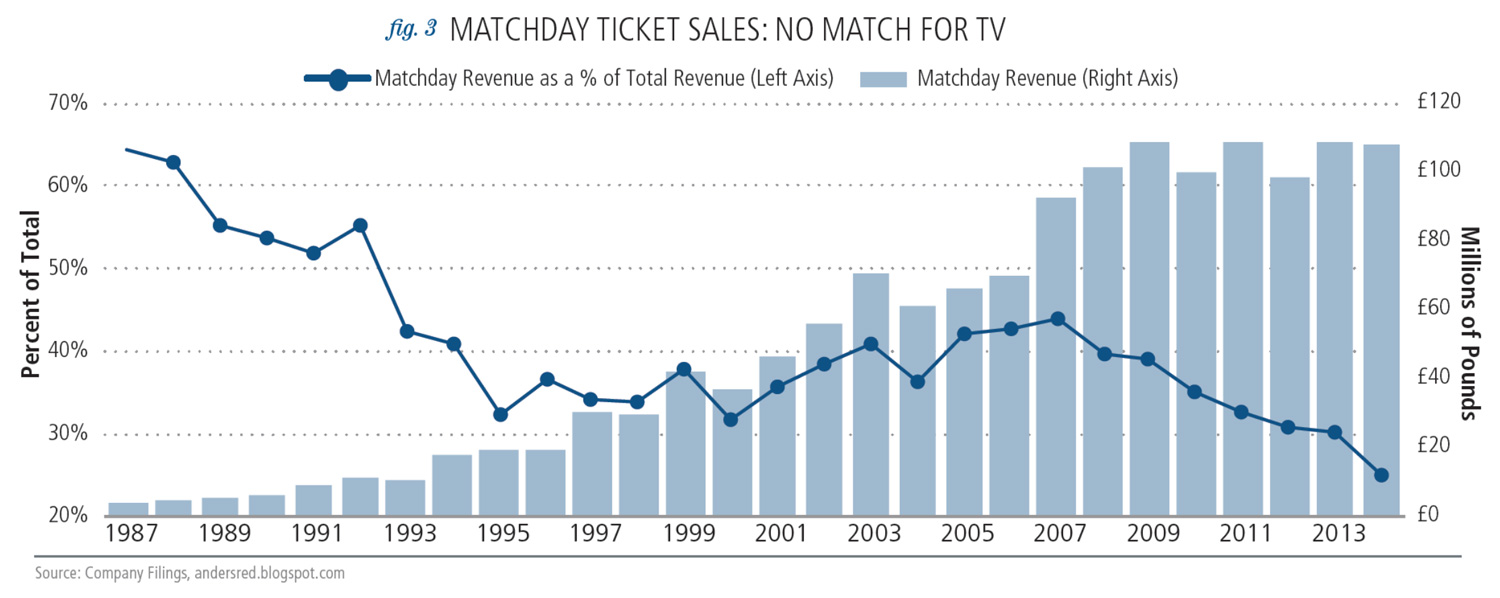
In 1987, matchday revenue accounted for 65% of Manchester United’s total revenue. By 2014, it was only 25% of total revenue (see Figure 3). That amounts to a 3.4% average annual decline in matchday revenue as a percent of the total. Note that matchday revenue increased from £4.2 million to £108.8 million since 1987; it’s just that other revenue sources have far outpaced it! Where has the growth come from?
The second visible way in which Manchester United has benefited from globalisation is the club’s massive boost in commercial revenue. This segment includes sponsorships, merchandising, and team tours. Remarkably, sponsorship revenue has exploded at a compound annual growth rate of 35% since 2009.
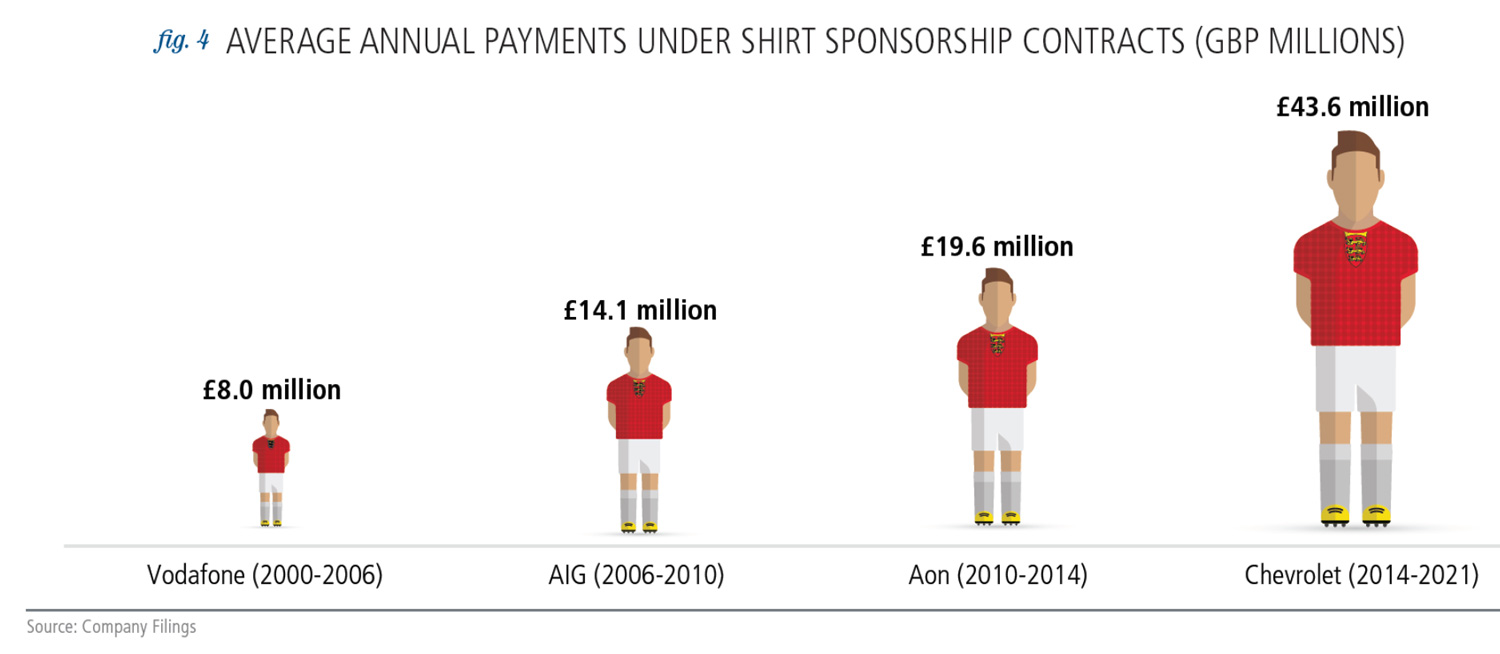
Part of that reflects a rebound in the global economy. But it was not just a rising global economic tide that lifted all boats. Where Vodafone once paid an average of £8 million per year to appear on every United shirt made, in 2014 Chevrolet agreed to pay the club an average of £44 million per year to appear on the club’s shirts (see Figure 4). The auto maker agreed to such a lucrative deal even despite Man U’s disappointing 7th place finish.
Chevrolet’s parent company, General Motors, wasn’t the only corporation ready to burst the dam on commercial agreements with Manchester United. German boot (cleat) maker Adidas recently dropped £750 million over ten years (£75 million/year) to be the official technical sponsor of Manchester United. The sum is only £40 million less than the club itself cost its new owners in 2005.
Compare that to the £24 million/year deal Nike initiated with Manchester United in 2002. The new Adidas deal with the Red Devils (Man U’s team nickname) is even richer than the £31 million/year they pay to Real Madrid for the same technical sponsorship. The other major difference between the two clubs? Real Madrid actually qualified for, and won, the Champions League in 2014.
Regardless of how we judge the sums paid, there is no doubt that the value of global sports teams is on the rise. The globalisation of sport has wrought changes on the top football clubs across Europe beyond lucrative endorsements and sponsorships. In 1980, Manchester United’s roster was disproportionately from the United Kingdom–25 of 26 players. Of their 26 listed players, 9 were from England, 8 from Ireland/North Ireland, 6 from Scotland, and 2 from Wales. There was only one non-UK native: Nikola Jovanović of Montenegro.
In 2014, things looked a bit different. Roughly 1/2 of the team’s roster was from outside of the UK. Across the Premier League, the data show the same. Through the 2013/14 season, players from locations other than England, France, Spain, Argentina, and Scotland played the plurality of minutes in the Premier League.
One man, though, has held strong. Ryan Giggs made his debut for Manchester United in 1991 and has since made 671 appearances, all for the Red Devils. Now the assistant manager of Manchester United, Giggs has played in more English Premier League matches than Manchester City’s team has in its entire history.
The 90th minute
Internationalisation is a good thing. Markets for footballers have become more competitive, and the chances that a young kid from the Amazon finds his way to the pitch at Old Trafford are as good as ever.
Fans and supporters benefit, too. English Premier League matches were broadcast live to over 200 countries in 2009. Indeed, in the space of two decades, “English football [has] moved from mainly being watched through physical attendance to being predominantly viewed digitally.” 1
Where we suggested that Manchester United’s increased proportional share of commercial revenue and decreased matchday revenue were writing on the wall, “the sale of broadcast rights outstrips matchday and other commercial income streams as the largest revenue generator at 16 out of the top 20 highest revenue generating teams in world football, contributing an average of 44% of each club’s total revenue.”2
With this walk through the finances of one of the world’s most prominent teams we hope you have a better sense of how globalisation and digitisation have turbo-charged elite sports franchises.
Organisations producing high-demand content are among those best positioned to thrive in the condensed, interconnected, informational 21st century. For better or for worse, the winner-take-all nature of global sports is here to stay.
Sources
1 David, M. and Millward, P. (2012). “Football’s Coming Home” Digital Reterritorialization, Contradictions in the Transnational Coverage of Sport and the Sociology of Alternative Football Broadcasts.” British Journal of Sociology., 63 (2). Pp 349-369.
2 Ibid.
———-


