
Indonesia’s decision to scrap domestic fuel subsidies and use the savings for needy infrastructure projects marks a big step forward for the country’s fiscal health. It not only lessens the burden of doling out subsidies, but represents a better allocation of resources, which should help to strengthen the economy.
The decline in oil prices over the past year has allowed the Indonesian government to scrap subsidies for domestic fuel and make good on its promise to reallocate resources to badly needed infrastructure investment. This, in our view, is a potential game changer for Indonesia’s sovereigndebt dynamics.
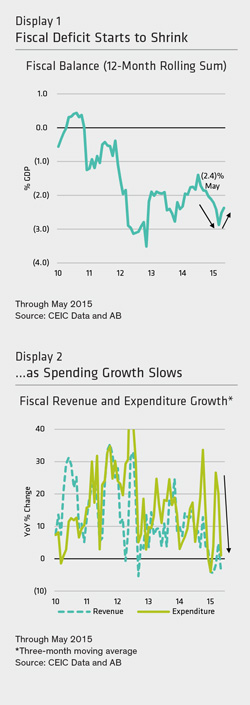 While the new administration led by President Joko Widodo has fallen short of the market’s high expectations in terms of reform execution, recent developments show that Indonesia’s fiscal position has started to improve, thanks to the reduced burden of the fuel subsidy. There have also been improvements in the disbursement of funds for infrastructure projects, which may help to revive the economy from its current doldrums.
Low Oil Price Helps
As global oil prices hit a low of around US$45 per barrel in January, the government scrapped major fuel subsidies, letting domestic fuel prices rise and temporarily push up inflation. At the same time, the government promised that some 60% of the savings from the subsidies—roughly 138 trillion Indonesian rupiah (IDR), or about US$11 billion—would be spent to kick-start key infrastructure projects. Combined, these steps amount to improved resource allocation—they implement a price reform and, at the same time, redirect resources to productive sectors of the economy that will contribute to long-term productivity advancement.
When world oil prices rebounded between March and early June, the pressure to resurrect fuel subsidies rose immediately, as local pumps found it hard to raise prices in synch with global crude prices. Fortunately, however, global oil prices have slumped again. The pressure to choose between boosting inflation further (as a result of more domestic fuel-price hikes) and resuming fuel subsidies is off again, and the government can now focus on implementing urgently needed infrastructure plans.
Significant Underspending
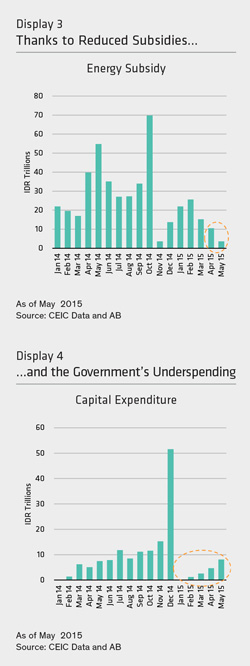
Officials have been frank about their underspending—so far, only 10% of the budgeted infrastructure expenditure for this year has been disbursed, and the government says it will try to spend at least IDR1 trillion a day in order to catch up with the plan. Bureaucratic bottlenecks and the slow setup of the new government are being blamed for the delay. Equally important, land acquisition is crucial to kick-starting infrastructure projects, but neither the central nor the local government has agreed on how to implement the new Land Acquisition Law because of different vested interests.
 Not all is bleak, though. A new National Land Agency and a central body to deliver infrastructure projects were recently established, and their head officials were appointed.
In any event, the infrastructure underspending and the subsidy cuts have resulted in reduced fiscal deficits in the second quarter. In our estimate, the fiscal shortfall has improved to 2.4% of gross domestic product (GDP) in May, from a peak of 2.9% in March on a 12-month rolling sum basis. The improvement wasn’t due much to improvement in revenue collection, but to the contraction in subsidies and capital expenditure. Continued weakness in oil and commodity prices should keep Indonesia in this fiscal sweet spot, which in turn should make more money available to the productive sectors of the economy (Displays 1-4).
Fiscal Outlook
We estimate that, if infrastructure spending is delayed continuously, Indonesia’s fiscal deficit could be trimmed down to 0.5% of GDP or less, as long as oil prices stay at current low levels. This is because fuel subsidies accounted for more than one-fourth of total budget spending—their reduction is having a large impact on the overall deficit.
However, from a broader perspective, this is only the second-best scenario. The best scenario is one in which infrastructure capital spending catches up, strengthening the supply side of the economy, while the fuel subsidy remains abolished for good. In this situation, we would expect the fiscal shortfall to be at around 1.5% of GDP in 2015. It would be a relatively modest reduction of the shortfall from last year’s 1.9%, but there would be more productive spending and less fiscal waste.
By Anthony Chan, Asian Sovereign Strategist, Global Economic Research, AB
———–


