
Despite the modest second quarter rebound, the economy’s growth rate has been generally sluggish over the past five years. This may suggest lower potential growth going forward—and less resource slack for the economy to grow without triggering a rebound in inflation. Third-quarter reports on jobs and wage growth will be critical for the Fed in determining when to start raising rates.
Modest Rebound in 2Q
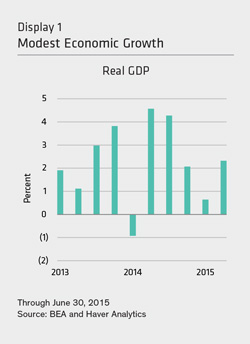
GDP In the second quarter, real gross domestic product (GDP) growth rose an estimated 2.3% annualized, following an upwardly revised gain of 0.6% in the first quarter (Display 1), according to the Bureau of Economic Analysis (BEA). Previously, first-quarter GDP was reportedly down 0.2%. But even though that contraction in the early part of 2015 was revised away, the economy’s performance in the first half of the year is still subpar.
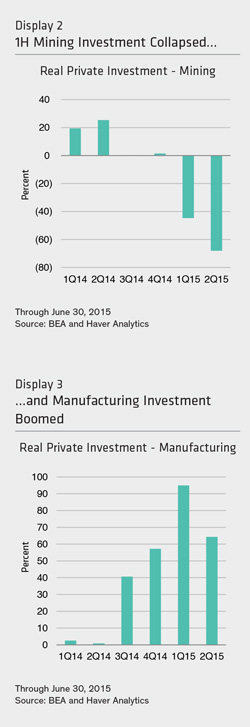
One key reason for the first half’s lackluster growth is the sharp and sudden collapse of capital spending in the energy sector. According to the BEA, investments in oil and gas exploration and mining collapsed at an annualized rate of 45% in 1Q and 68% in 2Q (Display 2, next page). This two-quarter decline mirrors the sharp plunge in energy capital spending in 1986—another period in which domestic oil prices collapsed.
The sharp drop in energy capital spending shaved 0.5% off the first quarter’s real GDP growth rate and 0.7% off the second quarter’s growth. At the same time, it masked a very powerful capital spending trend in manufacturing structures— primarily tied to the chemical industry building new smelters in the southwest (Display 3). Indeed, the twoquarter annualized growth rate of 79% in manufacturing structures was the second highest two-quarter gain in the past 50 years.
Growth should pick up during the second half of 2015. The drag from the collapse in energy capital will fade, given that the oil rig count has stabilized. The powerful upturn in manufacturing-structures investment will become more dominant in the aggregate capital spending numbers. Also, we expect continued gains in real consumer spending—close to the 2Q performance of 2.9% annualized growth. Along with that, we see further gains in housing investment, linked to the strong rebound in building permits. Thus, the US economy should be able to produce 2H real GDP growth in the 3.0%–3.5% range.
US Growth Potential? Apparently, Not What It Used to Be From a historical perspective, the US economy growing at a 3% annualized pace is not that unusual, nor should it trigger any concern over domestic price pressures. But revised long-term GDP data suggest that the US growth potential is a lot lower than it used to be. The US economy grew only 2.1% over the past five years instead of the previously reported 2.25%, and growth in the private sector was downwardly revised to 3.0% from 3.2%.
 Thus, if the US economy’s long-term potential growth rate is 2% or less, a growth rate of 3% for the second half of this year would place further downward pressure on domestic resources (labor) and upward pressure on domestic prices (inflation).
At this time, the upward pressure on prices seems to be modest, but occurring nonetheless. For example, employer costs for labor seem to be moving up–although the weaker-than-expected 0.2% gain in the employment cost index (ECI) for 2Q does raise questions over tightness in the labor market and breadth of wage increases. The weakness in the 2Q ECI was centered in sales and incentive-type compensation jobs. Yet the data doesn’t square with business surveys and tax data. Upcoming reports on jobs and wages will offer more intelligence on labor-market tightness.
Upward price pressure is also showing in consumer prices for domestic services (such as medical care, education, transportation, rents, etc.). These were running at 2.5% in the past year, while the rate of increase in the first half of 2015 ran at 3.0% annualized—the fastest gain since 2008. To be fair, prices for consumer goods (motor vehicles, apparel, medical products and furniture) are still contracting at a rate of about 0.5% per year, due to international competition and a strong dollar. Yet prices for consumer goods account for only 10% of the overall consumer price index, so the upturn trend in domestic services will ultimately dictate the trend in overall inflation.
Rate Lift-Off in September? At the July 29 Federal Open Market Committee (FOMC) meeting, policymakers upgraded their current assessment of economic growth. They noted better trends in consumer spending and housing, but acknowledged weaknesses in investment and net exports. Also, policymakers said that the labor markets have shown “solid gains,” and that it would only take “some” further improvement in labor markets for the Fed to be in a position to lift the target on the official rate.
We think policymakers purposely changed the language with respect to labor markets because of growing signs of wage pressures and favorable trends in leading indicators of employment—such as jobless claims, job openings and business surveys indicating labor shortages.
Although the FOMC’s wording change doesn’t guarantee an official rate hike in September, the path to the initial rate hike seems largely dependent on labor market gains and labor costs. And on that front we expect continued gains in the months ahead.
By Joseph G. Carson, US Economist and Director, Global Economic Research, AB
———


