
Given all the negative commentary about China at the moment, it’s difficult for many investors to get a balanced perspective on the risks and opportunities there. Our bottom-up research, however, is uncovering early signs of stabilizing trends which point to a better year for the country in 2016.
Two are particularly interesting, in our view: the growth of the domestic corporate bond market and signs of improving fundamentals in the property sector. While driven by different dynamics, the trends are potentially mutually reinforcing, with encouraging implications for the broader economy.
One of the key drivers of change is government policy, the overall thrust of which is to ensure that China avoids falling into the middle-income trap. The strategy is to rebalance the economy so that domestic consumption plays a greater role alongside the traditional growth engines of investment and heavy industry.
This requires a range of reforms to stimulate private investment (foreign and domestic) and more efficient pricing of capital, and the liberalization of capital markets is a key step in the process. Hence policy accounts for much of the recent growth in the corporate bond market (and, as we discuss later, the municipal bond market, too). These developments have broad implications, as a bond market can help fuel economic growth and, from a balance-sheet risk-management perspective, lead to a more efficient matching of assets and liabilities.
One of the interesting aspects of the bond market’s growth is the extent of participation by property developers which, until relatively recently, were obliged to borrow offshore and repatriate the proceeds for investment onshore. Since the law changed a dramatic transformation has taken place, as captured by Wind Information, a financial data services company based in Shanghai. According to Wind, onshore corporate debt issuance in China totalled RMB232 billion (US$36.5 billion) in August. Property developers accounted for nearly 45% of the total.
It’s also worth noting that, of the 55 developers that have issued in the onshore market, only one is rated AA- by onshore agencies while the others are all rated AA or higher. The market is also becoming better at evaluating risk, with a number of issuers with the same rating being priced differently, based on fundamentals.
Not so long ago, the property sector was a major concern for investors and regulators. That concern has eased since it’s become evident that developers can diversify their funding sources and reduce their borrowing costs by issuing in the bond market. This benign trend is likely to continue, with bond market participants expecting issuance to grow for the rest of the year.
Property sales pick up
The trend is coinciding with improvement in the property market. National Bureau of Statistics figures for August showed that sales across the board increased by 15.3% year-on-year by value, with residential property continuing to outperform non-residential. Evidently the stock market correction in June and July and the currency devaluation in August have not dampened interest among property buyers. At the same time, however, real-estate investment and land purchases have fallen further (Display).
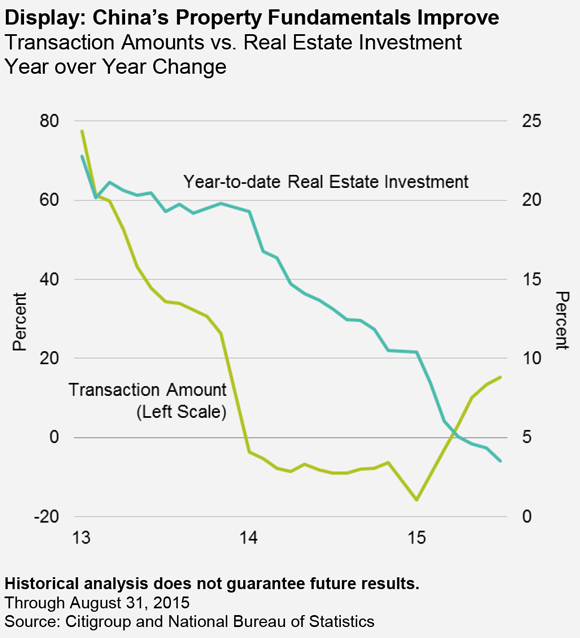
While there is further to go in the cycle before developers start to deplete their land banks, excess land stocks will be more of a problem in the lower-tier cities: in Tier 1 and Tier 2 cities, we see signs that a recovery is already under way and that developers are starting to worry about the availability of land.
Although this points to an eventual recovery in supply-side activity, we don’t expect such a change to become apparent before the second quarter of next year. The period between now and then, and the availability of funds from the bond market, could prove restorative for the property sector, giving developers time to stabilise their margins and improve earnings while maintaining healthy balance sheets.
China risk is conservatively priced
The benign coincidence between these bond-market and property-sector trends are further evidence in our view that China’s reforms, in some areas at least, are starting to synch with economic fundamentals, to the advantage of both.
Another example is the potential for a recovery in infrastructure activity. Earlier this year, the central government introduced a budgetary law which forced provincial and municipal governments to reduce their dependence on bank finance and raise capital in the domestic bond market. This gave rise to the municipal bond sector which raised RMB1.7 trillion (US$267 billion) in its first three months of operation.
We expect, once the central government announces its 13th Five-Year Plan next month, that this pool of liquidity will be channelled into infrastructure and other activities which will provide a boost to the economy late this year and well into 2016.
There are other upsides to the development of the municipal market: it’s lowered systemic risk in two ways, by removing the concentration risk of local-government exposure from the banking system, and by enabling local governments to lengthen the term of their borrowings. It also puts their debt into a form that can be purchased by institutions, thus creating better risk-sharing opportunities outside the banking sector.
In light of this, the warnings in recent media and sell-side broker reports about the increasing downside risks to China’s economy—and the consequent negative implications for the global outlook—seem misplaced.
Instead, we expect that, by the middle of next year, China’s growth may well have steadied and formed enough of a base for a rebound. That, in turn, suggests that the current pricing of risk in China’s markets is far too conservative.
By Hayden Briscoe, Director, Asia Pacific Fixed Income and Jenny Zeng, Research Analyst, Corporate Credit, AB
———-


