Airfares: In smoothed terms, discount fares fell by 6.1 per cent over the year to February. But business class airfares rose at a 7.0 per cent annual rate in February with “restricted economy” fares up by 5.2 per cent.
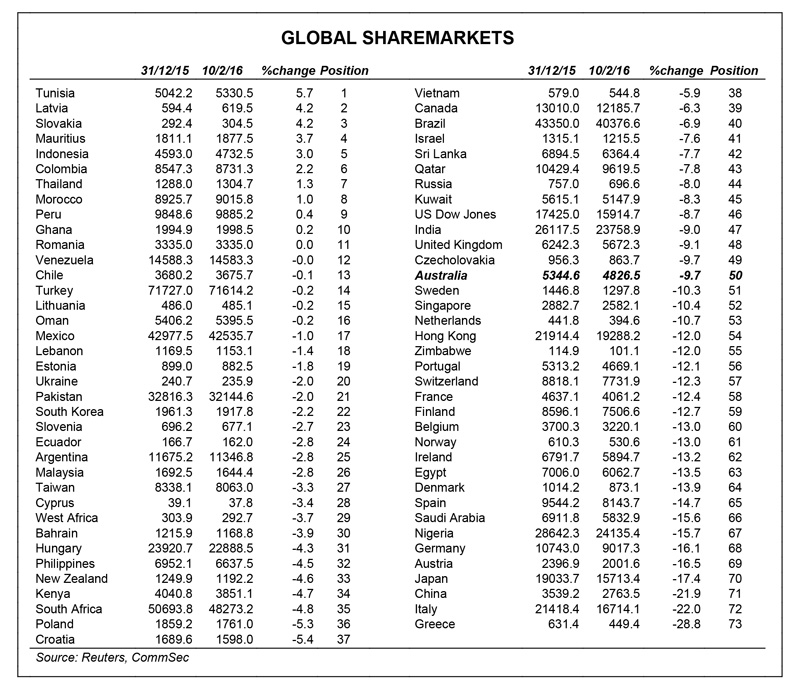
Global sharemarket retreat: All but 10 of 73 global sharemarkets monitored by CommSec have fallen since the start of the year. The world sharemarket (MSCI less Australia) has fallen 10.5 per cent since the start of the year.
What does it all mean?
There are still good deals to be had with discount airfares. Latest data shows that discount fares are around six per cent lower than a year ago. But it is a different question with business class and restricted economy airfares. Over the past two years business class airfares have been lifting at a near 10 per cent annual rate with restricted economy airfares rising at a 6.5 per cent annual rate.
The lift in all airfares except discount fares as well as lower jet fuel prices and modest wage growth highlights the positive operating conditions that currently exist for airlines.
For budding air travellers there is certainly value in shopping around for the best deals. In real (inflation-adjusted) terms, discount airfares are only 9 per cent above the lowest levels recorded in the 22-year history of the series.
If there is any solace for investors in slumping sharemarkets it is the fact that we are all in it together. Across the globe shares have slid by around 10 per cent since the start of 2016. In part the declines reflect a raft of uncertainties causing investors to trim positions. But fundamentally expensive sharemarkets – especially the US, China and Europe – have provided a ripe setting for investors to book profits.
At the time of writing today the Aussie sharemarket was higher by around 0.5 per cent. Gains in shares have been a rare experience in 2016 – there have only been 9 ‘up’ days in 27 sessions. However the local profit-reporting season has got off to a good start with companies generally lifting profits and maintaining or increasing dividends. There is a more positive ‘fundamental’ story to tell in Australia than other parts of the globe.
What do the figures show?
Airfares
The Bureau of Infrastructure, Transport and Regional Economics (BITRE) reports that business class airfares rose by 0.5 per cent in February to stand 8.2 per cent higher than a year ago – the fastest growth in nine months. In smoothed terms, business class airfares are up 7.0 per cent on the year, the fastest growth pace in 11 months.
“Restricted economy” airfares fell by 1.6 per cent in February after rising by 2.3 per cent in January. Restricted economy airfares are up 4.4 per cent on a year ago. In smoothed terms restricted economy fares are up 5.2 per cent over the year. Airfares have been rising at a 6.5 per cent average annual pace for the past two years.
Discount airfares rebounded by 7.5 per cent in February after falling by 11.7 per cent in January. Discount fares are still 6.4 per cent lower than a year ago. In smoothed terms, discount airfares are down 6.1 per cent on a year ago, equalling the biggest annual decline in 17 months.
In real terms, discount airfares are only 8.6 per cent above the lowest levels recorded.
Sharemarket trends
Of 73 global sharemarkets monitored, all but 10 markets have fallen so far in 2016. Monitoring the trends up to February 10, the Australian All Ordinaries index had fallen by 9.7 per cent (ASX 200 down 9.8 per cent) while the US Dow Jones had fallen 8.7 per cent (Nasdaq down 14.5 per cent), the Japanese Nikkei had slumped by 17.4 per cent while the German Dax was down 16.1 per cent.
A raft of uncertainties is behind sharemarket weakness including:
The slump in the oil price
Fears that energy producers could fail, affecting banks
Uncertainty about the outlook for the Chinese economy
Worries about a strong US dollar
Uncertainty about US rate hikes
Geopolitical uncertainties including Saudi Arabia/Iran; North Korea; Syria; refugee influx into Europe.
The world sharemarket (MSCI less Australia) in US dollar terms has fallen by 10.5 per cent so far in 2016.
What is the importance of the economic data?
The Bureau of Infrastructure, Transport and Regional Economics (BITRE) “provides economic analysis, research and statistics on infrastructure, transport and regional development issues to inform Australian Government policy development and wider community understanding.” The airfares data is useful in gauging inflation trends and providing insights on the aviation sector.
What are the implications for interest rates and investors?
The Australian sharemarket has been progressively falling over 2016, but Australia has certainly not been alone – the declines are very much a global trend. But policymakers haven’t lost influence. If the sharemarket weakness affects consumer and business spending, central banks and policymakers are likely to do all in their powers to resuscitate activity.
The Australian sharemarket is by no means super ‘cheap’ but recent declines have provided more value to investors. The Australian economy is in good shape with momentum provided by home building and consumer spending. Just like the Reserve Bank, we are tipping a modest lift in economic growth over 2016 and 2017.
Oil producers are moving closer to the pain threshold where they will have to look at trimming oil production and stabilising oil prices at low levels. Once oil prices stabilise, and perhaps edge modestly higher, many of investor concerns will start to dissipate.
It’s worth noting that the dividend yields on ANZ and NAB shares are near 8 per cent with the dividend yield on Westpac shares near 6.5 per cent. After posting its earnings result yesterday, the historical dividend yield for CBA shares is currently near 5.7 per cent. Historically-high dividend yields also apply for Telstra (5.5 per cent), AMP (5.3 per cent), Bendigo & Adelaide Bank (7.0 per cent), Woolworths (6.2 per cent) and Bank of Queensland (6.9 per cent).
Share prices move every day. The underlying value of the businesses behind those prices does not move nearly as often, or as much. That distinction matters more than usual right [...]
For many years, investment bonds have occupied a relatively small corner of the Australian investment landscape. While familiar to some advisers, others may have had limited reason to consider them [...]
Key takeaways The global system is becoming more fragmented and policy-driven, leading to more uneven and less predictable market outcomes. Geopolitical risk is now persistent, showing up not just in [...]
The Financial Planners and Advisers Code of Ethics (Code) has sat at the centre of adviser conduct in Australia since it became mandatory on 1 January 2020. This article, proudly [...]
Complaints are so big right now 2026 has been a big year for financial services complaints, and not just numerically. Certainly, the volume of complaints is noteworthy. AFCA data[1] released [...]