
Real GDP growth rose by a 0.7% annualized rate in the fourth quarter, hurt by continuing cutbacks in energy capital spending, inventory liquidation and foreign trade. The bruising impact of cutbacks in energy capital spending isn’t over, but the major brunt of it is in the rear. Yet negative feedback from weak global growth and currency shifts is still in the offing, and policymakers are likely to focus more on those forces in 2016, resulting—at best—in a very gradual lift in official rates.
The Economy in 2015
The economy slowed sharply in the fourth quarter, with real gross domestic product (GDP) growth rising at a mere 0.7% annualized rate. Once again, the strength of the economy’s performance was driven by household spending and investment. Real consumer spending on durable goods rose at a 4.3% annualized rate, while spending on housing climbed by an 8.3% annualized rate.
Despite these bright spots, the economy’s performance was negatively impacted by a series of items: Energy capital spending in structures declined by a 39% annualized rate; foreign trade subtracted 0.8 percentage from the quarter’s growth performance as real merchandise exports declined while real merchandise imports rose; companies scaled back on inventory investment, subtracting 0.5 percentage from the GDP growth rate; and unusually warm weather dramatically reduced household spending on utilities.
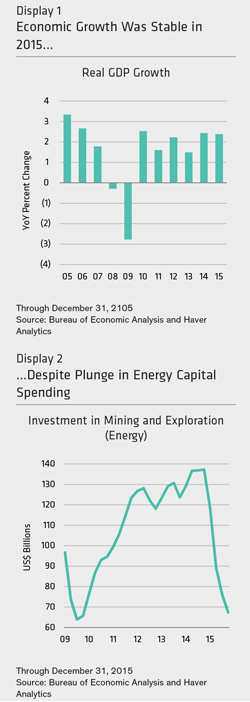
For 2015 overall, real GDP growth rose 2.4%, matching the growth rate of 2014. Depending on one’s perspective, the US economy was able to overcome the 50% collapse in energy capital spending (which subtracted 0.5% from the overall growth rate) and still post a modest advance in overall growth. Alternately, the fact that real GDP growth in 2015 only matched the pace of growth in 2014 suggests that the economy did not see any benefits from the sharp drop in energy prices.
History shows that the negative effects of sharp and large declines in energy prices are front-loaded, and that the positive benefits tend to surface 6–12 months after the initial drop in prices. The fact that energy prices have taken another nosedive in January indicates that there is still downside risk to energy capital spending in the first half of 2016. Also, the knock-on effect to equity prices has the potential to impact consumer spending—but so far there is little evidence of that in the sentiment reports and other hard data.
As we noted in our last commentary, incremental declines in energy capital spending and declines in equity markets (with negative wealth effects on consumer spending) raise the downside risks to our 2016 GDP growth estimate. Based on recent trends, we think it is prudent to lower this year’s growth rate to 2.7%— down from the initial estimate of 3.2%.
Fed policy
At the January 26–27 Federal Open Market Committee meeting, policymakers noted that the pace of growth had slowed in the fourth quarter, even though labor market gains stayed relatively strong. Yet the confusion caused by ongoing volatility in the energy markets and global financial markets left policymakers generally unsure about the growth and inflation outlooks.
As a result, they stated that they would be “closely monitoring global economic and financial developments and assessing their implications for the labor market and for the balance of risks to the outlook.” Clearly, policymakers are saying that it might take more time for them to gain clarity on the outlook—especially on the inflation front. Thus, delaying a rate hike until midyear is going to be the most likely result of their discussions. Consequently, we don’t expect the next official rate hike until the second quarter, probably June. And we are reducing our estimate of the number of rate hikes to three from four.
By Joseph G. Carson, US Economist and Director, Global Economic Research, AB
———


