
Go global for quality income – the case for global equity income investing in a low-yield world
The search for yield has never been more pressing for investors. Income is hard to find in the current market environment, with low interest rates, bond yields tending towards flat or negative and dividends under pressure. But by widening the search and seeking high-quality income stocks globally, it is possible to build portfolios that generate a high and growing income.
Global equity income investing can provide a relatively high income yield for retirees and other investors, as well as steady capital gains. It gives fund managers the flexibility to pick the best income stocks globally, rather than being limited to a single market.
The key is a truly global approach, an uncompromising search for well-run companies which pay a steady stream of dividends, and eschewing complex derivative-based strategies in favour of simplicity. When these principles are applied effectively, global equity income strategies can play an integral role throughout Australian savers’ lifespans, from the growth phase all the way into retirement.
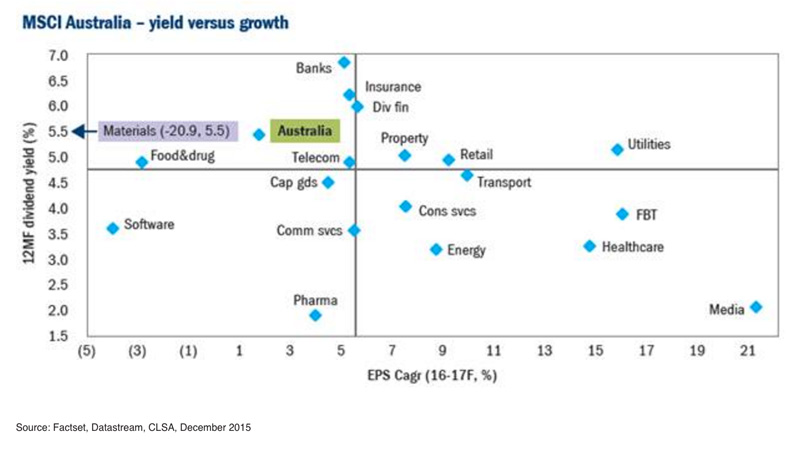
Australia boasts a strong dividend culture and a history of delivering good growth. However, much of these dividend yields have come from the financials and materials sectors, with little diversification further afield. Australian yields may be reasonable today, but given the narrowness of their sources, it is questionable whether they will continue to deliver in all market environments.
Going global
Why go global? A global approach provides the opportunity to access the world’s most promising high dividend stocks. This means a better diversified portfolio, offering a degree of downside protection if a particular country or sector underperforms. Investors benefit from a larger pool of prospective companies and industries than they would get by looking purely within Australia.
Global equity income funds have come to the fore in the wake of the financial crisis, which highlighted the need to diversify. Since then, other market events, such as the sharp fall in oil prices, have demonstrated the importance of not being overly reliant on one sector.
A badge of investment quality
Having so many stocks to choose from gives access to more well-run companies which pay consistently high dividends.
Dividends are an under-appreciated sign of investment quality. There are several reasons why companies which pay consistent dividends are appealing. Businesses which prioritise paying a steady stream of income to their shareholders are typically effectively managed, with a strong degree of cashflow certainty. They are usually established, profitable companies.
Empirical research by Robert Arnott and Clifford Asness showed that high dividend pay outs indicate a company is confident about the future. They concluded that company management confident of sustainable future earnings growth tend to pay out a large share of earnings in the form of dividends, unlike those that are more pessimistic who pay out a lower share – perhaps so that they can be confident of maintaining the dividend payouts.
Such well-managed companies tend to have a high dividend yield, earnings growth and robust balance sheets. Furthermore, as the table below shows, reinvested dividends compounding over time make a powerful contribution to capital growth. As a result, these companies offer the ideal combination of high income and potential capital growth.

The role of global income
Global income strategies can play a key role in giving investors a retirement income. Australian savers are moving away from taking their superannuation pension savings as lump sums and instead are adopting strategies which allow them to gradually draw income in retirement.
The latest data from the Australian Bureau of Statistics (2015) suggest that barely half (53%) of Australian retirees expect their main source of personal income in retirement to be superannuation, an annuity or allocated income.
Yet like many people all over the world, Australians are concerned about funding their retirement and their future financial security in general. Data from a white paper by IPSOS/MLC Australia, A look at lifestyle, financial security and retirement in Australia (2016), found that a third of Australians believe their children will not be able to afford the same quality of life that they have enjoyed.
Almost three in five Australians were concerned they would be unable to fund their current lifestyle over the next decade, with people aged 50-70 marginally more concerned than other age groups.
As investment products grow more sophisticated to meet the needs of retirees who no longer want to simply take a lump sum at retirement, global equity income strategies can play an integral role in meeting their needs. This style of investment gives investors a good yield, with the potential for growth over time.
Moreover, the role of income investing isn’t limited to the post-retirement universe. In fact, global equity income investing can help to accumulate capital. When dividends from an income fund are reinvested and compounded over time, they can form a large chunk of long-term growth.
It’s time to re-think the role of income in Australian investors’ portfolios. Income is much more than just a bond proxy. Across the globe, it is possible to identify companies which prioritise delivering solid dividends, while pursuing long-term growth. These companies represent an attractive proposition for Australian investors, wherever they are on their savings journey. The effect of compounding reinvested dividends adds to the attractiveness of this style of investing for younger savers.
By Stephen Thornber, Global Equity Portfolio Manager


