
Figures released by SQM Research this week have revealed that the number of national residential vacancies rose slightly during July, recording a vacancy rate of 2.5%, and 79,300 vacancies. Year-on-year results demonstrate that national vacancy rates have climbed one percentage point from this time last year.
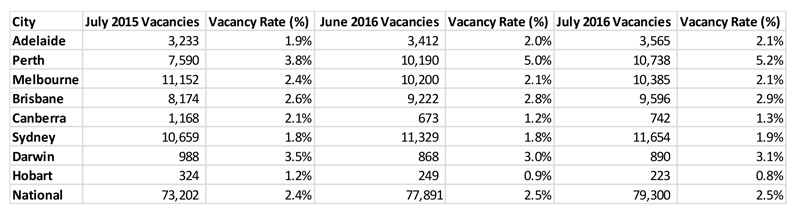
Perth recorded the largest monthly rise, with vacancies increasing by 0.2 percentage points during the month of July. On a year to year basis, Perth vacancies have climbed an alarming 1.4%, with vacancies climbing to 10,738.
In contrast, yearly falls were recorded for Canberra, Darwin, Hobart and Melbourne, with Canberra vacancies decreasing 0.8% compared to this time last year (July 2015). Both Hobart and Darwin recorded a yearly fall of 0.4 percentage points. Melbourne soon followed with a yearly fall of 0.3 percentage points.
Asking rents
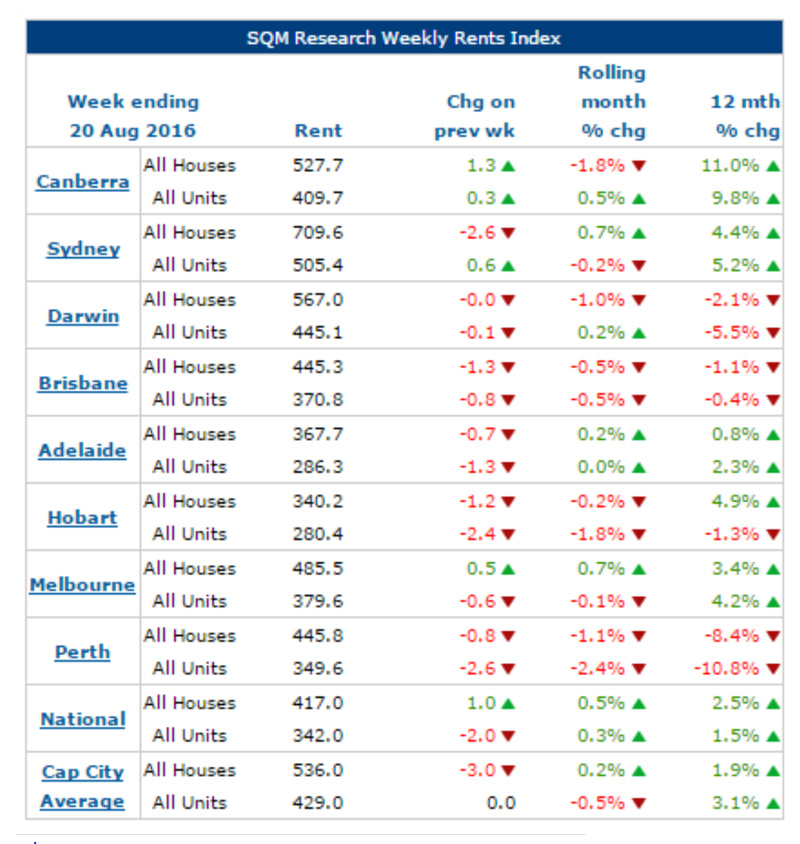
Notably, according to SQM Research, Perth has recorded ongoing falls in asking rents of 8.4% for houses and 10.8 % for units over the past 12 months. Yearly falls have also been recorded in Darwin, with asking rents down 2.1% for houses and 5.5% for units.
In contrast, asking rents in Canberra continue to rise; up 11.0% for houses and 9.8% for units. Notably, Hobart continues to record the most affordable rental accommodation with rents for houses at just $340 a week and units averaging $280 a week.
Managing Director of SQM Research, Louis Christopher, said “Overall, vacancy rates remain steady for the major capital cities. Perth continues to be the ongoing exception with further increases in vacancies this month as the mining downturn continues to hit the economy hard.
Looking forward, I believe the national vacancy rate will continue to creep upwards. Melbourne may start to record higher vacancies next year under the weight of completed apartment developments; but for now Melbourne remains a landlord’s market. Sydney is unlikely to record such a surge in vacancies as we believe the city’s population expansion is going to absorb much of the new stock.”
Source: www.sqmresearch.com.au
SQM’s calculations of vacancies are based on online rental listings that have been advertised for three weeks or more compared to the total number of established rental properties. SQM considers this to be a superior methodology compared to using a potentially incomplete sample of agency surveys or merely relying on raw online listings advertised. Please go to SQM’s methodology page below for more information on how SQM’s vacancies are compiled.
Key Points
- Nationally, vacancies rose slightly during July 2016, recording a rate of 2.5%, based on 79,300 vacancies.
- Perth recorded the highest vacancy rate in July 2016 of 5.2% based on 10,738 vacancies. Year on year, vacancy rates climbed 1.4 percentage points.
- Year on year, vacancy rates are down for Canberra, Hobart, Darwin and Melbourne.
- All capital cities experienced a rise in vacancies during July 2016, excluding Melbourne where vacancies remained tight at 2.1%.
- Hobart recorded the lowest vacancy rate during July 2016 – 0.8% based on 223 vacancies.
- Over the past 12 months, Perth has recorded ongoing falls in asking rents of 8.4% for houses and 10.8% for units.


