High-yield bonds have been on a solid run due to improving economic data, tightening credit spreads and fund inflows. Although they can play a strategic role in long-term portfolios, investors shouldn’t expect the current streak to continue forever says Kelley G. Baccei, High Yield Portfolio Manager at Eaton Vance, a leading global asset manager.
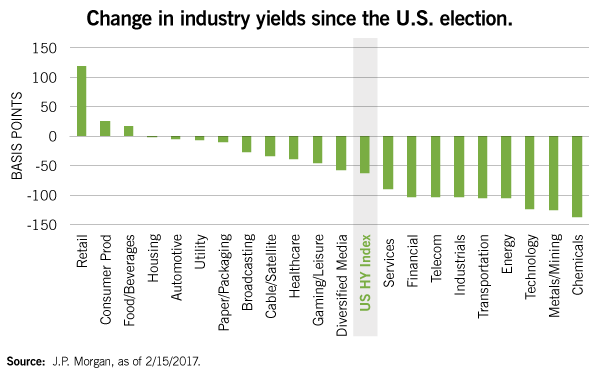
“Indeed, the high-yield market has experienced a powerful rally since the U.S. presidential election on expectations that Trump administration pro-growth policies can stoke the economy. This comes after the BofA Merrill Lynch US High Yield Master II Index gained 17.5% in 2016.
“Year to date, high-yield funds have gathered US$3 billion of inflows as of February 16, according to Bank of America Merrill Lynch,” she notes.
According to her, most of the recent rally has been driven by tightening credit spreads in a market characterized by low volatility and a deep bid for risk.
“Since the US election, the average yield on the BofA Merrill Lynch US High Yield Master II Index has compressed by approximately 80 basis points to 5.76%, as of February 20. Over the same period, the average yield on CCC-rated bonds, the riskiest segment of the market, has compressed by over 300 basis points.
“The takeaway is that the market is trading relatively tight and, overall, valuations seem relatively full.
However, it’s not all doom and gloom for high-yield bonds, which are sensitive to the health of the economy.
“Overall, the positive trend in earnings growth which we witnessed in the second and third quarters of 2016 seems to be continuing as companies report fourth quarter earnings. This implies that although spreads have compressed and investors are receiving less compensation for risk, credit fundamentals are supportive of tighter levels. Therefore, the market could stay in this range for at least some time if favorable fundamental trends continue.
“Also, we expect the average default rate in the high-yield segment to continue to decrease in 2017, to well below average historic default rates. We continue to anticipate that the economic policies of the Trump administration will be supportive of U.S. economic growth and help to lengthen the current credit cycle.
“High-yield bonds are generating attractive income in a low-rate environment, and can play a strategic part in portfolios.
“However, given current valuations and credit spreads, we think investors should temper their expectations after the recent rally. Investors who want to take a more defensive stance might consider more conservative positioning on both credit and duration,” she notes.