
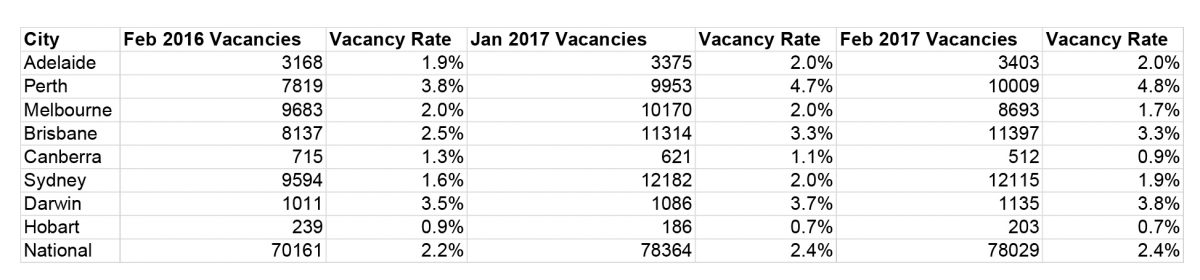
Housing data released by SQM Research this week has revealed the vacancy rate tumbled to just 1.7% in Melbourne in February this year, a near 10-year low, while falling in other eastern capitals against a steady national vacancy rate.
In Canberra, the vacancy rate fell to just 0.9%, the lowest since May 2012, while in Sydney, it has fallen to just 1.9%, down from 2.5% in December. Nationwide, the number of national residential vacancies in February with 78,029 rental homes available, giving a steady national vacancy rate of 2.4%.
Managing Director of SQM Research, Louis Christopher said: “The last time the vacancy rate was 1.7% in Melbourne was in June 2007, almost 10 years ago, so this is quite remarkable. Despite predictions of looming apartment oversupply in inner-city Melbourne, we are seeking vacancies fall, rather than rise.
“Even in in the Docklands, the vacancy rate tumbled to just 2.4 per cent last month, down from a high of 6% in December. The rental market could tighten further in Melbourne as some apartment developments are scaled back, which would cut supply and could pressure rental growth higher in that city.”
Perth recorded the highest vacancy rate at 4.8%, up marginally from 4.7% in January, followed by Darwin at 3.8%, up from 3.7% in January. In Brisbane, the vacancy rate was steady at 3.3%, and in Adelaide also at 2.0%. Hobart’s vacancy rate is the lowest of all capital cities at just 0.7%.
Asking rents
Reflecting its lower vacancy rate, rents rose strongly in Melbourne over the month to March 20, up by 1.6% for houses to $512.30 a week, giving an annual change of 7.2%. Only Canberra reported a higher annual asking rent growth for houses at 7.6%, with weekly asking rents up to $578.80.
Darwin continues to record falls in asking rents for houses, down 1.5% over the month, while unit rents were down 1.3%. Perth has again posted the largest yearly declines, with unit asking rents down 10.1% and house asking rents down 7.1%, though monthly declines were modest at 0.1% and 0.7% respectively.
Brisbane unit asking rents were down by 0.5% over the month to March 20, and house asking rents were down by 0.4%.
“Unlike Melbourne or Sydney, Brisbane’s unit rental market is slightly oversupplied, which has kept down rental growth. But in the other big cities, rental growth is strong, and well above the inflation rate and wages growth, suggest rentals are getting more and more unaffordable for the average person,” Christopher said.

SQM’s calculations of vacancies are based on online rental listings that have been advertised for three weeks or more compared to the total number of established rental properties. SQM considers this to be a superior methodology compared to using a potentially incomplete sample of agency surveys or merely relying on raw online listings advertised. Please go to our methodology page below for more information on how SQM’s vacancies are compiled.
Key Points
- Nationally, vacancies rose were steady during February, recording a rate of 2.4%.
- Perth recorded the highest vacancy rate of the capital cities at a rate of 4.8%
- Year-on-year vacancy rates were down for Melbourne, Canberra, Adelaide and Hobart.
- Hobart recorded the lowest vacancy rate of 0.7%, steady from January.


