
As high yield bond goes global, it’s time to look more closely at this asset class

Vivek Bommi
Since the Global Financial Crisis (GFC), investors have operated in an era of low interest rates which have helped fuel strong growth in equities. The strong rally has even lead the ASX to hit 10-year highs, but as the US Federal Reserve raised interest rate three times last year – and indicated more rate hikes will come – it is clear we have started to enter a tightening cycle, meaning investors will need to adjust their portfolios and consider new sources of income.
Vivek Bommi, Senior Portfolio Manager at Neuberger Berman shares why it may be timely for investors to look at high yield bonds, and why non-US high yields in particular provide an attractive source of income diversification.
Bonds are important to a diversified portfolio and generally considered a defensive asset class as they are safe, stable and help balance more volatile investments such as equities. In Australia, high yield bonds have traditionally been underrepresented in the portfolios of individuals and SMSFs due to a lack of ways to access this type of asset, but with rising US interest rates and the maturation of the market, there are good reasons investors should look this asset class more closely.
Most importantly, high yield bonds are now available from a more diverse range of corporates with strong businesses in a wider range of countries. This means global high yield bonds offer an opportunity to create a more diverse portfolio of fixed income assets than has been possible in the past.
Here’s how the market has changed and differs from more traditional bond investments:
1. Maturation of the High Yield Market
In the 1980s, high yield bonds were commonly referred to as ‘junk bonds’ due to their association with low-quality companies with questionable business models. In the decades since however, the market has matured dramatically, with the investible universe for global high yield bonds now consisting of 2,000 global companies with anaverage revenue of US$6 billion.
Companies who are users of the high yield market are now firms with strong business fundamentals, are highly liquid and stable, and include household names such as Avis, Jeep, Hertz and Netflix. Additionally, as the market has matured, credit quality has also improved to what is now mostly BB grade bonds, thereby reducing credit risk.
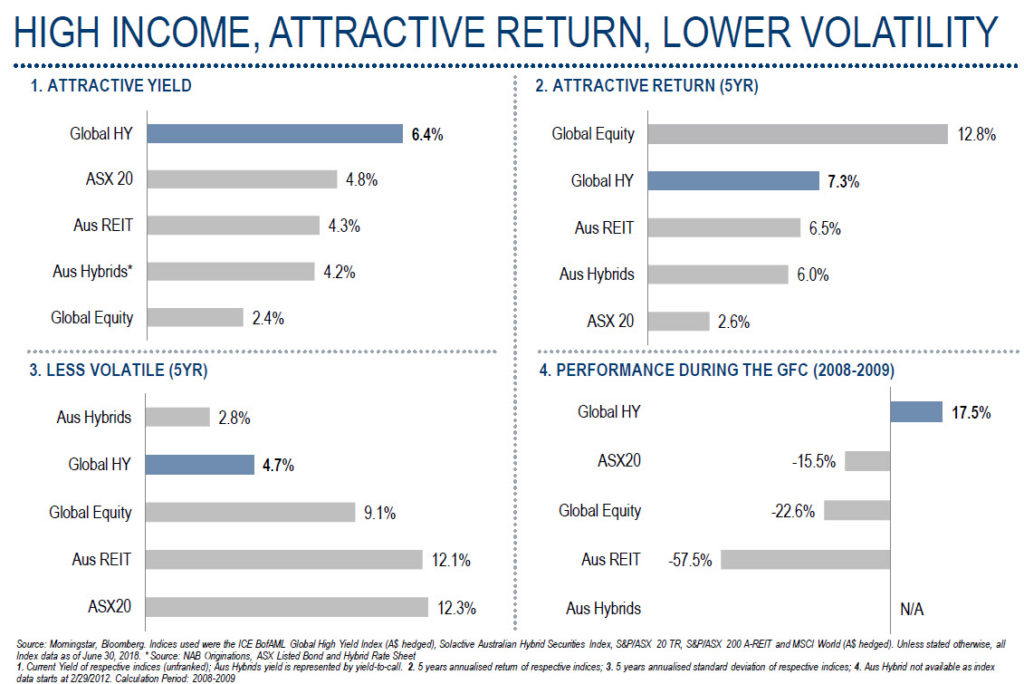
Driven by investor interest, we have witnessed a strong growth in the high yield market over the past decade, turning it into a US$2.1 trillion market – greater than the whole of the ASX combined. Historical data suggests that the market has matured, as an asset class global high yield has provided investors with high income and attractive returns with lower risk (see figure below). For example, compared to ASX20, Global High Yield outperformed both in terms of yield and 5-year returns. It also lives up to its reputation as a more stable investment option compared to equities, and unsurprisingly, outperformed global equities and Australian Hybrids during the GFC.
2. Global opportunities in high yield now provides meaningful multinational diversification
Not too long ago, “investing in high yield bonds” often meant “investing in U.S. high yield bonds”, however, the growth of the market in Europe and the Emerging world have challenged this assumption, and now provides investors with a meaningful source of income diversification.
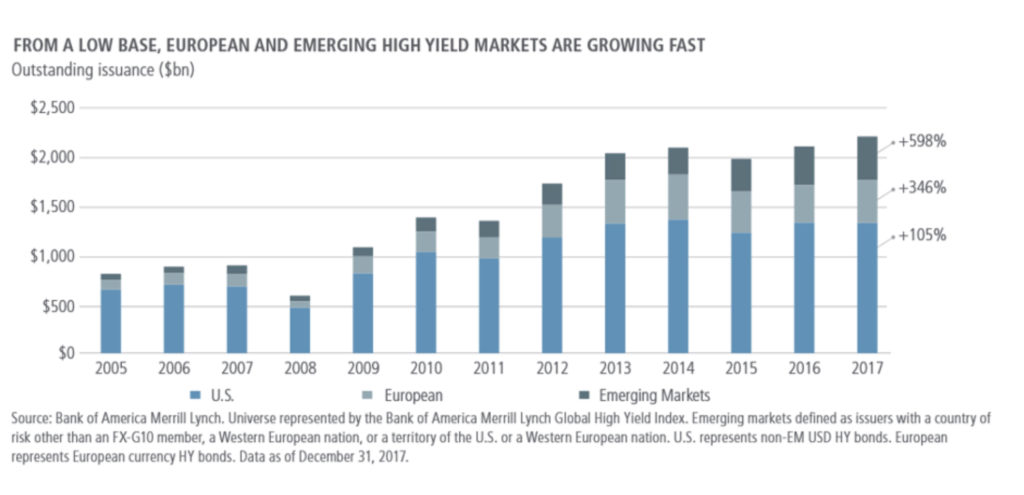
As the chart above illustrates, the size of the European market was less than $100 billion back in 2005 and is now more than four times that size. Emerging market high yield has rocketed from just $60bn in 2005 to nearly $450 billion today. Together they represent more than a third of the global high yield universe.
Currently the US makes up 60% of the global high yield market, while Europe makes up 20% and Emerging Markets the remainder. On size alone investors can no longer afford to ignore European and emerging markets high yield; throw in recent outperformance from the former, extra yield from the latter and meaningful diversification benefits from both, and it is clear high yields is now a global opportunity offering true diversification.
Investors looking for a stable source of diversification can now look at European and Emerging Market high yields, as they offer different market exposures from traditional US high yield bonds, both in terms of geography and industry.
While some may assume the increase in the size of the market is indicative of a borrowing binge, look closely and it will be clear other factors are in play.
One key reason is that a lot of the new issuance comes, not from companies that were already big users of the high yield markets, but from newcomers and companies diversifying their funding away from bank credit.
3. Rising interest rates do not mean increased credit risk for global high yield bonds
For investors concerned about the Federal Reserve’s policy tightening and the recent turnaround government bond yields, high yield assets have been shown to be significantly negatively correlated with 10-year U.S. Treasuries.
In periods of rising interest rates that are combined with economic growth, companies generally experience an improvement in earnings and company fundamentals improve. As a result, this leads to a decrease in corporate credit risk.
While high yield, like most other asset classes, can react negatively in the short term while U.S. Treasury yields are rising, high yield bonds have performed well in the medium term, even in comparison to investment grade bonds.
——–


