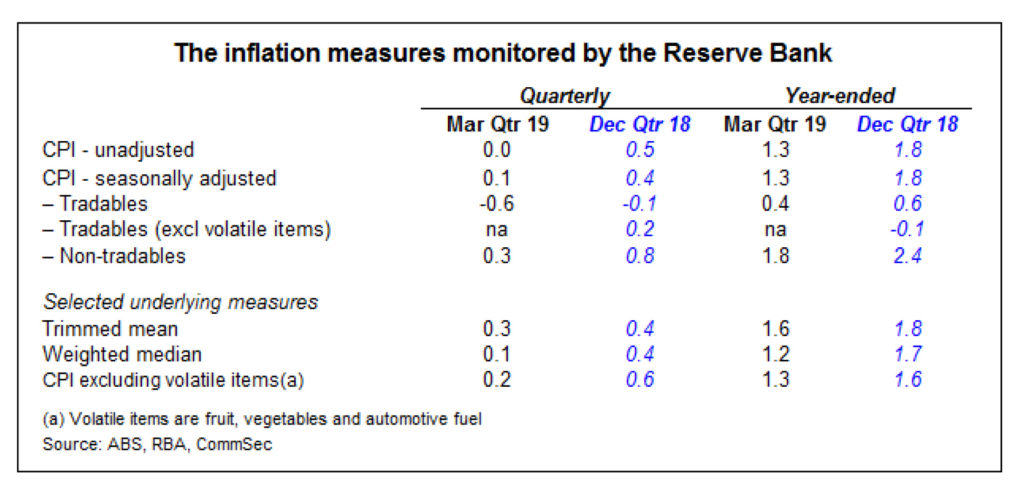
Inflation: The Consumer Price Index – the main measure of inflation in Australia – was unchanged in the March quarter, below expectations. In seasonally adjusted terms the CPI rose by 0.1 per cent. The annual rate of headline inflation eased from 1.8 per cent to 1.3 per cent. The Aussie dollar fell over half a cent against the greenback in response.
Underlying measures: The Reserve Bank monitors three measures to derive the underlying inflation rate. The trimmed mean rose by 0.3 per cent in the March quarter (1.6 per cent annual); the weighted median rose by 0.1 per cent (1.2 per cent annual) and the CPI less volatile items rose by 0.2 per cent (1.3 per cent annual). Overall, underlying inflation rose by 0.2 per cent in the quarter and by 1.4 per cent over the year. Market goods and services less volatile items fell by 0.1 per cent in the quarter to be up 1.4 per cent on the year.
Main changes: vegetables (+7.7 per cent), secondary education (+4.2 per cent), motor vehicles (+2.4 per cent) and medical and hospital services (+1.3 per cent). The most significant offsetting price falls this quarter are automotive fuel (-8.7 per cent), domestic holiday, travel and accommodation (-3.8 per cent) and international holiday, travel and accommodation (-2.1 per cent).
Notable lows: Clothing & footwear (29-year lows); Household textiles (32-year lows); Communication (32-year lows); Audio-visual equipment & services (29-year lows); personal care (23½-year lows).
What does it all mean?
Inflation is clearly not an issue. The published rate of inflation didn’t budge in the first three months of the year. Strip out volatile items and ‘underlying’ prices advanced around 0.2 per cent. In annual terms, annual inflation stands at a 2½-year low. Arguably the annual rate of ‘underlying’ inflation is the lowest on record at 1.4 per cent.
It is important to note that petrol prices plunged in the March quarter, but they have bounced back smartly in the June quarter. The Reserve Bank is well aware that inflation is likely to move higher from here.
So how can we explain the weakness in prices? The economy may have slowed but it certainly is not struggling. It all gets back to competition. Aussie consumers can buy goods whenever they want and wherever they are. If goods aren’t cheap enough locally, then Aussie consumers will look to source the items overseas. And consumers have so much power nowadays to compare prices.
Wages are clearly outpacing prices in the current environment. We may bemoan slower growth of wages, but consumer prices are growing even slower. Aussie consumers are in the ascendancy – they have rarely had it better than now. One thing is for certain – we will be hearing a whole lot less about the “soaring cost of living”.
The door remains ajar to a rate cut. That is, should a rate cut be needed. The unemployment rate remains near decade lows – indeed the NSW trend jobless rate is at record lows.
What do the figures show?
The Consumer Price Index – the main measure of inflation in Australia – was unchanged in the March quarter, below expectations. In seasonally adjusted terms the CPI rose by 0.1 per cent. The annual rate of headline inflation eased from 1.8 per cent to 1.3 per cent. The Aussie dollar fell over half a cent against the greenback in response.
The Reserve Bank monitors three measures to derive the underlying inflation rate. The trimmed mean rose by 0.3 per cent in the March quarter (1.6 per cent annual); the weighted median rose by 0.1 per cent (1.2 per cent annual) and the CPI less volatile items rose by 0.2 per cent (1.3 per cent annual). Overall, underlying inflation rose by 0.2 per cent in the quarter and by 1.4 per cent over the year. Market goods and services less volatile items fell by 0.1 per cent in the quarter to be up 1.4 per cent on the year.
Main Positive Contributors:
Food and non-alcoholic beverages is the most significant positive contributor to the CPI this quarter, with rises in all eight capital cities. Drought and adverse weather conditions affected the supply of fruits and vegetables, with price rises in all cities.
Education rose in all capital cities due to fees rising at the start of the school year. Increases in education ranged from Adelaide (+1.9 per cent) to Sydney (+3.4 per cent) and Canberra (+3.4 per cent).
Health rose in all capital cities due to the cyclical reduction in the proportion of consumers who qualify for subsidies under the Medicare Benefits Scheme (MBS) and Pharmaceutical Benefits Scheme (PBS).
Main Negative Contributors:
Recreation and culture is the most significant negative contributor to the CPI this quarter, with falls in all capital cities due to domestic holiday, travel and accommodation and international holiday, travel and accommodation. The fall in international holiday, travel and accommodation is due to the winter off-peak seasons in Europe and America.
Transport fell due to the lower world oil price resulting in a fall in automotive fuel. Automotive fuel fell in all capital cities this quarter, ranging from Adelaide (-7.8 per cent) to Darwin (-14.3 per cent).
Prices of tradables: The tradables component of the All groups CPI fell 0.6 per cent in the March quarter 2019. The tradable goods component fell 0.6 per cent due to automotive fuel (-8.7 per cent). The tradable services component fell 2 per cent due to international holiday travel and accommodation (-2.1 per cent).
Prices of non-tradables: The non-tradables component of the All groups CPI rose 0.3 per cent in the March quarter 2019. The non-tradable goods component rose 0.4 per cent, due to the pharmaceutical products (+5.0 per cent). The non-tradable services component rose 0.3 per cent, due to secondary education (+4.2 per cent).
Over the twelve months to the March quarter 2019, the tradables component rose 0.4 per cent and the non-tradables component rose 1.8 per cent. In seasonally adjusted terms, the tradables component of the All groups CPI fell 0.4 per cent and the non-tradables component rose 0.2 per cent.
Tradable goods are those items whose prices are largely determined on the world market. Non-tradable prices are more affected by domestic economic conditions.
Capital cities: Sydney -0.1 per cent in the quarter (annual +1.3 per cent); Melbourne +0.1 per cent (+1.2 per cent); Brisbane +0.1 per cent (+1.5 per cent); Adelaide +0.1 per cent (+1.3 per cent); Perth -0.1 per cent (+1.1 per cent); Hobart -0.2 per cent (+2.1 per cent); Darwin -0.8 per cent (+0.4 per cent); Canberra +0.1 per cent (+1.8 per cent).
Why is the data important?
The Consumer Price Index (CPI) is regarded as Australia’s premier measure of inflation. The CPI is published quarterly and measures price changes for a ‘basket’ of goods and services that dominate expenditure of metropolitan households. The “All Groups” index is the main focus, but other inflation measures are also published such as so-called ‘underlying’ measures. These include measures that abstract from price changes in volatile price items such as fresh food and petrol.
The Reserve Bank aims to keep the headline inflation rate between 2-3 per cent over an economic cycle. If inflation is high and expected to rise, the Reserve Bank may elect to raise interest rates in order to constrain price pressures. Conversely, if inflation is low and expected to remain low, the Reserve Bank may elect to cut interest rates if it believes the growth pace of the economy is in need of strengthening.
What are the implications?
Low inflation is a global phenomenon. Consumers have global choice – they can buy goods over the internet from the retailer that offers the best choice. In economic parlance, there has been an expansion of supply. Retailers need to cut through in the current environment – that is, come up with a good or service that stands out in quality, price and relative uniqueness.
The Reserve Bank won’t be lifting rates any time soon. In fact, if it believes the economy would benefit from rate stimulus, it could lower the cash rate even further from the 1.5 per cent record low.
Share prices move every day. The underlying value of the businesses behind those prices does not move nearly as often, or as much. That distinction matters more than usual right [...]
For many years, investment bonds have occupied a relatively small corner of the Australian investment landscape. While familiar to some advisers, others may have had limited reason to consider them [...]
Key takeaways The global system is becoming more fragmented and policy-driven, leading to more uneven and less predictable market outcomes. Geopolitical risk is now persistent, showing up not just in [...]
The Financial Planners and Advisers Code of Ethics (Code) has sat at the centre of adviser conduct in Australia since it became mandatory on 1 January 2020. This article, proudly [...]
Complaints are so big right now 2026 has been a big year for financial services complaints, and not just numerically. Certainly, the volume of complaints is noteworthy. AFCA data[1] released [...]