

Dan Cave
To say that COVID-19 has triggered a rollercoaster for markets across the globe is an understatement. The property sector has been particularly impacted though not always in the most predictable way.
One stock that has typified the rollercoaster in REIT markets since COVID is Unibail-Rodamco-Westfield (URW), Europe’s largest shopping mall owner. Saddled with high debts owing to the 2018 acquisition of Westfield’s international assets, URW was facing a slowing European economy and headwinds from increasing online sales penetration.
Further heat was applied as the pandemic sparked declines in income and capital values, across its assets. In response, the Board proposed a capital raising, which was ultimately blocked by activist investors and resulted in the subsequent replacement of both the Board and Chief Executive Officer. Following this, URW announced a long-term deleveraging plan of asset sales and the suspension of dividends for the next three years.
Notwithstanding this litany of issues, URW returned 73.1% in the month of November 2020 on news of the vaccine and continued to outperform, delivering 95.9% from 31 October 2020 to 31 May 2021 compared with the broader G-REIT market that returned 32.3% over the same period. All this from a company who has again withdrawn financial guidance for 2021.
Value versus growth – how is it different in REITs?
Earnings growth for REITs typically comes in the form of rent growth, and while REITs do have the ability to grow their portfolios somewhat, through development and funds management, the economics are very much linked to the property market. This differs from general equities where earnings can grow (or decline) at a more rapid rate, but also can be more volatile, unlike the income streams derived from contracted lease agreements.
While the notions of growth and value applies to GREITs in more of a property market context, the equity style factors are more applicable to A-REITs. This is due to the fact that A-REIT legislation is more accommodative in defining activities compared to their global counterparts, which don’t permit large exposures to non-rental earnings. Accordingly, some A-REITs can exhibit stronger growth and value characteristics based on these corporate earnings.
Rather than using a traditional equity growth and value lens to understand performance of REIT markets since COVID, we believe looking at which sectors are cyclical compared to those driven by secular trends is more instructive, although we note that these headwinds or tailwinds were largely in place before the pandemic.
Cyclical versus secular sectors
Following the market dislocation of March 2020, a large dispersion in REIT valuations emerged. Sectors considered cyclical owing their exposure to white collar employment growth, discretionary consumer spending and reliance on footfall traffic such as office, retail and hotels, traded at deep discounts. Conversely, sectors that were supported by secular themes, traded at or above their underlying property value as investors favoured greater earnings certainty over value. Examples include the technology-linked data centres and cellular towers, demographic driven healthcare and residential, and online sales penetration as a tailwind for industrial/logistics and a headwind for retail.
The vaccine surge
Following the announcement of a vaccine on 2 November 2020, equity markets, including REITs, surged. With large parts of the listed property market still trading at a discount to Net Asset Value (NAV) at the time, due to very uncertain outlooks across the sector, it’s not surprising that real estate securities performed very strongly as markets rebounded with the expectation of societies reopening.
Examining the US market, which accounts for over 50% of the G-REIT universe (as represented by the FTSE EPRA/NAREIT Developed Index), we can see the stark performance difference between the most cyclically linked companies and the least cyclical, as measured by economic sensitivity by DWS.

Note: segments derived from stock and sector economic sensitivity, ranked in quintiles by DWS. Source: Ironbark, DWS, Zenith Investment Partners
The hotels, retail, gaming and industrial sectors (Quintile 4 and 5) outperformed healthcare, net lease (long WALE) and self-storage (Quintile 1 and 2) by approximately 65% from the vaccine announcement to 31 May 2021. The most cyclically linked sectors also outperformed Quintile 3 by over 40% which included apartments, data centres, office and malls sectors) over the same period.
Quantity over quality
Given the remarkable surge in equity markets it’s not surprising that lower quality REITs, typified by higher leverage, outperformed. Whether this was good quality balance sheets impacted by COVID or lower quality companies with higher structural gearing prior to COVID, highly levered companies outperformed lower levered since the vaccine news broke.
How did this translate to manager performance?
In terms of peer group performance over the last 12 months, we can use the old sporting cliché, “it was a game of two halves”.
Many G-REIT managers delivered strong outperformance through the COVID period up until October 2020. Whilst not positioned for the pandemic per se, many global managers were positioned for a declining property market and slowing global economy, instead focusing on sectors with secular tailwinds over cyclical. Also, given the uncertain outlook across both equity and real estate markets over 2020, managers focused their efforts on assessing balance sheets, with a preference for companies with low gearing, sufficient liquidity and ample headroom to debt covenants. These strategies largely provided investors with strong excess returns for the 12 months to 31 October 2020.
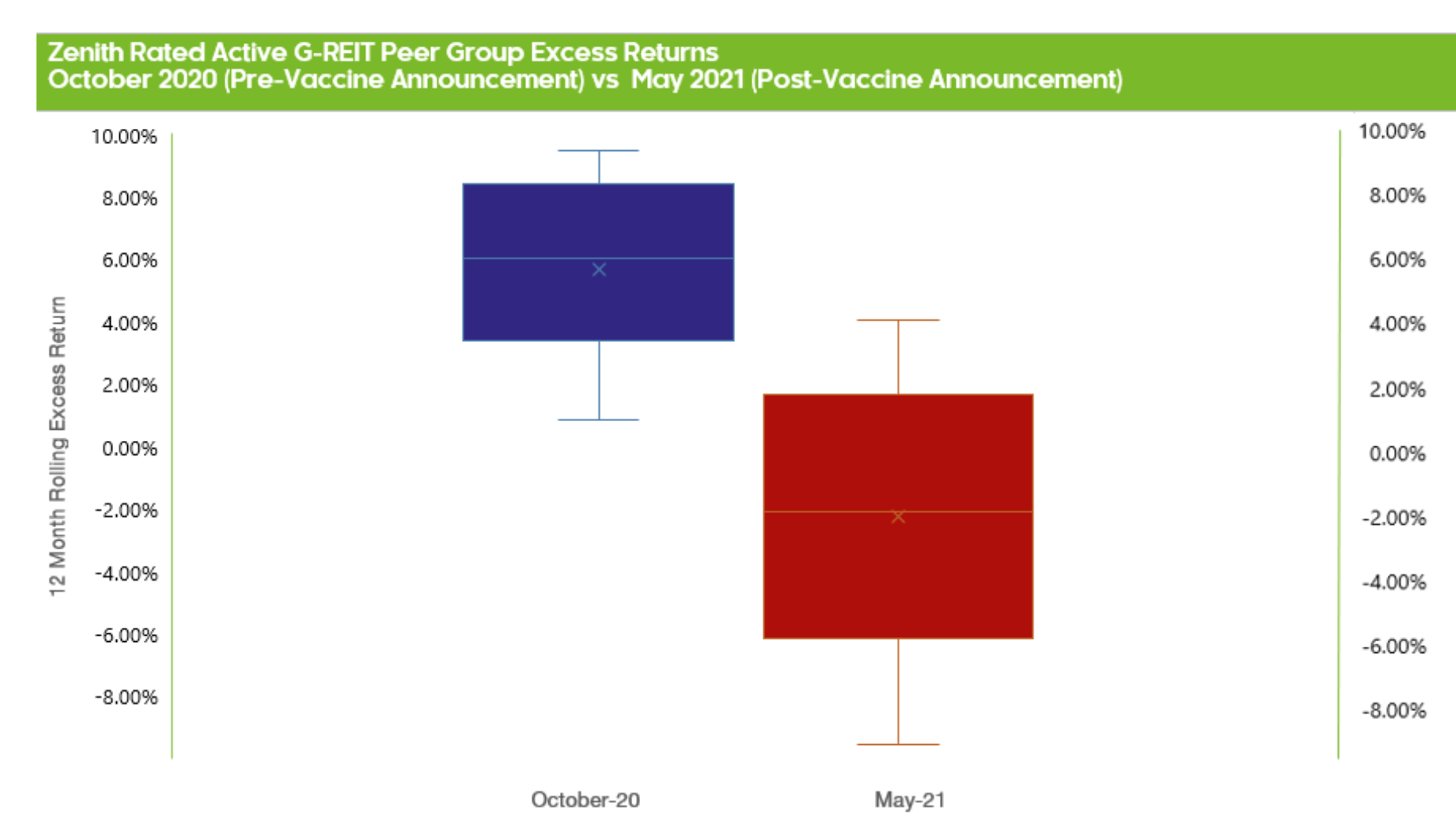
However, once the vaccine news broke and the market rotated into cyclically focused sectors (despite their challenged outlooks), many managers lagged the market, with most active funds finishing the 12 months to 31 May 2021 underperforming the Zenith assigned benchmark. While underperformance of the magnitude observed isn’t outside of expectations, we note that the speed in which the rolling performance for many in the peer group went from positive to negative was extreme.
Given the prevalence of corporate earnings in the A-REIT market, we see a greater diversity across the peer group with respect to manager’s investment strategies. Across the A-REIT peer group there’s a cohort of managers with an explicit value focus, which in some cases is coupled with a preference for rental income and yield.
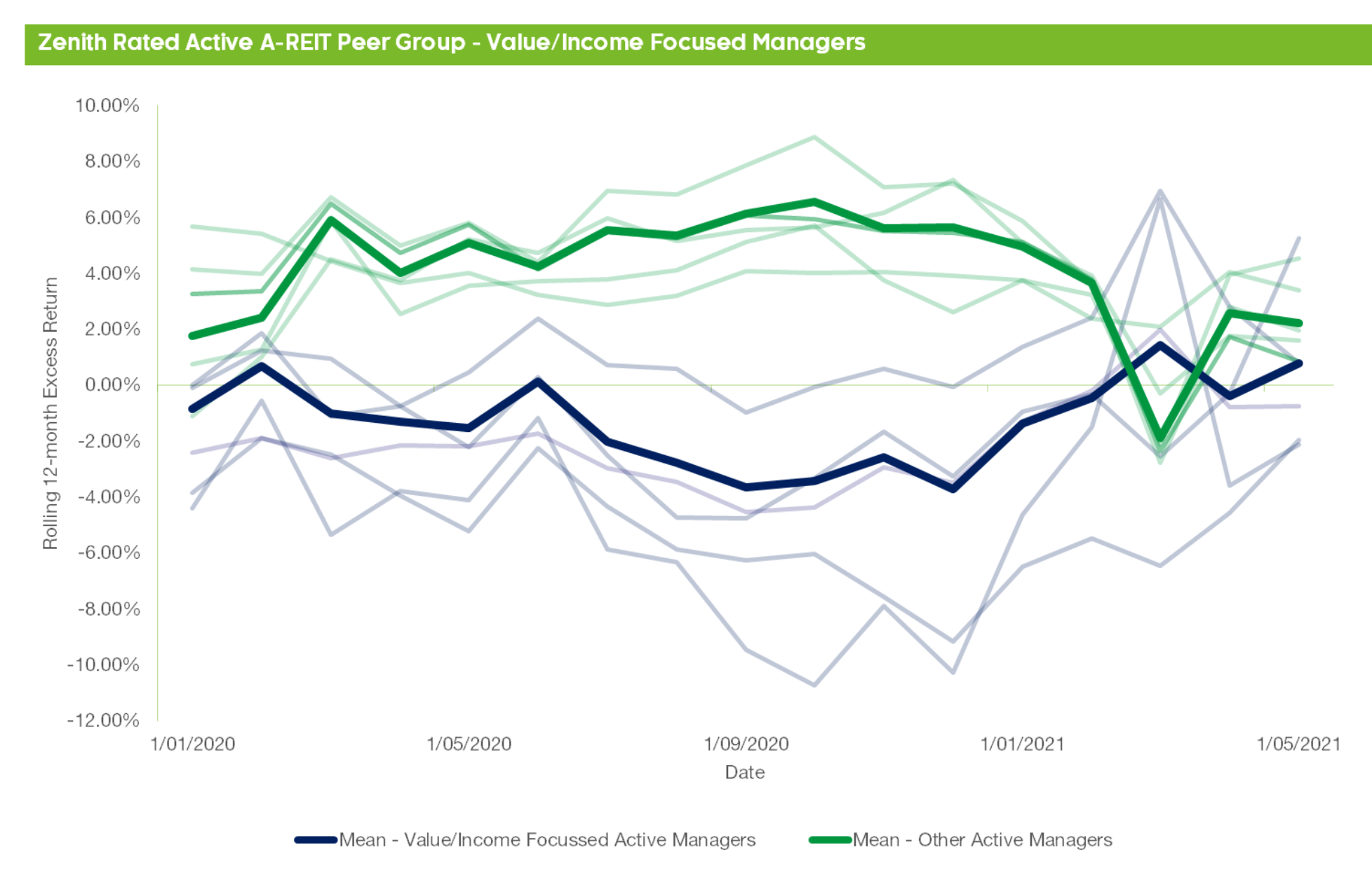
Comparing this value/income cohort with the remaining active managers in the Zenith rated peer group, we can see that the value rotation has influenced manager performance with the average rolling excess returns for the cohorts almost perfectly negatively correlated since the vaccine news.
By Dan Cave Senior Investment Analyst


